
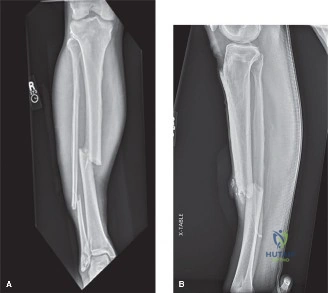
A 35-year-old male presents following a high-speed motorcycle accident. He has a closed comminuted mid-diaphyseal tibial fracture. Four hours post-admission, he reports severe pain that is worsening despite adequate parenteral analgesia. Upon examination, you find the findings shown below.
How do you approach the assessment and initial management of this patient?
Candidate: I would immediately suspect Acute Compartment Syndrome (ACS). I would perform a focused clinical exam assessing the "6 Ps," specifically looking for pain out of proportion to the injury, pain on passive stretch of the toes, and tense, wood-like compartments. I would not rely on the presence of pulses to rule it out. If clinical suspicion is high, I would measure intracompartmental pressures, looking for a delta pressure < 30 mmHg. Definitive management is an urgent four-compartment fasciotomy.
Candidates often state they would order an MRI or CT scan to confirm the diagnosis or "rule out" other pathology. This is a critical error that delays time-sensitive surgical intervention. Additionally, some candidates incorrectly rely on the absence of pulse as a requirement for diagnosis; you must emphasize that pulses are typically the *last* sign to disappear.
The candidate defines ACS as a clinical diagnosis. They must emphasize: 1. Clinical primacy: Pain out of proportion and pain on passive stretch are the diagnostic pillars. 2. Objective data: Mentioning the "Delta Pressure" (Diastolic BP minus Compartment Pressure) < 30mmHg, which is more reliable than absolute pressure. 3. Surgical urgency: Defining the procedure as a "four-compartment fasciotomy via dual incisions." 4. Systemic context: Acknowledging the risk of rhabdomyolysis and the need for fluid management/urine monitoring.
You have decided to proceed to the operating theatre for a four-compartment fasciotomy. Describe your incision strategy and how you avoid neurovascular injury during this procedure.
Candidate: I would use the standard dual-incision approach. The anterolateral incision releases the anterior and lateral compartments, while the posteromedial incision releases the superficial and deep posterior compartments.
Failing to mention the protection of specific nerves: the superficial peroneal nerve in the lateral incision and the saphenous nerve/vein in the medial approach. A weak candidate might say "I make an incision and cut the fascia," without identifying the specific anatomical structures at risk.
A sophisticated answer details the anatomical landmarks: - Anterolateral: Midline between the tibial crest and fibula, protecting the superficial peroneal nerve (which pierces the fascia distally). - Posteromedial: 2cm posterior to the medial tibial border to avoid the saphenous bundle. - Deep Posterior: Explicitly mentioning the release of the FHL/FDL fascia and the importance of protecting the neurovascular bundle (tibial nerve and posterior tibial artery) lying on the deep posterior compartment fascia.
Following the fasciotomy and definitive fixation of the tibia, how do you manage the fasciotomy wounds in the immediate post-operative phase?
Candidate: I would leave the wounds open, pack them with saline-soaked dressings, and return the patient to the operating theatre in 48-72 hours for a "second look" to assess muscle viability and perform formal debridement of any necrotic tissue.
Attempting immediate primary closure. This is a common error that leads to re-elevation of compartment pressures and potential skin necrosis. Another error is failing to mention the requirement for a planned "second look."
The candidate mentions the 48-72 hour second look as a mandatory step. They should discuss the "reconstructive ladder": if closure is not possible primarily due to swelling, they would consider VAC therapy, split-thickness skin grafting, or delayed primary closure as the limb edema subsides.
Detailed Chapters & Topics
Dive deeper into specialized chapters regarding case-45-compartment-syndrome