Part of the Master Guide

OITE & ABOS Orthopedic Exam MCQs: Trauma, Foot & Knee Board Review Part 132

Orthopedic Board Review MCQs: Ankle & Foot | Part 94
23 Apr 2026 42 min read 49 Views
OITE & ABOS Orthopedic Board Prep: Practice Exam Part 94

Key Takeaway

This page presents Part 94 of a comprehensive OITE & ABOS Orthopedic Surgery Board Review series. It features 50 high-yield multiple-choice questions designed for orthopedic residents and surgeons preparing for board certification exams. Utilize interactive study and exam modes to enhance your exam readiness.

Orthopedic Board Review MCQs: Ankle & Foot | Part 94

Comprehensive 100-Question Exam


00:00

Start Quiz

Question 1

A 32-year-old male is involved in a motor vehicle collision and sustains a talar neck fracture. Radiographs show a displaced talar neck fracture with subluxation of the subtalar joint, but the ankle joint remains reduced. What is the expected rate of avascular necrosis (AVN) of the talar body for this specific injury pattern, and which blood supply is most commonly disrupted first?


Explanation
This is a Hawkins Type II talar neck fracture (subluxation/dislocation of the subtalar joint with a normal ankle joint). The risk of AVN of the talar body for Type II fractures is classically reported as 20-50%. The artery of the tarsal canal (a branch of the posterior tibial artery) is the predominant blood supply to the talar body and is typically disrupted in displaced talar neck fractures.

Question 2

A 24-year-old football player presents with midfoot pain after a plant-and-twist injury. Weight-bearing radiographs demonstrate widening of the space between the medial and middle cuneiforms. A pure ligamentous Lisfranc injury is suspected. Which of the following best describes the normal anatomy of the Lisfranc ligament?


Explanation

The Lisfranc ligament is an interosseous ligament that connects the lateral aspect of the medial cuneiform to the medial aspect of the base of the second metatarsal. It is the largest and strongest of the ligaments supporting the first and second ray articulation. Notably, there is no direct transverse intermetatarsal ligament connecting the bases of the first and second metatarsals.

Question 3

A 50-year-old woman complains of a painful bunion. Radiographs reveal a hallux valgus angle (HVA) of 35 degrees, an intermetatarsal angle (IMA) of 16 degrees, and a distal metatarsal articular angle (DMAA) of 20 degrees. Clinical examination demonstrates hypermobility of the first tarsometatarsal (TMT) joint. Which of the following procedures is most appropriate to provide lasting correction?


Explanation

The patient has a moderate-to-severe hallux valgus deformity (IMA > 13 degrees, HVA > 30 degrees) with clinical first TMT hypermobility. The Lapidus procedure (arthrodesis of the first TMT joint) directly addresses the hypermobility and provides powerful correction of the high IMA, minimizing the risk of recurrence.

Question 4

A 55-year-old overweight woman complains of medial ankle pain and flattening of her arch over the past year. She is unable to perform a single-limb heel rise on the affected side. Weight-bearing radiographs show a flexible flatfoot deformity with normal joint spaces and no subtalar arthritis. What is the most appropriate surgical intervention if conservative management fails?


Explanation

The patient has a Stage II adult acquired flatfoot deformity (posterior tibial tendon dysfunction) characterized by a flexible deformity and an inability to perform a single-leg heel rise. Joint-sparing procedures are indicated. The classic reconstruction includes a soft tissue transfer (FDL to navicular), a bony procedure to restore the mechanical axis (medial displacement calcaneal osteotomy), and often a gastrocnemius recession for equinus contracture.

Question 5

A 16-year-old boy presents with progressive bilateral foot deformities and frequent ankle sprains. Examination reveals a cavovarus foot posture, depressed first ray, and a positive Coleman block test. Neurologic exam reveals decreased sensation in the distal lower extremities and diminished reflexes. Which muscle's relative preservation and overpowering of its weak antagonist primarily drives the plantarflexion of the first ray?


Explanation

In Charcot-Marie-Tooth (CMT) disease, muscle weakness occurs in a typical pattern: intrinsic foot muscles first, followed by the tibialis anterior and peroneus brevis. The relative preservation and strong pull of the peroneus longus overpowers the weak tibialis anterior, driving the first metatarsal into severe plantarflexion and creating the forefoot-driven cavovarus deformity.

Question 6

A 42-year-old weekend warrior feels a 'pop' in his posterior ankle while playing tennis. He has a positive Thompson test. Non-operative management is chosen. Which of the following rehabilitation protocols has been shown in high-quality randomized controlled trials to yield re-rupture rates comparable to surgical management?


Explanation

Recent high-quality studies have demonstrated that early functional rehabilitation protocols (involving early protected weight-bearing and early range of motion in a functional brace) for acute Achilles tendon ruptures result in re-rupture rates that are equivalent to operative repair, while avoiding surgical wound complications.

Question 7

A 45-year-old roofer falls from a height and sustains a closed, displaced intra-articular calcaneus fracture. CT scan reveals a Sanders Type III fracture. He is a heavy smoker (2 packs per day). What is the most appropriate definitive management considering his social history?


Explanation
Heavy smoking is a major risk factor for catastrophic wound complications following an extensile lateral approach to the calcaneus, with some studies showing complication rates over 30%. Therefore, minimally invasive techniques (like the sinus tarsi approach) or non-operative management are preferred in non-compliant heavy smokers.

Question 8

A 26-year-old hockey player sustains an external rotation injury to his right ankle. Radiographs show a fibular fracture 5 cm above the joint line and widening of the medial clear space. After ORIF of the fibula, the syndesmosis remains unstable. Which of the following is true regarding syndesmotic fixation?


Explanation

Dynamic fixation using a suture-button construct for syndesmotic injuries has been shown to yield similar or slightly better functional outcomes, a quicker return to sports, and eliminates the need for routine hardware removal compared to traditional static screw fixation. Routine removal of asymptomatic syndesmotic screws is not supported by current evidence.

Question 9

A 28-year-old female presents with chronic ankle pain and catching after a severe inversion ankle sprain 1 year ago. MRI demonstrates a 1.2 cm x 1.0 cm osteochondral lesion on the posteromedial talar dome with intact overlying cartilage. After failure of conservative management, what is the most appropriate next step in treatment?


Explanation

For primary osteochondral lesions of the talus that are small (< 1.5 cm^2) and have failed conservative management, arthroscopic bone marrow stimulation (microfracture or drilling) is the gold standard initial surgical treatment. OATS or structural allografts are reserved for larger lesions or revisions.

Question 10

A 45-year-old man presents with burning pain and tingling in the plantar aspect of his right foot, which worsens with prolonged standing and at night. Tinel's sign is positive over the medial ankle, posterior to the medial malleolus. EMG/NCS confirms compression of the posterior tibial nerve. Which of the following structures forms the roof of the tarsal tunnel?


Explanation

The tarsal tunnel is a fibro-osseous space located posteromedial to the ankle. The roof of the tarsal tunnel is formed by the flexor retinaculum (laciniate ligament), while the medial malleolus, talus, and calcaneus form the floor. Release of the flexor retinaculum is performed during a tarsal tunnel decompression.

Question 11

A 21-year-old collegiate wide receiver hyperextends his great toe during a game on artificial turf. He has significant pain, swelling, and ecchymosis at the first MTP joint, and is unable to push off. MRI reveals a complete tear of the plantar plate and capsuloligamentous complex with proximal retraction of the sesamoids. What is the most appropriate management?


Explanation

This describes a Grade 3 turf toe injury. In a high-level athlete, a complete tear of the plantar plate with visible proximal retraction of the sesamoids severely compromises push-off strength and first MTP joint stability. Surgical repair of the plantar plate is indicated to restore anatomy and function.

Question 12

A 15-year-old female dancer complains of pain in her forefoot, specifically over the second metatarsal head. Radiographs show flattening, sclerosis, and fragmentation of the second metatarsal head. Which of the following conservative treatments is most appropriate initially?


Explanation

The patient has Freiberg's infraction, an avascular necrosis of the metatarsal head (most commonly the second metatarsal). Initial management is conservative and consists of activity modification, metatarsal pads to offload the affected head, and stiff-soled shoes or a walking boot. Surgical intervention is reserved for refractory cases.

Question 13

A 24-year-old skier presents with lateral ankle pain and a snapping sensation over the lateral malleolus after a fall where his ankle was forcibly dorsiflexed. Physical exam reveals apprehension and a palpable pop over the lateral malleolus with resisted dorsiflexion and eversion. Which structure is most likely injured?


Explanation

The clinical presentation is classic for peroneal tendon subluxation. The primary restraint to peroneal tendon subluxation is the superior peroneal retinaculum (SPR). Injury or avulsion of the SPR (often combined with a shallow fibular groove) allows the peroneus brevis and longus tendons to subluxate anteriorly over the lateral malleolus during resisted dorsiflexion and eversion.

Question 14

A 30-year-old male sustains a twisting injury to his foot. Radiographs demonstrate a transverse fracture of the fifth metatarsal at the metaphyseal-diaphyseal junction, extending into the intermetatarsal articulation (between the 4th and 5th metatarsals). What anatomical feature puts this specific area at high risk for nonunion?


Explanation
This describes a true Jones fracture (Zone II). The base of the 5th metatarsal has a distinct watershed blood supply at the metaphyseal-diaphyseal junction, which relies predominantly on a single retrograde intramedullary nutrient artery. This tenuous blood supply is responsible for the high rates of delayed union and nonunion seen in Jones fractures.

Question 15

A 65-year-old man with post-traumatic end-stage ankle osteoarthritis is evaluated for a total ankle arthroplasty (TAA). He has an active lifestyle but does not participate in high-impact sports. Which of the following is considered an absolute contraindication to TAA?


Explanation

Absolute contraindications to total ankle arthroplasty include Charcot neuroarthropathy, active or recent infection, severe avascular necrosis of the talus (>50%), inadequate soft tissue envelope, absent lower extremity sensation, and severe uncorrectable malalignment. Concomitant subtalar arthritis can be addressed with an arthrodesis, and older age is actually an ideal indication.

Question 16

A 22-year-old track athlete presents with an insidious onset of vague dorsal midfoot pain that worsens with sprinting. Examination reveals localized tenderness over the 'N-spot'. Radiographs are negative. MRI confirms a non-displaced stress fracture in the central third of the tarsal navicular. What is the recommended initial treatment?


Explanation

Tarsal navicular stress fractures occur most frequently in the relatively avascular central third of the bone, placing them at high risk for nonunion. The gold standard initial treatment for a non-displaced navicular stress fracture is strict non-weight-bearing cast immobilization for a minimum of 6 to 8 weeks.

Question 17

A 60-year-old woman with longstanding, poorly controlled rheumatoid arthritis presents with a severe forefoot deformity characterized by hallux valgus and dorsal subluxation of the lesser MTP joints with painful plantar callosities. Which of the following surgical strategies is considered the classic and most reliable procedure for this severe rheumatoid forefoot deformity?


Explanation

The classic rheumatoid forefoot reconstruction (Hoffman procedure) involves arthrodesis of the first MTP joint to provide a stable medial column and resection of the lesser metatarsal heads to decompress the joints, reduce the dorsally dislocated toes, and alleviate painful plantar callosities.

Question 18

A 12-year-old boy presents with frequent ankle sprains and a rigid, painful flatfoot. Clinical examination shows a lack of subtalar motion and peroneal spasticity. Oblique radiographs of the foot demonstrate an osseous bridge between the anterior process of the calcaneus and the navicular. Which of the following is the most appropriate initial operative management if conservative measures have failed?


Explanation

For a symptomatic calcaneonavicular coalition in a young patient without degenerative arthritic changes, resection of the bony bar with interposition of tissue (typically the extensor digitorum brevis muscle belly or fat) is the surgical treatment of choice to restore motion and relieve pain. Arthrodesis is reserved for failed resections or if significant degenerative changes are present.

Question 19

A 40-year-old construction worker falls from a ladder and sustains a high-energy, comminuted distal tibia intra-articular fracture (AO/OTA 43-C3) with severe soft tissue swelling, fracture blisters, and shortening. What is the standard of care for the initial management of this injury?


Explanation
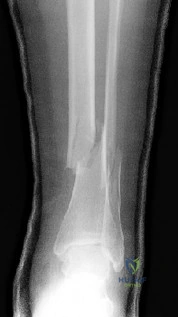
High-energy pilon fractures are notorious for severe soft tissue compromise. Immediate open reduction and internal fixation carries an unacceptably high risk of wound breakdown and deep infection. The standard 'damage control' approach is the application of a spanning external fixator to restore length and alignment until the soft tissues recover (typically 10-21 days), followed by definitive internal fixation.

Question 20

A 55-year-old man presents with chronic, severe posterior heel pain. Examination reveals a prominent Haglund's deformity and tenderness at the Achilles tendon insertion. Radiographs show a large calcaneal spur within the tendon insertion. He has failed physical therapy and NSAIDs over the past 12 months. Surgery is planned. If more than 50% of the Achilles tendon insertion must be detached to resect the calcification and exostosis, what additional procedure is most strongly recommended?


Explanation

During surgical debridement for insertional Achilles tendinopathy, if more than 50% of the Achilles tendon footprint is detached to adequately resect the retrocalcaneal exostosis and intratendinous calcifications, augmentation is recommended to prevent catastrophic failure and restore plantarflexion strength. The Flexor Hallucis Longus (FHL) tendon transfer is the gold standard for this augmentation due to its proximity, strength, and favorable line of pull.

Question 21

During open repair of an acute Achilles tendon rupture, care must be taken to repair the paratenon. What is the primary function of the paratenon in this region?


Explanation

The paratenon is a sheath that surrounds the Achilles tendon, acting to reduce friction and allow gliding against surrounding tissues. Careful closure of the paratenon during open Achilles repair is recommended to minimize adhesions to the overlying skin and optimize gliding, which facilitates rehabilitation and reduces the risk of skin necrosis or wound breakdown. The primary blood supply comes from the musculotendinous junction, the osteotendinous junction, and vessels in the paratenon (specifically from the anterior aspect), but its main functional role is enhancing gliding.

Question 22

A 62-year-old male presents with dorsal foot pain and limited dorsiflexion of the first metatarsophalangeal (MTP) joint. Radiographs show a dorsal osteophyte with more than 50% joint space narrowing, but the plantar half of the joint space is relatively preserved (Coughlin and Shurnas Grade 2). He has failed conservative management. What is the most appropriate surgical intervention?


Explanation

For Coughlin and Shurnas Grade 1 and 2 hallux rigidus (mild to moderate, with preservation of the plantar joint space), cheilectomy (removal of the dorsal osteophyte and the dorsal 30% of the metatarsal head) is the recommended initial surgical treatment. Arthrodesis is reserved for Grade 3 or 4 disease, or for patients who fail cheilectomy.

Question 23

A 55-year-old female presents with progressive flattening of her left foot, medial pain, and inability to perform a single heel raise. Examination reveals hindfoot valgus that is passively correctable and forefoot abduction. In addition to posterior tibial tendon insufficiency, tearing of which of the following structures is most highly associated with the development of the forefoot abduction seen in this stage?


Explanation

The spring ligament (calcaneonavicular ligament) complex is a primary static stabilizer of the longitudinal arch. Its failure, along with posterior tibial tendon dysfunction, allows the talus to plantarflex and rotate medially, leading to uncovering of the talar head and clinical forefoot abduction. The stage described is Stage IIb Adult Acquired Flatfoot Deformity (AAFD), characterized by a passively correctable deformity with significant forefoot abduction.

Question 24

A 30-year-old male sustains a high-energy injury to his foot and is diagnosed with a Hawkins type III talar neck fracture. Which of the following best describes this injury and its associated risk of avascular necrosis (AVN)?


Explanation

Hawkins classification for talar neck fractures: Type I: Nondisplaced (AVN 0-10%). Type II: Displaced with subtalar subluxation/dislocation (AVN 20-50%). Type III: Displaced with subtalar and tibiotalar dislocation (AVN near 100% in original series, modern series quote 70-100%). Type IV (added by Canale): Displaced with subtalar, tibiotalar, and talonavicular dislocation (AVN near 100%).

Question 25

The Lisfranc ligament is critical for midfoot stability. Which of the following accurately describes the anatomic attachments of the Lisfranc ligament?


Explanation

The Lisfranc ligament is a strong interosseous ligament that connects the lateral aspect of the medial cuneiform to the medial base of the second metatarsal. There is no direct ligamentous connection between the bases of the first and second metatarsals, making this articulation particularly vulnerable to disruption.

Question 26

A 40-year-old roofer falls 15 feet, sustaining a displaced, intra-articular calcaneus fracture (Sanders Type II). He is planned for open reduction and internal fixation via an extensile lateral approach. To minimize the risk of wound complications, which of the following principles must be adhered to during the approach?


Explanation

The extensile lateral approach to the calcaneus is associated with a high rate of wound healing complications (up to 25%). To minimize this risk, a 'no-touch' technique should be used, and the flap must be a full-thickness subperiosteal flap raised off the lateral wall of the calcaneus. The sural nerve and peroneal tendons should be contained within the elevated flap. Retractors (like K-wires into the talus) should be used instead of grasping the skin edges.

Question 27

A 60-year-old patient with poorly controlled diabetes mellitus presents with a red, hot, swollen foot. Radiographs demonstrate periarticular fragmentation, subluxation, and bony debris around the midfoot. According to the Eichenholtz classification, what stage of Charcot arthropathy is this, and what is the most appropriate initial treatment?


Explanation

Eichenholtz classification of Charcot arthropathy: Stage 1 (Developmental/Fragmentation): characterized by erythema, edema, heat, and radiographs showing bony fragmentation, joint subluxation/dislocation, and debris. Treatment is immobilization and offloading, typically with a total contact cast (TCC). Stage 2 (Coalescence): decreased swelling, absorption of debris, and early fusion. Stage 3 (Reconstruction): no inflammation, stable deformity. Stage 0 is the prodromal phase with clinical signs but normal radiographs.

Question 28

During evaluation of an external rotation ankle injury, disruption of the distal tibiofibular syndesmosis is suspected. Which of the following ligaments provides the greatest resistance to lateral translation of the fibula relative to the tibia?


Explanation

The syndesmosis consists of the AITFL, PITFL, interosseous ligament, and transverse ligament. Biomechanical studies (e.g., Ogilvie-Harris) have shown that the PITFL provides the greatest primary resistance to lateral displacement of the fibula (approx 42%), followed by the AITFL (approx 35%), and the interosseous ligament (22%).

Question 29


A 22-year-old collegiate basketball player sustains a fracture of the proximal fifth metatarsal. Radiographs show a transverse fracture at the metaphyseal-diaphyseal junction without distal extension beyond the fourth-fifth intermetatarsal articulation. What is the primary anatomic reason this specific fracture is at high risk for nonunion?


Explanation

A Jones fracture occurs at the metaphyseal-diaphyseal junction of the fifth metatarsal. This area is a vascular watershed zone, supplied retrogradely by the nutrient artery and antegrade by metaphyseal vessels. Because of the tenuous blood supply, these fractures are at high risk for delayed union or nonunion. High-level athletes often undergo early intramedullary screw fixation to expedite healing and return to play.

Question 30

A 14-year-old boy presents with frequent ankle sprains and rigid flatfeet. On examination, he has decreased subtalar motion and peroneal spasticity. Radiographs demonstrate the 'C-sign' on the lateral view. Which type of tarsal coalition does this finding most strongly suggest?


Explanation

The 'C-sign' on a lateral radiograph is formed by the medial outline of the talar dome and the posterior outline of the sustentaculum tali. It is highly indicative of a talocalcaneal coalition (specifically involving the middle facet). Calcaneonavicular coalitions often show the 'anteater nose' sign on the lateral view.

Question 31

Chronic plantar fasciitis often involves degenerative changes rather than purely inflammatory ones. The pathologic changes are most commonly located at the origin of which of the following structures?


Explanation

Plantar fasciitis is an enthesopathy (often characterized by mucoid degeneration rather than acute inflammation) that typically occurs at the origin of the central band of the plantar fascia from the medial tubercle of the calcaneus.

Question 32

A 45-year-old woman is being evaluated for hallux valgus surgery. Her weight-bearing AP foot radiograph reveals a Hallux Valgus Angle (HVA) of 35 degrees and an Intermetatarsal Angle (IMA) of 16 degrees. The metatarsophalangeal joint is subluxated but reducible. Which of the following surgical procedures is most appropriate?


Explanation

An HVA of 35° and IMA of 16° indicates a moderate to severe hallux valgus deformity. A distal osteotomy (like a chevron) is generally indicated for mild deformities (IMA < 13°). For an IMA > 13° to 15°, a proximal osteotomy (e.g., crescentic or Ludloff) or a diaphyseal osteotomy (Scarf) combined with a distal soft tissue release (modified McBride) is indicated. A Lapidus procedure is preferred if there is first ray hypermobility or arthritis.

Question 33

A 50-year-old woman complains of burning pain in her forefoot that radiates into her toes, typically worsening when wearing tight shoes. Compressing the metatarsal heads together while applying plantar pressure to the interspace elicits a palpable click and reproduces her pain. What is this clinical test called?


Explanation

Mulder's sign is a clinical test for Morton's neuroma. It involves squeezing the metatarsal heads together with one hand while applying dorsal-plantar pressure to the web space with the other. A palpable click (Mulder's click) and reproduction of symptoms indicate a positive test, caused by the enlarged nerve being displaced plantarward between the metatarsal heads.

Question 34

A 65-year-old man presents with a 'slapping' foot gait and weakness in ankle dorsiflexion following a stumble. He denies significant pain but notes a mass over the anterior ankle. On examination, he has weak active dorsiflexion, but can still extend his toes. Which of the following is true regarding this condition?


Explanation

Spontaneous rupture of the tibialis anterior tendon is relatively uncommon and typically occurs in older patients with chronic degenerative changes, often associated with diabetes or local steroid injections. It presents with foot drop or a slapping gait. Toe extensors (EHL, EDL) can provide weak dorsiflexion but do not fully mask the deficit. Nonoperative treatment (AFO) is often well-tolerated in low-demand, elderly patients.

Question 35

An acute dislocation of the peroneal tendons usually involves forced dorsiflexion of the everted foot with strong reflex contraction of the peroneal muscles. Which structure is primarily injured or avulsed in this mechanism?


Explanation

The superior peroneal retinaculum (SPR) is the primary restraint to subluxation or dislocation of the peroneal tendons. Injury to the SPR, typically an avulsion from its fibular attachment (often with a small cortical fleck of bone), allows the tendons to dislocate anteriorly over the lateral malleolus.

Question 36


A 45-year-old male sustains a high-energy, closed tibial pilon fracture. The soft tissues are significantly swollen with fracture blisters present. What is the currently recommended protocol for managing this injury to minimize soft tissue complications?


Explanation

High-energy pilon fractures are associated with profound soft tissue injury. Early ORIF historically led to devastating wound complications and infection (up to 30-50%). The standard of care is a staged approach: immediate spanning external fixation (with or without fibular fixation) to restore length and alignment, allowing the soft tissue envelope to recover (wrinkle sign present, blisters healed) over 10-21 days, followed by definitive tibial ORIF.

Question 37

A football player injures his great toe on artificial turf during a forced hyperextension mechanism. He has severe pain and swelling at the first MTP joint. 'Turf toe' represents an injury to which of the following structures?


Explanation

'Turf toe' is a sprain of the first MTP joint resulting from forced hyperextension. It specifically involves attenuation or tearing of the plantar capsuloligamentous complex, including the plantar plate, sesamoid sling, and collateral ligaments.

Question 38

A 20-year-old track athlete presents with insidious onset, vague midfoot pain that worsens with sprinting. A CT scan confirms a nondisplaced stress fracture in the central third of the tarsal navicular. What is the most appropriate initial management?


Explanation

The central third of the tarsal navicular is a relative avascular zone, predisposing it to stress fractures and nonunion. For acute, nondisplaced navicular stress fractures, strict non-weight bearing in a short leg cast for 6-8 weeks is the gold standard initial treatment, yielding high healing rates. Weight-bearing casts or boots have a higher failure rate.

Question 39

Based on classic literature, which of the following best describes the typical location, morphology, and etiology of osteochondral lesions of the talus?


Explanation

The classic mnemonic for OLTs is DIAL a PIMP: Dorsiflexion Inversion -> Anterior Lateral lesions (shallow, traumatic). Plantarflexion Inversion -> Medial Posterior lesions (deep, often insidious or less clearly related to a single acute trauma). Therefore, medial lesions are characteristically posterior, deep, and cup-shaped.

Question 40

A 60-year-old female with severe, long-standing rheumatoid arthritis presents with debilitating forefoot pain. She has severe hallux valgus, lesser toe clawing, and dorsal dislocation of the lesser MTP joints. The metatarsal heads are prominent on the plantar aspect. What is the gold-standard surgical procedure for this severe rheumatoid forefoot deformity?


Explanation

The classic, gold-standard surgical reconstruction for a severe rheumatoid forefoot with dislocated lesser MTP joints and severe hallux valgus is arthrodesis of the first MTP joint and resection of the lesser metatarsal heads (Hoffman procedure). This eliminates pain, realigns the first ray to provide medial column stability, and relieves plantar pressure from the dislocated lesser metatarsal heads.

Question 41

A 55-year-old female presents with a progressively collapsing arch and medial ankle pain. Examination reveals a positive 'too many toes' sign and the inability to perform a single-leg heel rise. Radiographs demonstrate a talonavicular uncoverage angle of 35 degrees and >40% uncovering of the talonavicular joint. What is the most appropriate surgical management for this stage of adult acquired flatfoot deformity?


Explanation

This patient has Stage IIb posterior tibial tendon dysfunction (PTTD), indicated by >30% talonavicular uncoverage. The addition of a lateral column lengthening (e.g., Evans osteotomy) is required to correct the significant forefoot abduction.

Question 42

A 52-year-old male with poorly controlled diabetes presents with a swollen, erythematous, and warm left foot without a history of trauma. Pedal pulses are bounding. Radiographs demonstrate fragmentation of the tarsometatarsal joints with bone debris and early subluxation. What is the most appropriate initial step in management?


Explanation

The presentation is classic for acute Eichenholtz Stage I (fragmentation stage) Charcot neuroarthropathy. The gold standard for initial management is strict immobilization and offloading, typically utilizing a total contact cast.

Question 43

A 16-year-old male presents with bilateral progressive cavovarus foot deformities. A Coleman block test normalizes hindfoot alignment. Neurological examination reveals depressed deep tendon reflexes. The pathogenesis of this deformity in Charcot-Marie-Tooth disease is primarily driven by which of the following muscle imbalances?


Explanation

In Charcot-Marie-Tooth disease, foot deformity stems from the strong peroneus longus (plantarflexing the first ray) and tibialis posterior (inverting the hindfoot) overpowering the weak tibialis anterior and peroneus brevis.

Question 44

A 22-year-old elite track athlete develops focal midfoot pain over the dorsal 'N spot'. A CT scan confirms a non-displaced stress fracture of the central third of the tarsal navicular. The high risk of nonunion in this specific anatomic location is secondary to a vascular watershed zone formed between which two arteries?


Explanation

The central third of the tarsal navicular is relatively avascular. It represents a watershed area between the branches of the dorsalis pedis artery (dorsal supply) and the medial plantar artery (plantar supply).

Question 45

A 52-year-old female presents with progressive medial ankle pain and a severe flatfoot deformity. Clinical examination demonstrates a positive single-leg heel rise test on the affected side but she can perform a double-leg heel rise. Weight-bearing radiographs reveal >30% uncovering of the talonavicular joint and a talonavicular angle of 25 degrees. The hindfoot deformity is flexible. Which of the following surgical strategies is most appropriate for this stage of deformity?


Explanation

This patient has a Stage IIB adult acquired flatfoot deformity, characterized by a flexible hindfoot with significant forefoot abduction (>30% talonavicular uncovering). Correcting the severe forefoot abduction requires a lateral column lengthening in addition to a medial displacement calcaneal osteotomy and FDL transfer.

Question 46

A 14-year-old boy presents with recurrent ankle sprains and rigid flatfeet. A lateral weight-bearing radiograph demonstrates a prominent 'C-sign' and a talar beak.

Based on the most likely diagnosis, which specific anatomical structure is most commonly involved in this pathology?


Explanation

The clinical presentation and 'C-sign' on a lateral radiograph are classic for a talocalcaneal coalition. The middle facet of the subtalar joint is the most commonly involved facet in talocalcaneal coalitions.

Question 47

A 68-year-old male is considering surgical intervention for end-stage ankle osteoarthritis. He has a history of well-controlled diabetes and hypertension. Which of the following conditions is considered an absolute contraindication for a primary total ankle arthroplasty (TAA)?


Explanation

Active infection, Charcot neuroarthropathy with significant bone loss, and absent motor function are absolute contraindications for TAA. Rheumatoid arthritis and mild coronal plane deformities are generally acceptable indications, provided the deformity can be balanced.

Question 48

Based on recent Level I evidence comparing operative and non-operative management of acute Achilles tendon ruptures using early functional rehabilitation protocols, which of the following statements is most accurate?


Explanation

When utilizing early functional rehabilitation and early weight-bearing protocols, the rerupture rates between operative and non-operative management of acute Achilles tendon ruptures are statistically similar. However, operative management carries a higher risk of superficial complications, including wound breakdown and infection.

Question 49

A 45-year-old male sustains a displaced intra-articular calcaneus fracture.

The surgeon decides to proceed with an extensile lateral approach. To minimize the risk of apical tip necrosis of the lateral soft tissue flap, the surgeon must preserve the primary blood supply to this angiosome. Which artery is responsible for this blood supply?


Explanation

The lateral calcaneal artery, a branch of the peroneal artery, supplies the lateral skin flap used in an extensile lateral approach. Protecting this vessel by ensuring a subperiosteal dissection and a full-thickness 'no-touch' flap retraction is critical to preventing wound necrosis.

Question 50

A 26-year-old female presents with progressive bilateral cavovarus foot deformity. A Coleman block test is performed. When her heel and lateral column are placed on the block while the first metatarsal is allowed to plantarflex freely, the hindfoot varus corrects to a neutral position. What is the primary initial step in the surgical reconstruction of this deformity?


Explanation

A positive Coleman block test (hindfoot corrects to neutral) indicates a flexible hindfoot driven by a rigidly plantarflexed first ray (forefoot-driven varus). The primary osseous correction required is a dorsiflexion closing wedge osteotomy of the first metatarsal.

Question 51

A 19-year-old collegiate basketball player sustains a Zone 2 fracture of the proximal fifth metatarsal (Jones fracture). Why do these specific fractures have a disproportionately high rate of delayed union and nonunion?


Explanation

Zone 2 fractures (Jones fractures) occur at the metaphyseal-diaphyseal junction, which is a vascular watershed area between the proximal metaphyseal vessels and the distal nutrient artery. This tenuous blood supply contributes directly to high rates of nonunion.

Question 52

When performing a minimally invasive repair for an acute Achilles tendon rupture, the sural nerve is at highest risk of iatrogenic injury. At what approximate distance proximal to the calcaneal tuberosity insertion does the sural nerve cross the lateral border of the Achilles tendon?


Explanation

The sural nerve typically crosses from lateral to medial across the lateral border of the Achilles tendon approximately 9 to 12 cm proximal to its calcaneal insertion. Sutures placed proximal to this level must be passed carefully to avoid nerve entrapment.

Question 53

A 55-year-old diabetic patient presents with a swollen, erythematous, and warm unilateral foot without systemic signs of infection. Radiographs show periarticular fragmentation, subluxation, and bony debris around the midfoot. According to the Eichenholtz classification, what is the most appropriate initial management?


Explanation

This patient is in Eichenholtz Stage I (developmental/fragmentation phase) of Charcot arthropathy. The gold standard of treatment during this acute inflammatory phase is immobilization and offloading, typically with a total contact cast.

Question 54

A 62-year-old female presents with flatfoot deformity. Examination reveals a flexible hindfoot valgus, but she is unable to perform a single-leg heel raise. Radiographs demonstrate significant forefoot abduction with a talonavicular uncoverage angle of 40 degrees. Which surgical intervention is most appropriate?


Explanation

The patient has Stage IIb posterior tibial tendon dysfunction (flexible hindfoot valgus with greater than 30% talonavicular uncoverage). Treatment requires FDL transfer, medial displacement calcaneal osteotomy, and a lateral column lengthening to correct the severe forefoot abduction.

Question 55

A 22-year-old track athlete presents with insidious onset of vague dorsal midfoot pain. Examination reveals focal tenderness at the "N-spot". CT scan confirms an incomplete stress fracture in the central third of the tarsal navicular. What anatomic factor primarily contributes to the high risk of nonunion in this specific region?


Explanation

The central third of the tarsal navicular is a vascular watershed area between the medial and lateral blood supplies. This relative avascularity significantly increases the risk of stress fractures and subsequent nonunion.

Question 56

When utilizing the extensile lateral approach for open reduction and internal fixation of a displaced intra-articular calcaneus fracture, preserving the blood supply to the lateral soft tissue flap is critical. Which artery provides the primary vascular supply to the apex of this flap?


Explanation

The lateral calcaneal artery, a terminal branch of the peroneal artery, provides the primary blood supply to the apex of the extensile lateral flap. Full-thickness "no-touch" subperiosteal dissection is crucial to prevent flap necrosis.

Question 57

A 28-year-old male presents with persistent anterolateral ankle pain 1 year after an ankle sprain. MRI demonstrates an osteochondral lesion of the talus (OCL) measuring 1.8 cm x 1.6 cm without massive subchondral cyst formation. He has failed non-operative management. What is the most appropriate surgical treatment?


Explanation

For primary talar OCLs larger than 1.5 cm squared (or >15 mm in diameter), structural restoration using an osteochondral autograft transfer (OATS) or allograft is recommended. Microfracture has a significantly higher failure rate in lesions of this size.

Question 58

A 25-year-old professional basketball player sustains an acute fracture at the metaphyseal-diaphyseal junction of the fifth metatarsal. To facilitate the fastest and safest return to elite-level play, what is the recommended treatment?


Explanation

Acute Zone 2 (Jones) fractures in elite athletes are treated with early intramedullary screw fixation. This provides robust biomechanical stability, decreases the risk of nonunion, and allows for an accelerated return to sport.

Question 59

A patient with Charcot-Marie-Tooth disease presents with a symptomatic cavovarus foot. A Coleman block test is performed, and the hindfoot varus corrects to a neutral alignment when the first metatarsal is allowed to plantarflex off the block. What does this indicate, and what surgical step is essential?


Explanation

A flexible hindfoot varus that corrects on a Coleman block test indicates that a plantarflexed first ray is driving the hindfoot into varus. Correction requires a dorsiflexion osteotomy of the first metatarsal to elevate the medial column.

Question 60

A 21-year-old collegiate football player sustains a severe hyperextension injury to his first metatarsophalangeal (MTP) joint. MRI confirms a complete disruption of the plantar plate complex with proximal retraction of the sesamoids. What is the most appropriate management?


Explanation

This is a Grade 3 turf toe injury involving complete disruption of the plantar plate and sesamoid retraction. High-level athletes typically require surgical repair to restore push-off mechanics and prevent chronic MTP joint instability.

Question 61

A 14-year-old female dancer presents with pain and swelling over the second metatarsophalangeal joint. Radiographs show flattening, sclerosis, and early fragmentation of the second metatarsal head. What is the primary underlying pathophysiology of this condition?


Explanation

Freiberg's infraction is characterized by avascular necrosis of the metatarsal head, most frequently involving the second metatarsal in adolescent females. It is thought to result from repetitive microtrauma and subsequent vascular compromise.

Question 62

A 65-year-old male with severe post-traumatic ankle osteoarthritis is evaluated for a total ankle arthroplasty (TAA). Which of the following conditions is generally considered an absolute contraindication for a primary TAA?


Explanation

Significant avascular necrosis of the talus (typically >50% of the body) is an absolute contraindication for TAA. The necrotic bone cannot adequately support the talar component, leading to a high risk of catastrophic component subsidence.

Question 63

A 30-year-old male falls from a ladder and sustains an isolated lateral subtalar dislocation. Closed reduction in the emergency department under conscious sedation is unsuccessful. What anatomical structure is most likely blocking the reduction?


Explanation

Lateral subtalar dislocations are notorious for being irreducible by closed means. The posterior tibial tendon is the most common anatomic structure that incarcerates and blocks reduction in lateral dislocations.

None

Dr. Mohammed Hutaif
Medically Verified Content by
Prof. Dr. Mohammed Hutaif
Consultant Orthopedic & Spine Surgeon
Chapter Index
