OITE & ABOS Orthopedic Review: Knee & Sports Medicine MCQs | Part 194
Key Takeaway
This page offers Part 194 of a comprehensive orthopedic surgery board review. Featuring 50 high-yield MCQs on topics like Arthroscopy, Knee, and Ligament, it's designed for orthopedic residents and surgeons. Utilize study or exam mode to sharpen skills for your OITE, AAOS, and ABOS certification exams.
OITE & ABOS Orthopedic Review: Knee & Sports Medicine MCQs | Part 194
Comprehensive 100-Question Exam
00:00
Start Quiz
Question 1
A 24-year-old athlete undergoes ACL reconstruction using an anteromedial portal technique for femoral tunnel drilling. Compared to a transtibial technique, which of the following is true regarding the femoral tunnel position and biomechanics?
Explanation
Question 2
A 55-year-old female presents with acute onset of medial knee pain and a 'pop' while squatting. MRI reveals a medial meniscus posterior root tear. Biomechanically, what is the consequence to the knee joint in this condition?
Explanation
Question 3
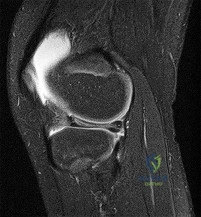
During a medial patellofemoral ligament (MPFL) reconstruction for recurrent patellar instability, the surgeon uses fluoroscopy to identify Schöttle's point. Which of the following describes the correct anatomic landmarks for the femoral attachment of the MPFL on a lateral radiograph?
Explanation
Question 4
A 22-year-old female presents with recurrent patellar dislocations. Examination reveals a positive J-sign. Imaging shows a TT-TG distance of 22 mm, normal patellar height, and grade III chondromalacia isolated to the distal/inferior patellar pole. Which of the following is the most appropriate surgical intervention?
Explanation
Question 5
In a single-bundle posterior cruciate ligament (PCL) reconstruction, the graft is designed to recreate the primary functional bundle of the PCL. Which bundle is being reconstructed, and in what position is it tightest?
Explanation
Question 6
A 26-year-old male presents for revision ACL reconstruction after re-rupturing his graft. CT scan demonstrates significant tunnel widening with the femoral tunnel measuring 16 mm and tibial tunnel measuring 15 mm. What is the most appropriate management?
Explanation
Question 7
A 30-year-old male sustains a high-energy knee dislocation (KD-III). The knee is reduced in the ER. Ankle-brachial index (ABI) is measured at 0.85. What is the next most appropriate step in management?
Explanation
Question 8
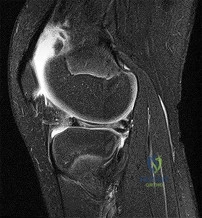
A 12-year-old boy presents with vague knee pain. Radiographs reveal a 1.5 cm osteochondritis dissecans (OCD) lesion on the lateral aspect of the medial femoral condyle. His physes are wide open. MRI shows no fluid behind the lesion and the overlying cartilage is intact. What is the best initial management?
Explanation
Question 9
Which of the following structures constitutes the primary static stabilizer against external rotation of the tibia at 30 degrees of knee flexion?
Explanation
Question 10
A 45-year-old male with end-stage renal disease on hemodialysis presents with inability to extend his knee after a stumble. Examination reveals a palpable gap superior to the patella. Which of the following histologic findings is most likely present in the torn tendon?
Explanation
Question 11
During an ACL reconstruction, a systematic arthroscopic evaluation is performed. A 'ramp lesion' is identified. Which of the following best describes this pathology?
Explanation
Question 12
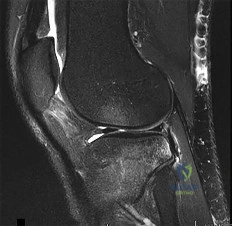
A 42-year-old manual laborer presents with isolated medial compartment knee pain. Standing alignment radiographs demonstrate 8 degrees of varus alignment. He has grade III medial compartment osteoarthritis and normal lateral and patellofemoral compartments. ROM is 5 to 120 degrees. He is a non-smoker. Which of the following is a relative contraindication to performing a medial opening wedge high tibial osteotomy (HTO) in this patient?
Explanation
Question 13
A 45-year-old female undergoes transtibial pull-out repair for a medial meniscus posterior root tear. Which of the following factors is most critical for restoring the hoop stresses of the meniscus during this procedure?
Explanation
Question 14
A 9-year-old Tanner stage 1 female sustains a complete ACL tear. Her parents opt for surgical reconstruction. Which of the following techniques minimizes the risk of growth arrest?
Explanation
Question 15
A 38-year-old male presents with chronic knee swelling, catching, and mild pain. Radiographs reveal multiple loose bodies of uniform size scattered throughout the knee joint. MRI shows joint effusion and multiple calcified nodules. Which of the following is the underlying pathophysiology of this condition?
Explanation
Question 16
During the terminal 30 degrees of knee extension, the tibia externally rotates relative to the femur. Which of the following anatomic features is primarily responsible for this 'screw home' mechanism?
Explanation
Question 17
A patient presents with knee pain and instability after a hyperextension injury. The Dial test demonstrates 20 degrees of increased external rotation on the injured side compared to the normal side at 30 degrees of flexion, but equal external rotation at 90 degrees of flexion. What is the most likely injury?
Explanation
Question 18
A 28-year-old female runner presents with anterior knee pain, exacerbated by descending stairs. She is diagnosed with patellofemoral pain syndrome. Which of the following anatomical factors is most likely to increase the lateral force vector on the patella?
Explanation
Question 19
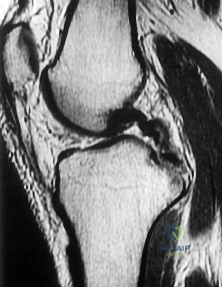
A 32-year-old female presents with recurrent, spontaneous hemarthrosis of the knee without a history of trauma. MRI of the knee shows a joint effusion and nodular synovial proliferation that demonstrates blooming artifact on gradient-echo (GRE) sequences. What is the most likely diagnosis?
Explanation
Question 20
A 24-year-old healthy male collegiate sprinter complains of cramping calf pain and numbness in his foot that occurs only after sprinting 200 meters. Symptoms resolve with 10 minutes of rest. Resting ankle-brachial index (ABI) is 1.0. However, ABI drops to 0.6 with active plantar flexion of the ankle against resistance. What is the most likely anatomic etiology of his symptoms?
Explanation
Question 21
A 50-year-old female presents with acute medial knee pain after a deep flexion event. MRI demonstrates a medial meniscus posterior root tear. What is the biomechanical consequence of this injury if left untreated?
Explanation
Question 22
A 22-year-old female is undergoing an isolated medial patellofemoral ligament (MPFL) reconstruction for recurrent patellar instability. To ensure proper graft anisometry, the femoral tunnel must be placed accurately. Based on Schöttle's radiographic point on a strict lateral radiograph, where is the anatomic femoral origin of the MPFL?
Explanation
Question 23
In posterior cruciate ligament (PCL) reconstruction, the 'killer turn' refers to the acute angle the graft makes at the posterior aspect of the tibia. What is the primary theoretical advantage of the tibial inlay technique over the transtibial technique?
Explanation
Question 24
During an anatomical reconstruction of the posterolateral corner (PLC) of the knee, a surgeon intends to reconstruct the three major static stabilizing structures. Which of the following combinations represents these structures?
Explanation
Question 25
A 30-year-old male sustains a knee dislocation (KD-III) with injuries to the ACL, PCL, and MCL. Vascular workup shows an ABI of 1.0. What is the recommended surgical timing for ligamentous reconstruction to balance the risk of arthrofibrosis and optimal tissue healing?
Explanation
Question 26
A 25-year-old professional soccer player sustains a severe valgus injury to the right knee. MRI demonstrates a complete tear of the superficial medial collateral ligament (sMCL). The distal aspect of the torn sMCL is flipped superficial to the pes anserinus. This specific finding is associated with:
Explanation
Question 27
When comparing bone-patellar tendon-bone (BTB) autograft to quadriceps tendon autograft for anterior cruciate ligament (ACL) reconstruction, quadriceps tendon autografts have been shown to have:
Explanation
Question 28
Which of the following criteria is most commonly utilized to permit a patient to return to unrestricted cutting and pivoting sports after an ACL reconstruction?
Explanation
Question 29
A 12-year-old male with open physes presents with knee pain. MRI reveals an intact, stable osteochondritis dissecans (OCD) lesion on the lateral aspect of the medial femoral condyle. He has failed 6 months of nonoperative management (restricted weight-bearing and activity modification). What is the next best step in management?
Explanation
Question 30
Quadriceps tendon ruptures often occur in a known hypovascular zone. Where is this critical hypovascular zone of the quadriceps tendon located?
Explanation
Question 31
A 10-year-old boy presents to the emergency department after falling directly onto a flexed knee. Radiographs reveal a high-riding patella and a small bony avulsion at the inferior pole of the patella. What is the most appropriate management for this injury?
Explanation
Question 32
A 7-year-old girl presents with snapping and lateral joint line pain in her right knee. MRI demonstrates a Wrisberg variant discoid lateral meniscus. According to the Watanabe classification, what anatomical feature defines this specific variant?
Explanation
Question 33
A 14-year-old male jumping athlete presents with acute knee pain and inability to extend the knee against gravity. Radiographs reveal a fracture extending from the tibial tubercle proximally across the epiphyseal plate and into the articular surface. According to the Ogden classification of tibial tubercle fractures, which type is this?
Explanation
Question 34
A 19-year-old female soccer player undergoes revision ACL reconstruction. The surgeon decides to perform a lateral extra-articular tenodesis (LET) using a modified Lemaire technique. Where is the graft typically routed in relation to the lateral collateral ligament (LCL) to provide optimal rotational stability?
Explanation
Question 35
A 28-year-old marathon runner presents with lateral knee pain that worsens after 3 miles of running. Examination reveals tenderness over the lateral femoral epicondyle, particularly when the knee is flexed to 30 degrees. The underlying pathophysiology of this condition involves friction of the iliotibial band over the lateral epicondyle during which phase of the gait cycle?
Explanation
Question 36
A 20-year-old male is tackled during a football game with his knee flexed and foot internally rotated. He presents with prominent lateral knee deformity and inability to bear weight. Radiographs confirm an anterolateral dislocation of the proximal tibiofibular joint. Which nerve is most commonly at risk in this type of injury or during its surgical management?
Explanation
Question 37
A 45-year-old female presents with symptomatic, isolated lateral compartment knee osteoarthritis. Standing alignment radiographs demonstrate 8 degrees of valgus mechanical axis deviation. The deformity is localized to the distal femur. Which of the following is the most appropriate surgical intervention to unload the lateral compartment?
Explanation
Question 38
A 24-year-old male sustains an anterior knee dislocation that is reduced in the field. Upon arrival at the trauma bay, the knee is swollen but stable. Distal pulses are palpable but slightly asymmetric. The Ankle-Brachial Index (ABI) is calculated to be 0.85. What is the most appropriate next step in management?
Explanation
Question 39
A 28-year-old active male presents with a symptomatic 4 cm^2 focal full-thickness chondral defect on the weight-bearing surface of the medial femoral condyle with minimal subchondral bone involvement. He previously underwent a microfracture procedure 2 years ago that failed. Which of the following cartilage restoration procedures is most appropriate?
Explanation
Question 40
A 50-year-old man presents with posterior knee swelling and aching pain. MRI demonstrates a large popliteal (Baker's) cyst. Which two anatomical structures form the interval through which the synovial fluid typically herniates to form this cyst?
Explanation
Question 41
A 22-year-old soccer player sustains an internal rotation injury to the knee resulting in an ACL tear. Radiographs show an avulsion fracture of the anterolateral proximal tibia (Segond fracture). Which of the following structures is most likely attached to this avulsed bony fragment?
Explanation
Question 42
A 30-year-old male is evaluated for knee instability. On physical examination, the dial test shows 15 degrees of increased external rotation at 30 degrees of flexion compared to the contralateral side, but symmetric rotation at 90 degrees of flexion. Which structure(s) is/are most likely injured?
Explanation
Question 43
During reconstruction of the posterior cruciate ligament (PCL), the surgeon aims to recreate its primary biomechanical bundles. Which of the following best describes the tensioning pattern of the normal PCL bundles during knee range of motion?
Explanation
Question 44
A 26-year-old patient presents to the emergency department after a high-energy dashboard injury resulting in a knee dislocation. The knee is currently reduced. Distal pulses are palpable but slightly asymmetric, and the ankle-brachial index (ABI) is 0.85. What is the most appropriate next step in management?
Explanation
Question 45
A 45-year-old active male with medial compartment osteoarthritis and varus alignment undergoes a medial opening wedge high tibial osteotomy (HTO). If the osteotomy gap is opened disproportionately more anteriorly than posteriorly, what biomechanical effect will this have on the knee?
Explanation
Question 46
A 22-year-old female presents with an isolated 4.5 cm2 full-thickness chondral defect on the weight-bearing surface of her medial femoral condyle. She has failed conservative management. Which of the following is the most appropriate surgical intervention for this lesion?
Explanation
Question 47
A 7-year-old boy presents with a painless clunking sensation in his lateral knee during extension. MRI confirms a complete Wrisberg variant discoid lateral meniscus. What anatomical feature defines the Wrisberg variant of a discoid meniscus?
Explanation
Question 48
The predominant vascular supply to the anterior cruciate ligament (ACL) is derived from which of the following arteries?
Explanation
Question 49
A 28-year-old male sustains a multiligament knee injury. Physical examination reveals a +3 posterior drawer test and a positive dial test at both 30 and 90 degrees of flexion. Which combination of injured structures is most likely responsible for these findings?
Explanation
Question 50
A 30-year-old male presents with a grossly deformed knee after a motorcycle crash. After successful closed reduction of the knee dislocation, palpable distal pulses are present but weak. The Ankle-Brachial Index (ABI) is calculated to be 0.85. What is the most appropriate next step in management?
Explanation
Question 51
A 22-year-old soccer player undergoes arthroscopic repair of a bucket-handle medial meniscus tear. Which of the following factors most significantly increases the biological healing rate of the meniscal repair?
Explanation
Question 52
A 12-year-old male presents with chronic anterior knee pain. Radiographs and an MRI
demonstrate a stable osteochondritis dissecans (OCD) lesion. What is the most common anatomical location for an OCD lesion of the knee?
Explanation
Question 53
In comparing a 10-mm bone-patellar tendon-bone (BPTB) autograft to the native anterior cruciate ligament (ACL), which of the following biomechanical statements is most accurate regarding the graft's initial properties at the time of implantation?
Explanation
Question 54
A 6-year-old girl presents with a painless clicking and "snapping" sensation in her lateral knee with extension. MRI confirms a discoid lateral meniscus. The Wrisberg variant of a discoid meniscus causes this hypermobility due to the absence of which of the following normal anatomical structures?
Explanation
Question 55
When utilizing interference screws for soft-tissue ACL graft fixation in the tibial tunnel, which of the following screw configurations provides the optimal pullout strength and minimizes graft slippage?
Explanation
Question 56
During medial patellofemoral ligament (MPFL) reconstruction, identifying the correct femoral footprint is critical to ensure proper graft isometry. According to Schöttle's point on a true lateral radiograph, where should the femoral attachment be positioned?
Explanation
Question 57
A 28-year-old male sustains a varus-hyperextension injury to his knee. Examination reveals a positive dial test at 30 degrees of knee flexion, but symmetric external rotation at 90 degrees compared to the contralateral knee. Which of the following structures is most likely injured?
Explanation
Question 58
A 22-year-old collegiate soccer player presents with a symptomatic 3.5 cm^2 full-thickness osteochondral defect on the weight-bearing surface of the medial femoral condyle. He has failed nonoperative management. Which of the following is the most appropriate surgical intervention?
Explanation
Question 59
An 11-year-old female soccer player (Tanner stage 2) sustains a midsubstance ACL rupture. She has wide open physes. The surgeon plans an epiphyseal-sparing ACL reconstruction. Which of the following grafts and techniques avoids the femoral and tibial physes entirely?
Explanation
Question 60
A 24-year-old male undergoes arthroscopy for an acute ACL rupture. The surgeon evaluates the posterior horn of the medial meniscus through the intercondylar notch and identifies a ramp lesion. Biomechanically, untreated ramp lesions in the setting of ACL reconstruction primarily increase which of the following?
Explanation
Question 61
A 45-year-old active male has symptomatic isolated medial compartment osteoarthritis with a varus mechanical axis. A medial opening wedge high tibial osteotomy (HTO) is planned. To maintain native sagittal plane kinematics, where should the osteotomy gap be larger?
Explanation
Question 62
A 30-year-old male sustains a posterior dashboard injury to his knee. Physical examination reveals a 12-mm posterior step-off of the tibia relative to the femoral condyles at 90 degrees of flexion. The dial test shows 20 degrees of increased external rotation at both 30 and 90 degrees of knee flexion compared to the contralateral side. Which structures are injured?
Explanation
Question 63
A 19-year-old female hears a "pop" while pivoting during basketball. Based on the classic MRI findings of a noncontact ACL rupture, what associated bone bruise pattern is most commonly seen?
Explanation
Question 64
A 25-year-old football player is diagnosed with a grade 3 medial collateral ligament (MCL) tear. MRI reveals the tear is located at the distal (tibial) insertion with the ligament flipped superficial to the pes anserinus. What is the most appropriate management?
Explanation
Question 65
A 21-year-old female presents with recurrent lateral patellar instability. MRI demonstrates a normal trochlear groove, but her tibial tubercle-trochlear groove (TT-TG) distance is measured at 24 mm. Which of the following surgical interventions is most appropriate?
Explanation
Question 66
A 50-year-old male presents with acute posterior knee pain after deep flexion. MRI demonstrates an extrusion of the medial meniscus >3mm and a defect at the posterior horn attachment. Which of the following best describes the biomechanical consequence of this injury?
Explanation
Question 67
A 32-year-old male sustains a high-velocity knee dislocation (KD-IV). After closed reduction, his ankle-brachial index (ABI) is measured at 0.85. The limb is warm and well-perfused. What is the next best step in management?
Explanation
Question 68
The anterolateral ligament (ALL) of the knee is increasingly recognized for its role in controlling rotational laxity. Where is the precise femoral origin of the ALL relative to the fibular collateral ligament (FCL)?
Explanation
Question 69
A 14-year-old male presents with knee pain. Radiographs reveal a 1.5 cm osteochondritis dissecans (OCD) lesion of the lateral aspect of the medial femoral condyle. His physes are open. MRI shows no fluid behind the lesion. He has failed 6 months of non-weight bearing management. What is the next best step?
Explanation
Question 70
A 25-year-old active male presents with claudication-like calf pain during running. Pulses are normal at rest but diminish with active plantar flexion of the ankle against resistance. What is the most common anatomic anomaly responsible for this condition?
Explanation
None
