Full Question & Answer Text (for Search Engines)
Question 1:
Histology of chronic Achilles tendinosis DOES NOT reveal which of the following:
Options:
- Abnormal fiber structure
- Focal hypercellularity
- Vascular proliferation
- Abundant inflammatory cells
- All of the above are noted
Correct Answer: Abundant inflammatory cells
Explanation:
Histological analysis of Achilles tedinosis has revealed abnormal fiber structure, focal hypercellularity, and vascular proliferation. Inflammatory cells are not present in patients with chronic Achilles tendinosis.
Question 2:
Initial management of a symptomatic Haglundâ s deformity in a runner consists of:
Options:
- Intratendinous steroid injection
- Debridement of the tendon
- Excision of the posterosuperior calcaneal prominence
- Heel lift and soft shoe counter
- A firm heel counter and medial heel wedge
Correct Answer: Heel lift and soft shoe counter
Explanation:
Haglunds deformity is characterized by a prominence about the posterosuperior calcaneus that can lead to retrocalcaneal bursitis and Achilles tendon injury just proximal to its insertion. The initial treatment involves relieving pressure from the affected area with a heel lift and soft heel counter. Resistant cases may benefit from excision of the prominence and debridement of the bursa and tendon.
Question 3:
Which of the following is not consistent with a complete rupture of the Achilles tendon:
Options:
- A palpable defect 3 cm to 4 cm proximal to the Achilles insertion
- Ability to plantarflex the foot against gravity
- Sensation of being kicked in the calf
- Plantarflexion of the foot with the Thompson test
- No previous symptoms of Achilles related pain
Correct Answer: Plantarflexion of the foot with the Thompson test
Explanation:
Patients who sustain an Achilles tendon rupture will often feel as if they were kicked in the back of the leg. They experience the sudden onset of pain and may present with a palpable defect. The patients may note plantarflexion weakness but may demonstrate active plantarflexion of the foot as a result of other muscles that cross posterior to the ankle such as the flexor hallucis longus and tibialis posterior muscles. The Thompson test (midcalf squeeze) will typically illicit no plantarflexion of the foot.
Question 4:
The primary collagen type found in the knee meniscus is:
Options:
- Type I
- Type II
- Type III
- Type V
- Type VI
Correct Answer: Type I
Explanation:
Type I collagen makes up 90% of the collagen in the meniscus. The remainder is made up of types II, III, V, and VI collagen. Type II makes up the majority of collagen in articular cartilage.
Question 5:
The transverse intermensical ligament is occasionally the only site of attachment for the:
Options:
- Anterior horn lateral meniscus
- Anterior horn medial meniscus
- Posterior horn lateral meniscus
- Posterior horn medial meniscus
- None of the above
Correct Answer: Anterior horn lateral meniscus
Explanation:
Although the majority of the time the anterior horn of the medial meniscus has a firm bony attachment, the transverse intermeniscal ligament is the only site of anterior attachment in 3% to 14% of cases.
Question 6:
With regard to the meniscofemoral ligaments, the ligament of Humphrey runs ___ to the posterior cruciate ligament (PC L) and the ligament of Wrisberg runs _____ to the PC L.
Options:
- Posterior, anterior
- Anterior, posterior
- Anterior, anterior
- Posterior, posterior
- Medial, lateral
Correct Answer: Anterior, posterior
Explanation:
The anterior meniscofemoral ligament of Humphrey runs from the femur to the posterior horn of the lateral meniscus anterior to the PC L. The ligament of Wrisberg runs posterior to the PCL. It is occasionally the only posterior horn attachment site for a discoid lateral meniscus and can result in excessive motion and posterior horn instability.
Question 7:
The ligament that has an association with an unstable lateral discoid meniscus is:
Options:
- Ligament of Humphrey
- Medial collateral ligament
- Lateral collateral ligament
- Ligament of Wrisberg
- Anterior cruciate ligament
Correct Answer: Ligament of Humphrey
Explanation:
The anterior meniscofemoral ligament of Humphrey runs from the femur to the posterior horn of the lateral meniscus anterior to the posterior cruciate ligament (PC L). The ligament of Wrisberg runs posterior to the PC L. It is occasionally the only posterior horn attachment site for a discoid lateral meniscus and can result in excessive motion and posterior horn instability. The medial and lateral collateral ligaments are not the attachment sites for the posterior horn of some lateral discoid meniscal variants.
Question 8:
Vascularity of the adult meniscus is limited to the:
Options:
- Inner 10% to 30%
- Inner 30% to 50%
- Peripheral 10% to 30%
- Peripheral 30% to 50%
- Entire meniscus is vascular
Correct Answer: Peripheral 10% to 30%
Explanation:
Studies show that only the peripheral 10% to 25% of the lateral meniscus and 10% to 30% of the medial meniscus is vascular. The vascularity arises from the medial and lateral genicular arteries.
Question 9:
The most important structure that resists anterior tibial translation in the anterior cruciate ligament (AC L)-deficient knee is the:
Options:
- Anterior horn medial meniscus
- Anterior horn lateral meniscus
- Posterior horn medial meniscus
- Posterior horn lateral meniscus
- Lateral collateral ligament
Correct Answer: Posterior horn medial meniscus
Explanation:
One study evaluated the role of the meniscus in anteroposterior stability of the AC L-deficient knee. The researchers found that the posterior horn of the medial meniscus was the most important structure resisting an applied anterior tibial force in an AC Ldeficient knee. The peripheral portion of the meniscus is essential for both load transmission and stability.
Question 10:
Approximately what percentage of middle-aged tennis players are able to return to tennis after rotator cuff surgery:
Options:
Correct Answer: 80%
Explanation:
In a series evaluating the results of surgical treatment of rotator cuff tears in 51 middle-aged tennis players, Sonnery-C ottet and colleagues discovered that approximately 80% of patients returned to tennis at latest follow-up.
Question 11:
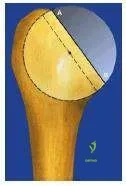
Proximal humeral anatomy is variable. Which of the following measurements most accurately describe the range of diameters of the humeral head (length of line AB):
Options:
- 25 mm to 35 mm
- 35 mm to 45 mm
- 45 mm to 55 mm
- 25 mm to 45 mm
- 35 mm to 55 mm
Correct Answer: 35 mm to 55 mm
Explanation:
Proximal humeral anatomy is variable. The high variability is the basis for radical changes in design of shoulder arthroplasty. The diameter of the humeral head ranges from approximately 35 mm to 55 mm.
Question 12:
Which of the following statements best describes the relationship of humeral head diameter to humeral head thickness:
Options:
- Humeral head diameter and humeral head thickness are independent of one another.
- Humeral head diameter and humeral head thickness have a directly proportional linear relationship.
- Humeral head diameter and humeral head thickness have an inversely proportional linear relationship.
- Humeral head diameter and humeral head thickness have a directly proportional logarithmic relationship.
- Humeral head diameter and humeral head thickness have an inversely proportional logarithmic relationship.
Correct Answer: Humeral head diameter and humeral head thickness are independent of one another.
Explanation:
Humeral head diameter and humeral head thickness have a directly proportional linear relationship.
Question 13:
Proximal humeral anatomy is variable. Which of the following measurements most accurately describe the range of radius of curvature of the humeral head (length of line AB):
Options:
- 5 mm to 10 mm
- 10 mm to 15 mm
- 15 mm to 20 mm
- 20 mm to 30 mm
- 30 mm to 40 mm
Correct Answer: 20 mm to 30 mm
Explanation:
Proximal humeral anatomy is variable. This high variability is the basis for radical changes in design of shoulder arthroplasty. The humeral head radius of curvature ranges from approximately 20 mm to 30 mm.
Question 14:
The proximal humeral articular surface can be described as a portion of a sphere. The center of this sphere has which of the following anatomic relationships to the long axis of the humerus:
Options:
- The center of this sphere lies on the long axis of the humerus.
- The center of this sphere is offset medially with respect to the long axis of the humerus.
- The center of this sphere is offset posteriorly with respect to the long axis of the humerus.
- The center of this sphere is offset anteriorly with respect to the long axis of the humerus.
- The center of this sphere is offset medially and posteriorly with respect to the long axis of the humerus.
Correct Answer: The center of this sphere lies on the long axis of the humerus.
Explanation:
Anatomically, a sphere can be fit to the proximal humerus with the articular surface comprising a portion of that spher The center of this sphere is offset 3 mm to 11 mm medially and 1 mm to 6 mm posteriorly with respect to the long axis of the humerus.
Question 15:
Which of the following pitch types is associated with the development of shoulder pain in baseball pitchers between the ages of 9 and 14 years:
Options:
- Fastball
- C hange-up
- C urveball
- Slider
- Knuckle ball
Correct Answer: C urveball
Explanation:
A study following 476 young baseball pitchers for one season demonstrated that the use of the curveball in this age group was associated with a 52% increased risk of the development of shoulder pain.
Question 16:
Which of the following pitch types is associated with the development of elbow pain in baseball pitchers between the ages of 9 and 14 years:
Options:
- Fastball
- C hange-up
- C urveball
- Slider
- Knuckle ball
Correct Answer: Slider
Explanation:
A study following 476 young baseball pitchers for one season demonstrated that use of the slider in this age group was associated with an 86% increased risk of the development of elbow pain.
Question 17:
It is recommended to limit youth baseball pitchers (9 to 14 years of age) to how many pitches per game
Options:
Correct Answer: 75
Explanation:
In young baseball pitchers, high pitch counts are associated with increased risk of shoulder pain. Based on a study of 476 youth baseball pitchers, it is recommended to limit pitch counts to 75 pitches per gam.
Question 18:
It is recommended to limit youth baseball pitchers (9 to 14 years of age) to how many game situation pitches per baseball season:
Options:
Correct Answer: 600
Explanation:
In young baseball pitchers, high pitch counts are associated with increased risk of shoulder pain. Based on a study of 476 youth baseball pitchers, it is recommended to limit pitch counts to 600 game situation pitches per season.
Question 19:
Which of the following statements is true regarding traumatic anterior shoulder instability:
Options:
- Abnormal glenohumeral translation occurs mainly in the provocative position of 90° abduction and external rotation, and this translation is corrected by contraction of the dynamic shoulder stabilizers.
- Abnormal glenohumeral translation occurs in multiple arm positions, and this translation is corrected by contraction of the dynamic shoulder stabilizers.
- Abnormal glenohumeral translation occurs mainly in the provocative position of 90° abduction and external rotation, and this translation is not corrected by contraction of the dynamic shoulder stabilizers.
- Abnormal glenohumeral translation occurs in multiple arm positions, and this translation is not corrected by contraction of the
- No abnormal glenohumeral translation occurs in traumatic shoulder instability.
Correct Answer: Abnormal glenohumeral translation occurs mainly in the provocative position of 90° abduction and external rotation, and this translation is corrected by contraction of the dynamic shoulder stabilizers.
Explanation:
dynamic shoulder stabilizers. A study evaluating glenohumeral translation and muscle activity related traumatic and atraumatic shoulder instability demonstrated that patients with traumatic shoulder instability have abnormal glenohumeral translation mainly in the provocative position of 90° abduction and external rotation. This translation is corrected by contraction of the dynamic shoulder stabilizers.
Question 20:
Which of the following is the most common radiographic finding in patients with lateral epicondylitis:
Options:
- Soft tissue calcification at the lateral aspect of the elbow
- Coronoid osteophyte
- Olecranon osteophyte
- Intraosseous cyst
- Osteochondritis dessicans
Correct Answer: Soft tissue calcification at the lateral aspect of the elbow
Explanation:
In a radiographic analysis of 294 patients with lateral epicondylitis, 20 patients had lateral soft tissue calcification, 14 patients had coronoid osteophytes, nine patients had olecranon osteophytes, two patients had intraosseous cysts, and two patients had osteochondritis dessicans. The author concluded that routine radiography is not warranted in the initial management of lateral epicondylitis.