Mastering Iliopsoas and Adductor Release: A Comprehensive Intraoperative Guide
Key Takeaway
Join us in the OR for an immersive masterclass on iliopsoas and adductor release. We'll meticulously cover comprehensive surgical anatomy, crucial preoperative planning, and granular, real-time intraoperative execution. Learn precise dissection techniques, instrument handling, and critical neurovascular precautions. This guide also details essential pearls, pitfalls, and comprehensive postoperative management to optimize outcomes for hip contracture patients.
Introduction and Epidemiology
Psoas and adductor contractures represent a fundamental musculoskeletal pathology frequently encountered in pediatric orthopedic surgery, predominantly within the context of cerebral palsy (CP) and other neuromuscular conditions such as myelodysplasia, traumatic brain injury, and hereditary spastic paraparesis. These contractures arise secondary to disuse, muscular imbalance, or prolonged spasticity. The degree of contracture is highly variable and correlates strongly with the patient's age, the underlying diagnosis, and the severity of neuromuscular dysfunction, often categorized by the Gross Motor Function Classification System (GMFCS).
Detecting isolated hip flexion contractures mediated by the psoas muscle can be clinically challenging due to compensatory mechanisms such as increased lumbar lordosis and anterior pelvic tilt. Similarly, the primary challenge in managing adductor contractures lies in the precise preoperative and intraoperative determination of which specific muscle units require lengthening and the optimal degree of release to achieve functional improvement without inducing iatrogenic weakness.

Hip flexion and adduction contractures develop progressively. A mild hip flexion contracture is physiologic at birth and persists throughout infancy until the child achieves independent standing and walking. In an older child who has failed to achieve these developmental milestones, a persistent hip flexion contracture may represent the retention of fetal alignment rather than an acquired pathologic state. Physiologic hip abduction range of motion at birth is 60 to 90 degrees, which is significantly greater than the expected adult range. Appropriate musculotendinous length develops dynamically during skeletal growth; the muscle responds to longitudinal bone growth and the mechanical stretch associated with typical childhood activities. Growth occurs at the musculotendinous junction through the serial addition of sarcomeres.

When typical functional activities are absent, or when there is a profound muscular imbalance between the hip flexors/adductors and their antagonists (hip extensors and abductors), normal sarcomere addition fails. This leads to a transition from dynamic spasticity to fixed myostatic contracture. If severe and persistent, these contractures alter the mechanical forces across the developing hip joint, leading to progressive hip subluxation, acetabular dysplasia, and ultimately, frank dislocation. Hip dysplasia and dislocation are most prevalent in severe cerebral palsy (spastic quadriplegia, GMFCS levels IV and V) and in L2 or L3 level myelodysplasia, where the muscular imbalance is most pronounced (innervated hip flexors and adductors overpowering paralyzed or weak abductors and extensors). In ambulatory children (GMFCS I, II, and III), these contractures manifest kinematically as anterior pelvic tilt, excessive transverse plane pelvic rotation, a lack of terminal hip extension in stance phase, and a contribution to crouch gait. Although a "scissoring gait" is classically attributed solely to adductor contractures, kinematic data demonstrates that this visual phenomenon most commonly results from a complex combination of hip flexion, adduction, and internal rotation.
Surgical Anatomy and Biomechanics
A profound understanding of the regional anatomy is critical for executing precise musculotendinous lengthenings while avoiding iatrogenic neurovascular injury.
Iliopsoas Anatomy
The iliopsoas is the primary hip flexor and consists of two distinct muscle bellies the psoas major and the iliacus. The psoas major originates from the transverse processes and lateral aspects of the vertebral bodies of T12 through L5. The muscle belly descends over the sacral ala and crosses the pelvic brim.

At the level of the pelvic brim (superior pubic ramus), the psoas transitions into a distinct intramuscular tendon. At this anatomic juncture, the psoas tendon lies deep to the muscle belly of the iliacus. The femoral neurovascular bundle (femoral nerve, artery, and vein) is situated superficial to the iliacus and psoas fascia. The psoas and iliacus combine distal to the pelvic brim, forming a common tendon that inserts onto the lesser trochanter of the proximal femur. Recognizing the distinct separation of the psoas tendon and iliacus muscle fibers at the pelvic brim is the anatomic basis for the intramuscular psoas lengthening technique, which preserves iliacus function and maintains essential hip flexion power for swing-phase clearance in ambulatory patients.
Adductor Compartment Anatomy
The adductor group of the hip is located in the medial compartment of the thigh and includes the adductor longus, adductor brevis, adductor magnus, and gracilis. The pectineus is also functionally considered part of this group but is rarely the primary target for lengthening. These muscles originate from the pubic and ischial rami and the pubic tubercle, inserting medially along the linea aspera of the femur (adductors) and the proximal medial tibia at the pes anserinus (gracilis).

The adductor longus possesses a distinct, easily palpable tendinous origin at the pubic tubercle. The gracilis has a broad muscular and fascial origin along the inferior pubic ramus. The adductor brevis and adductor magnus predominantly have muscular origins.

The innervation of the medial compartment is primarily via the obturator nerve (L2, L3, L4). The obturator nerve exits the pelvis through the obturator foramen and immediately divides into anterior and posterior branches. The anterior branch descends in the internervous fascial interval deep to the adductor longus and superficial to the adductor brevis. This branch innervates the adductor longus, adductor brevis, and gracilis. The posterior branch descends in the interval deep to the adductor brevis and superficial to the adductor magnus, innervating the adductor magnus (along with the tibial division of the sciatic nerve for the hamstring portion of the magnus).

Biomechanics of Contracture
In the sagittal plane, spasticity of the iliopsoas forces the hip into flexion. To maintain an upright posture and keep the center of mass over the base of support, the patient compensates by increasing anterior pelvic tilt and lumbar lordosis. In the coronal plane, adductor spasticity overpowers the hip abductors (gluteus medius and minimus). This creates a mechanical adduction moment at the hip joint. When combined with the coxa valga and increased femoral anteversion typically seen in neuromuscular dysplasia, the resultant force vector of the femur is directed superiorly and posteriorly, leading to progressive uncovering of the femoral head, capsular stretching, and eventual posterosuperior dislocation.
Indications and Contraindications
Surgical intervention is predicated on a combination of clinical examination findings, radiographic parameters, and, when available, three-dimensional computerized gait analysis. The goals of surgery differ significantly between ambulatory (GMFCS I-III) and non-ambulatory (GMFCS IV-V) patients. In ambulatory patients, the goal is to improve gait kinematics, reduce energy expenditure, and prevent secondary joint degeneration. In non-ambulatory patients, the goal is to maintain a located, painless hip to facilitate perineal hygiene, sitting balance, and ease of positioning.
| Parameter | Operative Indications | Non Operative Management |
|---|---|---|
| Radiographic (Reimers Migration Percentage) | MP > 30 to 40% with documented progression over 6 to 12 months. | MP < 30%, stable on serial surveillance radiographs. |
| Clinical Range of Motion | Hip abduction < 30 degrees in extension. Fixed flexion contracture > 15 to 20 degrees. | Hip abduction > 45 degrees. Flexion contracture < 10 degrees. |
| Gait Kinematics | Persistent scissoring causing tripping. Severe anterior pelvic tilt limiting terminal stance extension. | Mild dynamic spasticity responsive to bracing or botulinum toxin. |
| Patient Age | Typically > 3 to 4 years old (after failure of conservative measures). | Infants and toddlers (optimize with physical therapy and bracing). |
| Functional Status | Painful hip subluxation interfering with seating or hygiene (GMFCS IV/V). | Pain-free, located hips with manageable hygiene. |
Contraindications
Absolute contraindications include the presence of severe, fixed bony deformities (e.g., profound coxa valga, severe femoral anteversion, or advanced acetabular dysplasia) that cannot be managed by soft tissue release alone. In these scenarios, soft tissue release must be combined with a Varus Derotational Osteotomy (VDRO) and/or a pelvic osteotomy (e.g., Dega or San Diego osteotomy). Relative contraindications include underlying movement disorders such as severe athetosis or dystonia, where isolated lengthening may lead to unpredictable functional outcomes or rapid reversal of deformity. Furthermore, profound weakness of the hip flexors or abductors should caution the surgeon against aggressive lengthening, which could precipitate a complete loss of ambulatory capacity.
Pre Operative Planning and Patient Positioning
Thorough preoperative clinical assessment is mandatory. The Thomas test is utilized to unmask hidden hip flexion contractures by maximally flexing the contralateral hip to obliterate the lumbar lordosis and lock the pelvis. The Ely test assesses rectus femoris spasticity, which can contribute to apparent hip flexion contractures.

Adductor contractures are evaluated by measuring passive hip abduction with the hips and knees extended (assessing the gracilis and medial hamstrings) and with the hips and knees flexed (relaxing the gracilis to isolate the adductor longus and brevis). A discrepancy where abduction is significantly greater in flexion indicates a predominant gracilis contracture.
Radiographic evaluation requires an anteroposterior (AP) pelvis radiograph and a frog-leg lateral view. The critical measurement is the Reimers Migration Percentage (MP), calculated by determining the percentage of the ossified femoral head that lies lateral to Perkin's line. An MP greater than 30% is generally considered the threshold for subluxation. The acetabular index should also be measured to assess for concomitant dysplasia.

If available, 3D gait analysis provides invaluable objective data. Kinematic graphs will demonstrate the exact degree of anterior pelvic tilt and the timing of hip extension deficits. Dynamic electromyography (EMG) can differentiate between dynamic spasticity (abnormal firing during stance or swing) and fixed myostatic contracture.
Patient Positioning
The patient is placed supine on a standard radiolucent operating table. General anesthesia is administered. Muscle relaxants should be used judiciously if intraoperative nerve stimulation is planned, though anatomic identification of the obturator nerve is typically sufficient. The patient is prepped and draped to allow free, unencumbered manipulation of both lower extremities from the iliac crests to the toes. A sterile tourniquet is not utilized. The hips are placed in a frog-leg position (flexed, abducted, and externally rotated) to place the adductor musculature under tension and bring the adductor longus origin into subcutaneous prominence.
Detailed Surgical Approach and Technique
The surgical technique must be meticulous to achieve the desired lengthening while preserving neurovascular integrity and preventing over-lengthening.
Adductor Release
An open approach is strongly preferred over percutaneous tenotomy to allow for direct visualization of the adductor brevis and the anterior branch of the obturator nerve.

A 3 to 4 centimeter longitudinal incision is made overlying the palpable origin of the adductor longus, beginning just distal to the pubic tubercle and extending distally in line with the muscle belly. Subcutaneous tissues are bluntly dissected. Care must be taken to avoid the greater saphenous vein, which lies in the superficial fascia slightly lateral and posterior to the incision.

The deep fascia is incised longitudinally over the adductor longus. The distinct, cord-like tendinous origin of the adductor longus is isolated using a right-angle clamp.

A complete transverse tenotomy is performed approximately 1 to 2 centimeters distal to the pubic attachment. Upon release, the muscle belly will retract distally.

Retracting the cut ends of the adductor longus exposes the underlying areolar tissue and the anterior branch of the obturator nerve. The nerve runs obliquely from proximal-lateral to distal-medial across the superficial surface of the adductor brevis. It must be definitively identified and protected with a blunt retractor.

Once the nerve is protected, the adductor brevis is evaluated. If the hip still fails to achieve 45 to 50 degrees of abduction, the adductor brevis is addressed. In ambulatory patients, an intramuscular lengthening (fractional lengthening) of the epimysium is preferred to maintain some adductor power. In non-ambulatory patients with severe subluxation, a complete transverse myotomy of the adductor brevis can be performed.

If the gracilis is clinically tight (limited abduction with the knee extended), it is identified posterior and medial to the adductor longus. The gracilis is enveloped in its own fascial sheath. An intramuscular lengthening or complete myotomy is performed depending on the severity of the contracture. The adductor magnus should routinely be spared to prevent excessive abduction contracture, catastrophic loss of hip stability, and severe functional decline.
Iliopsoas Release at the Pelvic Brim
For ambulatory patients, the psoas must be lengthened over the pelvic brim to preserve the iliacus muscle and maintain active hip flexion power. This is critical for initiating the swing phase of gait.
The approach is typically performed through the same medial groin incision used for the adductor release. The hip is flexed and externally rotated. The surgeon bluntly develops the interval between the pectineus (which is retracted laterally) and the adductor brevis (retracted medially).
Deep dissection reveals the lesser trochanter and the iliopsoas tendon. However, for a pelvic brim release, the dissection is directed proximally along the iliopsoas muscle belly toward the superior pubic ramus. The femoral neurovascular bundle lies immediately lateral and superficial to the operative field and must be protected by maintaining dissection strictly medial to the iliopsoas muscle belly.
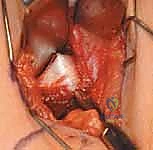
Once the pelvic brim is palpated, the iliopsoas muscle is elevated. A right-angle clamp is carefully passed deep to the tendinous portion of the psoas, which lies on the posterior aspect of the muscle complex at this level. The tendon is isolated from the overlying iliacus muscle fibers. A transverse tenotomy of the psoas tendon is performed. The surgeon will palpate a distinct "give" as the tendon is sectioned, while the muscular fibers of the iliacus remain completely intact. The hip is then extended to confirm adequate release and verify that the anterior pelvic tilt has been reduced.
Iliopsoas Release at the Lesser Trochanter
In non-ambulatory patients (GMFCS IV and V) with severe, fixed flexion contractures and hip subluxation, a complete release of the iliopsoas at its insertion on the lesser trochanter is indicated.
Using the same medial approach, the dissection is carried distally to the lesser trochanter. The entire iliopsoas tendon is identified at its insertion. A complete tenotomy is performed directly off the bone. This provides maximum correction of the flexion contracture but results in a profound loss of hip flexion power, which is functionally acceptable in non-ambulatory patients where the primary goal is joint preservation and positioning.
After achieving hemostasis, the deep fascia is loosely approximated. The subcutaneous tissue is closed with interrupted absorbable sutures, and the skin is closed with a running subcuticular closure or interrupted inverted mattress sutures. Sterile dressings are applied.
Complications and Management
Surgical intervention for hip flexor and adductor contractures carries specific risks that must be mitigated through precise surgical technique and appropriate patient selection.
| Complication | Estimated Incidence | Etiology and Pathophysiology | Prevention and Salvage Strategies |
|---|---|---|---|
| Over Lengthening / Iatrogenic Weakness | 5 to 10% | Complete release of psoas at lesser trochanter in an ambulatory patient; Release of adductor magnus. | Strict adherence to pelvic brim psoas lengthening in GMFCS I-III. Spare adductor magnus. Salvage requires extensive physical therapy; rarely, tendon transfers. |
| Recurrence of Contracture | 15 to 30% | Growth spurts; inadequate initial release; failure of postoperative bracing/therapy. | Ensure adequate intraoperative release (abduction > 45 degrees). Strict adherence to post-op standing programs and orthotics. May require revision release or bony osteotomy. |
| Obturator Nerve Injury | < 2% | Blind percutaneous tenotomy; aggressive retraction; failure to identify the anterior branch. | Always utilize an open approach. Directly visualize and protect the nerve before brevis release. If transected, primary microsurgical repair is indicated. |
| Hematoma Formation | 2 to 5% | Inadequate hemostasis from rich muscular blood supply in the medial compartment. | Meticulous electrocautery. Release tourniquet (if used) prior to closure. Postoperative compression dressings. Evacuation required if expanding or causing skin necrosis. |
| Wound Infection | 1 to 3% | Proximity to perineum; incontinence in severely involved patients. | Preoperative chlorhexidine. Intraoperative antibiotics. Careful wound sealing (e.g., skin glue). Aggressive management with I&D and targeted antibiotics if deep infection occurs. |
A unique complication related to psoas lengthening is the potential exacerbation of anterior pelvic tilt. If the hip flexors are over-lengthened in a patient with pre-existing weak hip extensors, the pelvis may tilt further anteriorly due to the loss of dynamic stabilization, paradoxically worsening the patient's crouch gait. This highlights the necessity of comprehensive preoperative gait analysis to assess the relative strength of the hip extensors prior to psoas release.
Post Operative Rehabilitation Protocols
The immediate postoperative phase focuses on maintaining the surgical correction while allowing the soft tissues to heal in their new, lengthened position.
For non-ambulatory patients or those with significant preoperative subluxation, bilateral long leg casts with a fixed abduction bar (Petrie casts) are frequently applied in the operating room. The hips are positioned in 30 to 45 degrees of abduction and neutral rotation. The casts are typically maintained for 3 to 4 weeks. Alternatively, custom-molded abduction orthoses or rigid abduction pillows may be utilized, provided patient compliance and nursing care are reliable.
For ambulatory patients, rigid immobilization is often avoided to prevent profound muscle atrophy and loss of motor control. Instead, these patients are placed in knee immobilizers or resting night splints to maintain extension, and an abduction wedge is used while supine.
Physical therapy is initiated immediately postoperatively or upon cast removal. The protocol emphasizes:
1. Passive Range of Motion: Gentle, sustained stretching of the hip flexors and adductors to prevent scar contracture.
2. Active Strengthening: Targeted strengthening of the antagonist muscle groups, specifically the hip abductors (gluteus medius) and hip extensors (gluteus maximus). This is critical to re-establish muscular balance across the joint.
3. Weight Bearing: Early mobilization and weight-bearing are encouraged. Ambulatory patients resume standing and walking with assistive devices as tolerated. Non-ambulatory patients are placed in standing frames for 1 to 2 hours daily to provide mechanical loading to the hip joint, which stimulates favorable acetabular remodeling.
Long-term surveillance is mandatory. Patients must be followed with serial clinical examinations and AP pelvis radiographs every 6 to 12 months until skeletal maturity to monitor the Reimers Migration Percentage and ensure maintenance of hip stability.
Summary of Key Literature and Guidelines
The management of hip displacement in neuromuscular disorders is guided by robust academic literature and consensus guidelines.
- Reimers (1980): Established the Migration Percentage (MP) as the standard radiographic metric for quantifying hip subluxation. Reimers demonstrated that an MP > 33% is highly predictive of progressive dislocation and warrants surgical intervention.
- Bleck (1987): In his seminal text on the orthopedic management of cerebral palsy, Bleck outlined the anatomic basis for the "psoas over the brim" lengthening, emphasizing the preservation of the iliacus to maintain functional hip flexion in ambulatory children.
- Gage (1991): Pioneered the use of 3D computerized gait analysis to differentiate between dynamic spasticity and fixed contracture, fundamentally changing the indications for soft tissue release and preventing iatrogenic over-lengthening.
- American Academy for Cerebral Palsy and Developmental Medicine (AACPDM): The AACPDM has published comprehensive hip surveillance guidelines. These guidelines mandate regular radiographic screening based on the patient's GMFCS level, ensuring early detection of lateral migration before the onset of fixed bony deformity, thereby maximizing the efficacy of soft tissue releases like the adductor and iliopsoas lengthening.
- Shore et al. (2012): Demonstrated that early adductor and psoas release significantly alters the natural history of hip displacement in CP, reducing the need for subsequent major reconstructive bony surgery (VDRO and pelvic osteotomies) in a substantial percentage of appropriately selected patients.
Clinical & Radiographic Imaging
You Might Also Like