Scoliosis Examination Question: Master Your Oral Exam
Key Takeaway
This topic focuses on Scoliosis Examination Question: Master Your Oral Exam, Scoliosis, a crucial topic for any examination question scoliosis, is a lateral spinal curvature exceeding 10° (Cobb method), presenting as a complex three-dimensional deformity. It can be idiopathic, congenital, neuromuscular, or syndromic. Treatment focuses on progressive deformity or preventing cardiorespiratory compromise, often requiring specialist referral and potential surgical intervention.
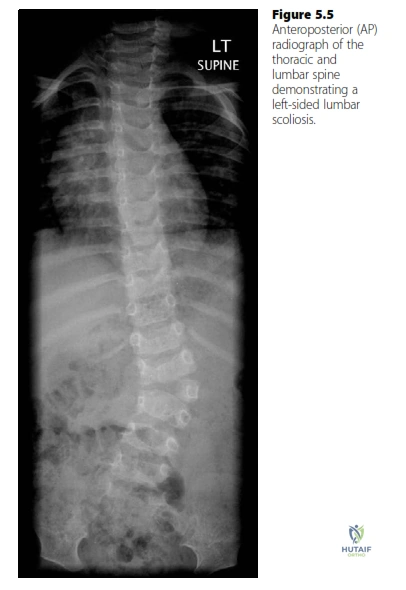
I am presenting you with this patient's AP radiograph. Describe the findings and tell me what you see.
Candidate: "This is an AP standing radiograph of the thoracolumbar spine. There is a left-sided lumbar scoliosis. Looking closely at the apical region, there appears to be a congenital vertebral anomaly, specifically a hemivertebra, which is the likely driver for this structural deformity."
Describing only the curve without analyzing the underlying anatomy. Failing to mention the 'standing' nature of the film, missing the hemivertebra, or jumping straight to 'idiopathic scoliosis' without ruling out congenital causes.
A systematic approach: 1. Orientation (AP Standing, Spine). 2. Assessment of deformity (Side of convexity, level of apex, presence of congenital anomaly). 3. Immediate clinical context (This is a congenital scoliosis secondary to a hemivertebra, requiring specific assessment for associated intraspinal or systemic VACTERL anomalies).
This patient has been diagnosed with a congenital scoliosis. What are the clinical indications for surgical intervention in such a patient, and how does this differ from Adolescent Idiopathic Scoliosis (AIS)?
Candidate: "In congenital scoliosis, surgery is indicated earlier due to the predictable progression based on growth imbalance—such as a unilateral unsegmented bar with contralateral hemivertebrae. Unlike AIS, where we watch and brace, congenital curves are often rigid and progress regardless of bracing, necessitating early prophylactic fusion or hemivertebra excision."
Suggesting bracing for congenital scoliosis. Examiners will pounce on this; bracing is rarely effective for congenital vertebral anomalies because the deformity is structural and mechanical, not postural or idiopathic.
Structure the answer by mechanism of progression. Explain that in congenital cases, we treat the 'growth potential' (e.g., hemivertebrae vs. bars). Mention the importance of early detection to prevent secondary structural changes in the compensatory curves, which are initially flexible but become structural over time.
You mentioned an anterior approach for this patient. Describe the Hodgson's (thoraco-abdominal) approach to the thoracolumbar junction.
Candidate: "The patient is in the lateral decubitus position. I would perform a thoracotomy over the 10th rib, extending it anteriorly toward the rectus sheath. I would resect the rib subperiosteally, enter the chest cavity, identify the diaphragm, and perform a peripheral detachment of the diaphragm to allow visualization of the spine while preserving its innervation via the phrenic nerve."
Forgetting the phrenic nerve or failing to mention the specific level of the rib resection. Ignoring the retroperitoneal entry (the 'thoraco-abdominal' transition) is a critical omission for a senior registrar level answer.
Systematic surgical description: Positioning, level of incision, handling of the rib (subperiosteal), safe entry into the chest, careful preservation of the phrenic nerve by peripheral detachment of the diaphragm, identification of the retroperitoneal space, and ligation of segmental vessels under vision.
