The Stainless Steel Goniometer: An Orthopedic Specialist's Definitive Guide
In the intricate world of orthopedics and rehabilitation, objective measurement is paramount. Among the essential tools that stand the test of time and clinical rigor, the goniometer holds a distinguished place. Specifically, the Stainless Steel Goniometer represents the gold standard for its unparalleled durability, precision, and sterile capabilities. This comprehensive guide, crafted by an expert Medical SEO Copywriter and Orthopedic Specialist, delves deep into every facet of this indispensable instrument, from its meticulous design to its profound impact on patient care.
1. Comprehensive Introduction & Overview
A goniometer (from Greek gonia meaning angle, and metron meaning measure) is a medical instrument used to measure the range of motion (ROM) of a joint. It is a fundamental tool for orthopedists, physical therapists, occupational therapists, chiropractors, and other healthcare professionals involved in musculoskeletal assessment and rehabilitation. By quantifying angular displacement, goniometers provide objective data crucial for diagnosis, treatment planning, progress tracking, and evaluating the effectiveness of interventions.
While various materials like plastic and aluminum are used for goniometers, stainless steel offers distinct advantages that elevate it to a professional-grade instrument. Its inherent strength, resistance to corrosion, ease of sterilization, and tactile feedback make it the preferred choice for demanding clinical and surgical environments where precision and hygiene are non-negotiable.
This guide will explore the sophisticated engineering behind stainless steel goniometers, their diverse clinical applications, precise usage protocols, stringent maintenance requirements, the underlying biomechanical principles, and their ultimate contribution to superior patient outcomes.
2. Deep-Dive into Technical Specifications & Mechanisms
The design of a stainless steel goniometer, while seemingly simple, is engineered for maximum accuracy and longevity.
2.1. Core Components
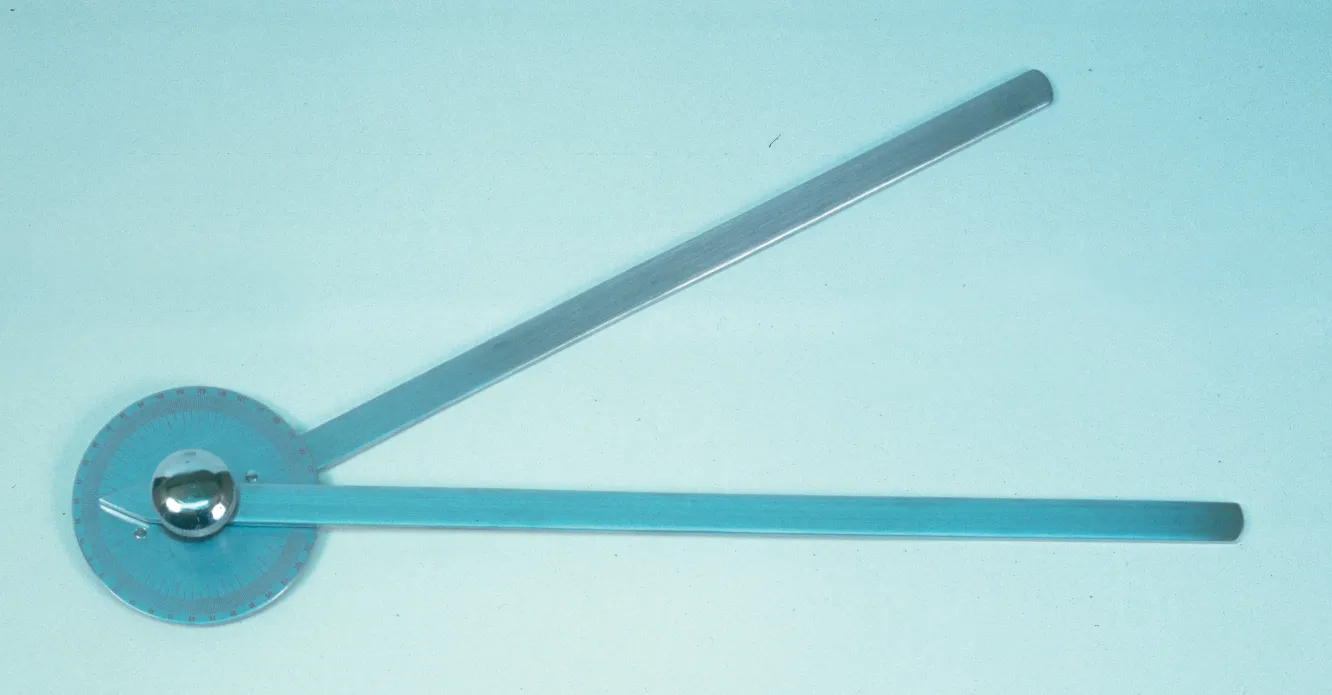
A standard goniometer consists of three primary components:
- Body/Protractor: This is the central circular or semi-circular component, typically marked with a 0-180° or 0-360° scale. Precision laser-etched markings ensure clear, unambiguous readings.
- Stationary Arm: Fixed to the body, this arm serves as the reference point for measurement. Its alignment with the proximal segment of the joint is critical.
- Movable Arm: This arm pivots around the fulcrum (axis) of the protractor and is aligned with the distal segment of the joint. Its movement relative to the stationary arm indicates the joint's angular displacement.
- Fulcrum/Axis: The pivot point of the goniometer, which must be carefully aligned with the anatomical axis of motion of the joint being measured.
2.2. Design & Materials: The Stainless Steel Advantage
The choice of stainless steel for goniometer construction is deliberate and impactful:
- Material Composition: Typically, medical-grade stainless steel (e.g., 300 series, like 304 or 316) is used. This alloy contains chromium, which forms a passive layer on the surface, providing exceptional resistance to rust, corrosion, and staining, even when exposed to bodily fluids, cleaning agents, and high-temperature sterilization.
- Durability & Longevity: Stainless steel is remarkably robust, resisting bending, scratching, and deformation. This ensures the goniometer maintains its structural integrity and calibration accuracy over countless uses, unlike plastic alternatives that can degrade or warp over time.
- Precision Manufacturing: The rigidity of stainless steel allows for extremely precise machining and laser etching of scales, minimizing parallax error and ensuring consistent accuracy.
- Weight & Feel: The substantial feel of a stainless steel goniometer provides a sense of quality and stability during measurement, aiding in steady alignment.
- Hygiene & Sterilization: This is perhaps the most critical advantage. Stainless steel can withstand rigorous sterilization protocols, including high-temperature steam autoclaving, ensuring aseptic conditions for surgical or invasive procedures, and preventing cross-contamination in clinical settings.
2.3. Scale Types and Precision
Goniometers come with various scales:
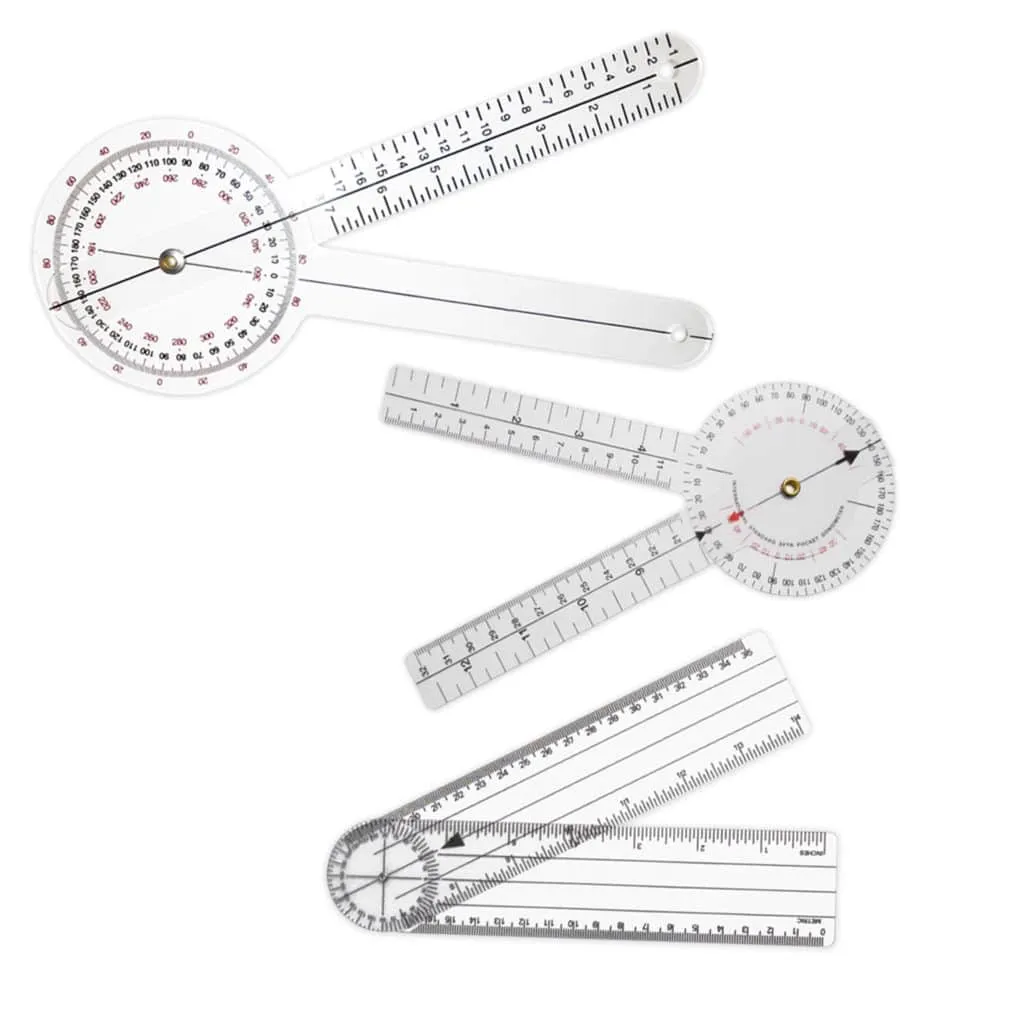
- 180° Scale: Measures from 0° to 180°, often used for joints like the elbow or knee where full extension is 0°.
- 360° Scale: Measures a full circle, useful for joints with broader ranges of motion or for measuring rotation.
- Degree Markings: Typically in 1° increments, allowing for precise readings. Some models may feature smaller increments for research purposes.
The precision of a goniometer is inherent in its manufacturing and the clarity of its markings. A well-designed stainless steel goniometer, when used correctly, can achieve inter-rater and intra-rater reliability within a few degrees, making it a reliable tool for clinical decision-making.
3. Extensive Clinical Indications & Usage
The stainless steel goniometer is an indispensable tool across numerous orthopedic and rehabilitative scenarios. Its primary application is the objective measurement of joint range of motion (ROM).
3.1. General Principles of Goniometry Usage
Accurate goniometry requires meticulous technique:
- Patient Positioning: The patient must be positioned consistently according to standardized protocols (e.g., supine, prone, seated) to isolate the joint and minimize compensatory movements.
- Stabilization: The proximal joint segment (stationary arm alignment) should be stabilized to prevent unwanted movement.
- Anatomical Landmark Identification: Palpate and precisely identify the bony landmarks that define the joint's axis of motion and the alignment points for the goniometer arms.
- Goniometer Alignment:
- Fulcrum: Align the goniometer's fulcrum with the estimated axis of rotation of the joint.
- Stationary Arm: Align the stationary arm with the longitudinal axis of the proximal bone segment.
- Movable Arm: Align the movable arm with the longitudinal axis of the distal bone segment.
- Measurement: Move the joint through its full available ROM, keeping the goniometer aligned. Read the angle at the end of the motion.
- Documentation: Record the measurement accurately, including the type of motion (e.g., knee flexion), the side (left/right), and any pain or crepitus observed.
3.2. Specific Clinical Applications & Joint Measurements
The goniometer is used for a wide array of joints and conditions:
| Joint | Motion Measured | Typical Anatomical Landmarks / Goniometer Alignment |
|---|---|---|