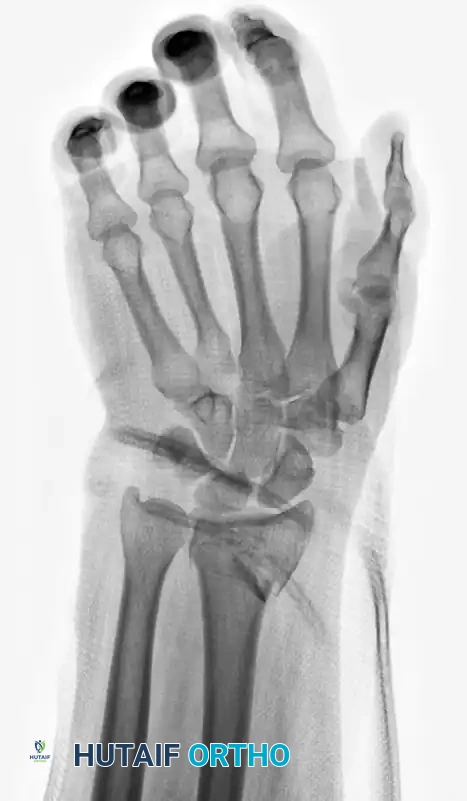
Osteotomy for Intraarticular Malunion of the Distal Radius: Comprehensive Surgical Principles and Salvage Procedures
Key Takeaway
Intraarticular malunion of the distal radius significantly alters radiocarpal kinematics, leading to early posttraumatic osteoarthritis. Corrective osteotomy, utilizing the Marx and Axelrod technique, aims to restore articular congruity through precise recreation of the primary fracture plane. This guide details the dorsal and volar surgical approaches, step-by-step osteotomy execution, defect grafting, definitive fixation strategies, and evidence-based salvage procedures for advanced degenerative changes.
INTRODUCTION AND BIOMECHANICAL CONSIDERATIONS
Intraarticular malunion of the distal radius represents a formidable reconstructive challenge for the orthopaedic surgeon. The radiocarpal joint is highly sensitive to articular incongruity; biomechanical studies demonstrate that an articular step-off of greater than 2 mm exponentially increases focal contact stresses, inevitably precipitating posttraumatic osteoarthritis. The primary goal of an intraarticular osteotomy is to anatomically restore the articular surface, normalize radiocarpal kinematics, and delay or prevent the onset of degenerative joint disease.
The technique popularized by Marx and Axelrod provides a systematic approach to recreating the primary fracture plane, mobilizing the malunited fragment, and restoring joint congruity. Success relies heavily on meticulous preoperative planning, precise surgical execution, and the judicious use of structural bone grafting to support the mobilized articular segments.
💡 Clinical Pearl: Patient Selection
Intraarticular osteotomy is most successful in symptomatic patients with a well-defined articular step-off or gap, preserved cartilage space on radiographs, and an absence of advanced global radiocarpal arthritis. Timing is critical; intervention before the onset of irreversible chondral damage yields the most favorable long-term outcomes.
PREOPERATIVE PLANNING
Standard posteroanterior (PA), lateral, and oblique radiographs of the wrist are mandatory. However, plain radiography consistently underestimates the complexity of intraarticular malunions.
A high-resolution computed tomography (CT) scan with 2D multiplanar reformats (sagittal and coronal) and 3D surface rendering is the gold standard. The CT scan allows the surgeon to:
* Precisely map the location of the articular step-off (dorsal vs. volar).
* Identify the original fracture lines and metaphyseal scar.
* Assess the presence of central impaction (die-punch fragments).
* Evaluate the distal radioulnar joint (DRUJ) for concomitant incongruity or subluxation.
SURGICAL TECHNIQUE: MARX AND AXELROD OSTEOTOMY
The surgical approach is dictated by the location of the primary articular displacement. Dorsal malunions require a dorsal approach, whereas volar malunions (e.g., malunited volar Barton fractures) necessitate a palmar approach.
The Dorsal Approach
If the articular malunion is located dorsally, the distal radius is approached through a longitudinal dorsal incision.
- Incision and Dissection: Make a longitudinal incision centered over Lister's tubercle. Develop the interval between the third (extensor pollicis longus) and fourth (extensor digitorum communis) extensor compartments.
- Tendon Retraction: Open the third compartment and transpose the extensor pollicis longus (EPL) tendon radially. Subperiosteally reflect the extensor tendons of the fourth compartment ulnarly, taking care not to violate the compartment's internal septa.
- Capsulotomy: Continue the exposure distally into the dorsal wrist capsule. Expose the distal radial articular surface utilizing a T-shaped or ligament-sparing capsulotomy to allow direct visualization of the radiocarpal joint.
The Volar Approach
If the intraarticular malunion is located volarly, a modified Henry approach is utilized.
- Incision and Interval: Make a palmar incision utilizing the interval between the flexor carpi radialis (FCR) tendon and the radial artery.
- Deep Dissection: Retract the FCR and flexor tendons ulnarly and the radial artery radially. Incise the pronator quadratus along its radial border and elevate it ulnarly to expose the volar metaphysis.
- Joint Visualization: The articular surface is typically visualized directly through the malunited fracture site. It is imperative to preserve the stout volar radiocarpal ligaments (e.g., radioscaphocapitate, long radiolunate), as they are critical for carpal stability.
⚠️ Surgical Warning: Ligament Preservation
During the volar approach, aggressive capsular release can lead to devastating radiocarpal instability. Visualization should be achieved through the fracture plane or via a limited, carefully repaired capsulotomy, strictly preserving the extrinsic volar ligaments.
Joint Preparation and Osteotomy Execution
Once the joint is exposed, the critical steps of identifying the malunion and recreating the fracture plane begin.
- Cartilage Assessment: Use a dull instrument (such as a Freer elevator) to gently probe the articular surface. The surgeon must distinguish between native hyaline cartilage and the reparative fibrocartilage that fills the step-off. Fibrocartilage will feel distinctly softer and more yielding than the surrounding hyaline cartilage.
- Debridement: Carefully excise the fibrocartilage using a fine curette or scalpel to fully appreciate the true articular step-off and expose the margins of the malunited fragments.
- Identifying the Metaphyseal Scar: Trace the articular step-off proximally to identify the metaphyseal scar. This scar represents the primary extraarticular extension of the fracture and dictates the trajectory of the osteotomy.
- Guidewire Placement: Pass two or three small (0.062-inch) Kirschner wires (K-wires) along the anticipated plane of the old fracture. Begin at the extraarticular metaphyseal component and advance the wires so they exit precisely within the joint at the articular step. This ensures the correct three-dimensional plane has been identified.
- Fluoroscopic Confirmation: Confirm the trajectory of the K-wires with intraoperative fluoroscopy in multiple planes before committing to the osteotomy.
- The Osteotomy: Using a sharp 3- or 4-mm wide osteotome, carefully make the osteotomy through the old fracture site, guided by the K-wires, advancing into the joint.
Reduction, Grafting, and Definitive Fixation
- Mobilization and Reduction: Once the osteotomy is complete, mobilize the fragment. Reduce the articular surface under direct vision, ensuring absolute congruity. Monitor the reduction with intraoperative fluoroscopy.
- Provisional Fixation: Provisionally stabilize the reduced osteotomy with 0.045-inch or 0.062-inch K-wires.
- Bone Grafting: Elevating a depressed articular fragment inevitably creates a metaphyseal void. If the osteotomy creates a large metaphyseal defect, it is mandatory to fill this void with autogenous iliac crest bone graft (cancellous or corticocancellous) to provide structural support and prevent secondary subsidence.
- Definitive Fixation: Secure the construct using lag screws or a buttress plate. For dorsal malunions, a low-profile dorsal buttress plate is utilized. Small 2.0-mm and 2.7-mm plate designs, including modern fragment-specific or locking plates, are highly useful for capturing small articular fragments without causing tendon irritation.
💡 Clinical Pearl: Addressing Concomitant Pathology
Extraarticular malunions (e.g., radial shortening, dorsal tilt), if present, must be corrected before definitive fixation of the intraarticular component. Furthermore, assess for scapholunate instability; treat recent injuries with primary ligament repair and chronic injuries with reconstructive procedures. Any uncorrected pathology in the distal radioulnar joint (DRUJ) requires concurrent management (e.g., ulnar shortening osteotomy, Darrach, or Sauvé-Kapandji procedure).
POSTOPERATIVE CARE PROTOCOL
Rigid internal fixation allows for early rehabilitation, which is critical for restoring function and preventing arthrofibrosis.
- Immediate Postoperative Phase (0-14 Days): A light volar plaster splint is applied in the operating room. Elevation and active digit range of motion (ROM) are initiated immediately to prevent tendon adhesions and reduce edema.
- Intermediate Phase (2-6 Weeks): Upon suture removal at 10-14 days, the patient is transitioned to a custom-molded, removable plastic volar splint. This splint is worn continuously for 6 weeks, removed only for supervised active and active-assisted ROM exercises of the wrist and forearm.
- Late Phase (>6 Weeks): Splinting is gradually discontinued. Strengthening exercises are initiated based on radiographic evidence of consolidation.
- Return to Activity: Strenuous activities, heavy lifting, and contact sports are strictly avoided until solid radiographic union is achieved, which typically requires at least 3 months.
Outcomes: In Marx and Axelrod's series, the majority of patients returned to their preinjury occupation, with a subset returning to lighter work. While long-term results over decades are variable, no progression of degenerative arthritis was observed at an average follow-up of 28.5 months when articular congruity was successfully restored.
SALVAGE PROCEDURES FOR POSTTRAUMATIC ARTHRITIS
When an intraarticular malunion is neglected, or if the initial injury was a severely comminuted fracture that progresses to posttraumatic osteoarthritis, reconstructive osteotomy is no longer viable. Symptomatic patients require salvage procedures. The choice of procedure is dictated by the severity of pain, the specific joints involved, the patient's functional demands, and their age.
Wrist Denervation
Denervation of the wrist (typically targeting the anterior and posterior interosseous nerves) is recommended as a palliative procedure.
* Indications: Patients with low physical demands who have persistent, debilitating pain despite exhaustive conservative treatment (splinting, NSAIDs, intraarticular injections).
* Benefits: It does not alter the underlying biomechanics or burn bridges for future salvage procedures, offering pain relief while preserving existing motion.
Total Wrist Arthrodesis
Total wrist arthrodesis remains the gold standard for global radiocarpal and midcarpal arthritis.
* Indications: Young patients, heavy manual laborers, or individuals with strenuous physical demands who have advanced arthritic changes throughout the radiocarpal and midcarpal joints of the dominant hand. It is also the ultimate salvage procedure when other surgical options (e.g., partial fusions, arthroplasty) have failed.
* Outcomes: A highly stable, painless wrist is reliably achieved; however, all radiocarpal and midcarpal motion is permanently sacrificed.
* Concomitant DRUJ Management: Because of the discrepancy in length between the radius and ulna following trauma, or due to concurrent traumatic arthritis in the DRUJ, the distal ulna usually should be resected (Darrach procedure) or fused with proximal pseudarthrosis (Sauvé-Kapandji) at the time of arthrodesis to ensure pain-free forearm rotation.
Partial Wrist Arthrodesis
If posttraumatic arthritis is localized, motion-preserving partial wrist arthrodesis is highly effective. These procedures reduce pain and improve stability while retaining functional motion through the spared articulations.
Radioscapholunate (RSL) Arthrodesis
- Indications: Utilized when the entire radiocarpal joint (scaphoid and lunate facets) is arthritic, but the midcarpal joints (capitolunate, scaphotrapezial) are completely spared.
- Biomechanics: By fusing the radius, scaphoid, and lunate, the radiocarpal joint is eliminated. Wrist flexion and extension are subsequently driven entirely through the preserved midcarpal joint. Excision of the distal pole of the scaphoid is often performed concomitantly to improve midcarpal kinematics and increase the range of motion.
Radiolunate Arthrodesis
- Indications: Indicated for highly localized arthritis isolated strictly to the lunate facet of the distal radius, typically following a neglected "die-punch" type of injury.
- Advantages: This limited arthrodesis preserves significantly more motion than a total wrist or RSL fusion, as the radioscaphoid articulation remains intact. However, it has very narrow indications and requires pristine cartilage on the scaphoid facet and midcarpal joints.
- Clinical Evidence: Saffar reported excellent results of radiolunate fusion in a cohort of 11 patients with high functional demands. In this series, arthritis was strictly limited to the lunate facet, with no degenerative changes in the midcarpal joints.
- Pain: Significantly reduced in all patients.
- Strength: Grip strength improved from an average of 45% of the uninjured wrist preoperatively to 57% postoperatively.
- Motion: Functional motion was preserved. Patients achieved an average of 33 degrees of flexion, 39 degrees of extension, 17 degrees of radial deviation, and 29 degrees of ulnar deviation.
- Complications: Nonunion was reported in only one patient, while eight patients successfully returned to their preinjury occupations.
CONCLUSION
The management of intraarticular malunions of the distal radius requires a nuanced understanding of carpal kinematics and meticulous surgical technique. The Marx and Axelrod osteotomy provides a reliable method for restoring articular congruity in the pre-arthritic wrist, utilizing precise K-wire guidance, structural grafting, and rigid fixation. When posttraumatic arthritis has already supervened, the surgeon must pivot to salvage procedures—ranging from denervation to partial or total arthrodesis—tailoring the intervention to the patient's specific pattern of arthritis and functional demands.
You Might Also Like