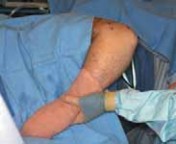
Excision of Heterotopic Ossification of the Elbow: A Masterclass in Surgical Management
Key Takeaway
Heterotopic ossification (HO) of the elbow severely restricts range of motion and function. Surgical excision aims to restore joint kinematics through meticulous subperiosteal resection while protecting critical neurovascular structures, particularly the ulnar and radial nerves. This comprehensive guide details the posterolateral, medial, and anterior surgical approaches, highlighting indications, biomechanical considerations, step-by-step techniques, and evidence-based postoperative prophylaxis protocols essential for preventing recurrence and optimizing clinical outcomes.
INTRODUCTION TO HETEROTOPIC OSSIFICATION OF THE ELBOW
Heterotopic ossification (HO) is the aberrant formation of mature, lamellar bone within non-osseous soft tissues. The elbow joint is uniquely susceptible to this pathology, often resulting in profound stiffness, mechanical blocks to motion, and significant impairment of activities of daily living (ADLs). The functional arc of elbow motion (30° to 130° of flexion, with 50° of pronation and 50° of supination) is easily compromised by even small volumes of ectopic bone.
Surgical excision of heterotopic ossification remains the gold standard for restoring elbow kinematics when conservative measures fail. The procedure demands a meticulous understanding of elbow anatomy, precise neurovascular management, and strict adherence to postoperative prophylactic protocols to prevent recurrence. The techniques pioneered by Morrey and Harter form the foundational basis for modern operative intervention.
CLINICAL PEARL:
The timing of surgical intervention has evolved. Historically, surgeons waited 12 to 18 months for the ectopic bone to "mature," guided by normalization of serum alkaline phosphatase and decreasing activity on bone scintigraphy. Contemporary evidence supports earlier excision (typically 4 to 6 months post-injury) once the patient's range of motion has plateaued and the radiographic margins of the ossification appear sharply defined on computed tomography (CT).
PATHOANATOMY AND CLASSIFICATION
The anatomical location of heterotopic ossification is highly correlated with the underlying pathological process. Understanding these patterns is critical for preoperative planning and selecting the appropriate surgical approach.
Traumatic Heterotopic Ossification
Trauma is the most common etiology, frequently following elbow dislocations, distal humerus fractures, or terrible triad injuries.
* Posterolateral Predominance: The most frequent site is the posterolateral elbow. A bony bridge often forms between the lateral humeral condyle and the posterolateral olecranon.
* Olecranon Fossa Involvement: Ectopic bone frequently fills the olecranon fossa, creating a hard mechanical block to terminal extension.
* Anterolateral Compartment: The second most common location. Bone may extend from the distal humerus to the radius and ulna at the level of the bicipital tuberosity, severely restricting forearm rotation.
* Coronoid Hypertrophy: The coronoid process is frequently enlarged or engulfed in ectopic bone, creating a mechanical block to elbow flexion.
Burn-Related Heterotopic Ossification
Thermal injuries induce a profound systemic inflammatory response, leading to distinct patterns of ectopic bone formation.
* Posteromedial Predominance: Burn-related HO most frequently localizes to the posteromedial aspect of the elbow.
* Cubital Tunnel Obliteration: The architecture of the cubital tunnel is often completely obliterated.
* Ulnar Nerve Encasement: The ulnar nerve may be entirely encased in mature cortical bone, necessitating highly specialized neurolysis techniques.
Neurogenic Heterotopic Ossification
Associated with traumatic brain injury (TBI) or spinal cord injury (SCI), neurogenic HO presents unique surgical challenges.
* Muscular Involvement: Ossification tends to occur directly within the muscle bellies rather than in the periarticular capsule.
* Location: Most commonly found anteriorly within the flexor muscles (brachialis) or posteriorly within the extensor mechanism (triceps).
* Planar Growth: The ectopic bone typically follows a single anatomical plane.
* Radioulnar Involvement: The proximal radioulnar joint and interosseous membrane may be involved, leading to complete radioulnar synostosis.
PREOPERATIVE PLANNING AND IMAGING
Thorough preoperative evaluation is mandatory. Standard orthogonal radiographs (anteroposterior and lateral) provide a baseline assessment, but a high-resolution Computed Tomography (CT) scan with 3D reconstructions is the definitive imaging modality.
CT imaging allows the surgeon to:
1. Map the exact location and volume of the ectopic bone.
2. Identify the relationship of the HO to the articular surface.
3. Assess the patency of the olecranon and coronoid fossae.
4. Anticipate areas of neurovascular encasement (e.g., a bony tunnel surrounding the ulnar nerve).
SURGICAL TECHNIQUE: EXCISION OF HETEROTOPIC OSSIFICATION
The surgical approach (posterolateral, medial, or anterior) is dictated by the location of the heterotopic bone. A universal posterior skin incision is highly recommended, as it allows access to all compartments of the elbow through the elevation of full-thickness fasciocutaneous flaps.
SURGICAL WARNING:
The use of a sterile tourniquet is essential for maintaining a bloodless field during intricate neurolysis. However, the tourniquet must be deflated prior to closure to ensure absolute hemostasis, as postoperative hematoma is a primary catalyst for recurrent heterotopic ossification.
1. Posterolateral Excision
The posterolateral approach is the workhorse for traumatic HO, specifically targeting the bony bridge between the lateral condyle and the olecranon.
- Incision and Dissection: Utilize a midline posterior skin incision. Develop full-thickness subcutaneous flaps laterally. Extreme care must be taken to identify and protect the ulnar nerve medially, even if the primary pathology is lateral.
- Triceps Management: Retract the triceps mechanism medially. It is crucial to perform this without disturbing the triceps insertion on the olecranon.
- Subperiosteal Exposure: Expose the ectopic bone using a strict subperiosteal technique. This minimizes bleeding and prevents violation of adjacent healthy muscle tissue, which could trigger recurrence.
- Resection of the Bony Bridge: Use an osteotome or a high-speed burr to resect the central portion of the posterolateral bony bridge.
- Dynamic Clearance: Once the bridge is broken, flex and extend the elbow dynamically. Remove the remaining attachments of the ectopic bone to the humerus and the olecranon.
- Olecranon Fossa Decompression: Meticulously excise any ectopic bone within the olecranon fossa. A clear fossa is mandatory to reduce olecranon impingement and restore terminal extension.
- Capsular Management: Unlike standard contracture releases, an anterior capsular release is generally not necessary if the primary pathology is purely extra-articular heterotopic ossification.
2. Medial Excision
Medial excision is frequently required in burn-related HO or severe traumatic cases where the ossification extends medially. The critical step in this approach is the management of the ulnar nerve.
- Ulnar Nerve Identification: The ulnar nerve must be identified proximally in the posterior compartment of the arm, well above the zone of ossification.
- Neurolysis and Encasement: Trace the nerve distally. In severe cases, the nerve may be completely surrounded by a tunnel of ectopic bone. Use a high-speed diamond burr to unroof the bony tunnel. Never use osteotomes near an encased nerve due to the risk of concussive neuropraxia or transection.
- Triceps Expansion: Expose the medial triceps expansion and incise it distal to its insertion to gain access to the posteromedial gutter.
- Subperiosteal Resection: Expose the medial ectopic bone subperiosteally and resect it en bloc or piecemeal, depending on its size and proximity to the joint line.
- Ulnar Nerve Transposition: If the posterior ectopic bone extends significantly to the medial aspect of the elbow, or if the bone interferes with ulnar nerve function, an ulnar nerve transposition is absolutely necessary. Transfer the nerve anteriorly (subcutaneous or submuscular, depending on soft tissue quality) to prevent postoperative tethering or neuritis.
3. Anterior Excision
Anterior excision is indicated for neurogenic HO within the brachialis or traumatic HO blocking the coronoid fossa. This approach carries a high risk to the radial nerve and the brachial artery/median nerve bundle.
- Lateral Supracondylar Exposure: Elevate the origins of the brachioradialis and the extensor carpi radialis longus (ECRL) from the lateral supracondylar ridge.
- Radial Nerve Protection: Identify the radial nerve in the interval between the brachialis and the brachioradialis. The nerve must be isolated, protected with a vessel loop, and gently retracted laterally.
- Brachialis Elevation: Elevate the brachialis muscle off the anterior capsule to expose the anterior heterotopic bone.
- Resection: Resect the bone subperiosteally. Pay special attention to clearing the coronoid fossa to restore full elbow flexion. Ensure the anterior branch of the medial collateral ligament (AMCL) is protected during deep medial dissection.
CLOSURE AND HEMOSTASIS
Meticulous closure is as critical as the resection itself. Poor hemostasis leads to hematoma formation, which provides a scaffold for recurrent ossification.
- Tourniquet Deflation: Deflate the tourniquet prior to closure.
- Hemostasis: Obtain absolute hemostasis using electrocautery. Bone wax may be used sparingly on raw cancellous bone surfaces, though some surgeons prefer prophylactic agents like bone wax mixed with local anesthetics or hemostatic matrix.
- Drain Placement: Place a deep suction drain to evacuate postoperative hematoma.
- Capsular Management: Do not close the capsule. Leaving the capsule open allows for immediate postoperative range of motion and prevents secondary capsular contracture.
- Layered Closure: Perform a routine layered closure of the fascia and skin.
- Dressing: Apply a bulky, soft, compressive dressing that supports the wound but allows for immediate postoperative range of motion. Avoid rigid casting.
PITFALL:
Closing the joint capsule after extensive HO excision is a common error that severely limits the efficacy of postoperative continuous passive motion (CPM) and leads to recurrent stiffness.
POSTOPERATIVE CARE AND PROPHYLAXIS
The excision of heterotopic ossification is only the first half of the treatment. Without aggressive postoperative prophylaxis and rehabilitation, recurrence rates are unacceptably high.
1. Prophylactic Modalities
To prevent the differentiation of mesenchymal stem cells into osteoblasts, a dual-modality approach is often employed, particularly in high-risk patients.
- Radiation Therapy: If the heterotopic ossification involves muscle fibers (especially in neurogenic or severe traumatic cases), the surgical field is treated with low-dose radiation. A single fraction of 700 cGy (Centigray) is administered, ideally within 24 to 48 hours postoperatively. Radiation effectively halts the proliferation of rapidly dividing osteoprogenitor cells.
- Pharmacological Prophylaxis: If radiation is contraindicated or unavailable, or as an adjunct in lower-risk cases, Non-Steroidal Anti-Inflammatory Drugs (NSAIDs) are utilized. Indomethacin 75 mg daily (often given as 25 mg TID or 75 mg sustained release) is prescribed for 3 to 6 weeks after surgery. Indomethacin inhibits prostaglandin synthesis, which is a necessary step in ectopic bone formation.
2. Rehabilitation Protocol
Early, aggressive mobilization is the cornerstone of postoperative success.
- Continuous Passive Motion (CPM): Motion is regained with the immediate use of a CPM machine, typically initiated in the recovery room or on postoperative day one. The patient should spend a significant portion of the day in the CPM machine to maintain the intraoperative arc of motion.
- Progressive Splinting: Static progressive splinting or dynamic splinting is utilized during periods of rest. Patients often alternate between flexion and extension splints at night to prevent soft tissue contracture.
- Active-Assisted Range of Motion (AAROM): Physical therapy focusing on AAROM and active range of motion (AROM) begins immediately. Strengthening is delayed until the soft tissues have adequately healed (typically 6 weeks).
3. Management of Refractory Stiffness
Despite optimal surgical technique and prophylaxis, some patients may struggle to maintain their motion goals.
* Manipulation Under Anesthesia (MUA): If the patient fails to progress or loses significant motion, a gentle manipulation under anesthesia can be performed at approximately 6 weeks after surgery. This must be done with extreme caution to avoid fracturing the osteopenic bone or rupturing the newly healed soft tissues.
CONCLUSION
The excision of heterotopic ossification of the elbow is a complex, high-stakes procedure that requires a deep understanding of three-dimensional elbow anatomy and neurovascular relationships. By adhering to strict subperiosteal dissection planes, ensuring complete decompression of the ulnar and radial nerves, and implementing rigorous postoperative radiation or pharmacological prophylaxis, the orthopaedic surgeon can successfully restore functional motion and significantly improve the patient's quality of life.
You Might Also Like