
العربية
Comprehensive Master Guide · Medically Reviewed

Revision THA Acetabulum: Overcoming Paprosky IIIA & Metallosis

Master the challenges of revision THA with expert strategies for overcoming severe Paprosky IIIA acetabular defects and metallosis-induced osteolysis.

15 Detailed Chapters
25 min read
Updated: Jun 2026
Dr. Mohammed Hutaif Clinic
Medically Reviewed by
Prof. Dr. Mohammed Hutaif Clinic
Verified Content Expert Reviewed

Quick Medical Answer

We review everything you need to understand about Revision THA Acetabulum: Overcoming Paprosky IIIA & Metallosis. Revision THA acetabulum, specifically for Paprosky Type IIIA defects, addresses severe periacetabular osteolysis, metallosis, and ARMD following a failed primary total hip arthroplasty. This complex procedure involves solid reconstruction using trabecular metal augments, a revision shell, and bone graft to restore acetabular integrity and relieve symptoms like pain and inability to walk due to component loosening.

Illustration of revision tha acetabulum - Dr. Mohammed Hutaif
🎓

FRCS Masterclass: Clinical Viva

Interactive Examiner Scenario • Test your knowledge before revealing the answers.

👨‍⚕️ Examiner Scenario

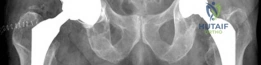
You are presented with a 65-year-old patient who underwent a primary THA 8 years ago. They now present with progressive groin pain and an audible 'squeaking' from the hip. Radiographs show significant supero-medial migration of the acetabular component. How would you classify this defect, and what are your primary differential diagnoses?

Clinical Image
Pre-operative Radiograph

Candidate: I would classify this as a Paprosky IIIA acetabular defect because of the superior bone loss and migration. My main differential is aseptic loosening, but given the 'squeaking' and migration, I am highly concerned about metallosis or Adverse Local Tissue Reaction (ALTR) if it was a metal-on-metal implant, or polyethylene wear leading to osteolysis.

❌ Common Pitfall (Poor Answer)

Candidates often focus solely on the 'defect' and forget to mention systemic concerns or the biological status of the tissues. Failing to mention the 'squeaking' as a specific clinical red flag for bearing surface issues (like ceramic-on-ceramic or taper corrosion) shows a lack of clinical synthesis.

⭐ The Gold Standard (Perfect Answer)

The candidate must define the defect (Paprosky IIIA: superior rim/cavitary loss with preserved but compromised columns). They must bridge the clinical symptom (squeaking) to the diagnosis (bearing surface failure/metallosis). They should immediately propose a structured investigation: "I would assess the bearing surface history, order serum cobalt/chromium levels, and proceed to MARS-MRI to quantify the pseudotumor and evaluate soft tissue integrity before surgical planning."

👨‍⚕️ Examiner Scenario

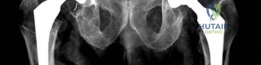
You have decided to proceed to revision. Intraoperatively, after removing the failed cup, you find a massive cavitary defect and significant synovitis. How do you approach the reconstruction, and what are the specific considerations for the bone loss vs. the inflammatory response?
Clinical Image
Imaging of defect

Candidate: I need a dual approach. For the metallosis, I must perform a total synovectomy and excise all pseudotumorous tissue to minimize the risk of recurrence and chronic inflammation. For the Paprosky IIIA bone loss, I will use a structural augment or a cage, likely with porous tantalum or titanium, to restore the center of rotation and obtain biological fixation where possible.

❌ Common Pitfall (Poor Answer)

Candidates often forget to mention taking intraoperative samples for both histopathology and microbiology. In revision cases, especially with pseudotumors, the distinction between metallosis and indolent infection is often blurred; assuming it is just "metal debris" without ruling out infection is a major error.

⭐ The Gold Standard (Perfect Answer)

A perfect response structure: 1. Biological Control: Extensive debridement of all metal-stained tissue and synovium + multiple tissue samples for culture/path. 2. Mechanical Reconstruction: Assessment of pelvic column integrity. For IIIA, utilize porous augments for cavitary filling and a revision cup. If column integrity is compromised, switch to an anti-protrusio cage. 3. Goal: Restoration of the anatomical center of rotation to optimize abductor mechanics.

👨‍⚕️ Examiner Scenario

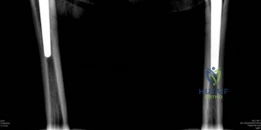
Look at this post-operative radiograph. The patient is now 6 weeks out. What specific rehabilitation precautions are you emphasizing for this construct?
Clinical Image
Post-operative Reconstruction

Candidate: I would keep the patient on protected weight-bearing, likely toe-touch or partial, for at least 6 to 12 weeks to allow for graft incorporation and bone ingrowth into the porous augments. I would also reinforce standard dislocation precautions due to the extensive soft tissue handling required during debridement.

❌ Common Pitfall (Poor Answer)

Failing to connect the "rehabilitation" to the "surgical technique." If the candidate used extensive structural bone grafting, ignoring the need for delayed weight-bearing leads to graft collapse and early implant failure.

⭐ The Gold Standard (Perfect Answer)

A comprehensive answer: "The rehabilitation is dictated by the fixation achieved: 1. Weight-bearing: Restricted (TTWB/PWB) to protect structural graft/augments. 2. Range of Motion: Strict hip precautions (no flexion >90°, no adduction, no internal rotation) to account for the compromised soft tissue envelope and the high risk of instability post-revision. 3. Monitoring: Serial radiographs to track graft incorporation and component stability before progressing to full weight-bearing."

Detailed Chapters & Topics

Dive deeper into specialized chapters regarding revision-hip-arthroplasty-case-title-revision-tha-acetabulum-paprosky-type-iiia-armd-with-metallosis-with-severe-periacetabular-osteolysis-and-co-cr-levels-7-μgl

15 Chapters
01
Chapter 1 14 min

Revision Total Hip Arthroplasty with Antiprotrusio Cage: An Intraoperative Masterclass for Acetabular Bone Loss

Explore our intraoperative masterclass on Revision Total Hip Arthroplasty. Learn to manage severe acetabular bone loss …

02
Chapter 2 14 min

Deciding to Remove Hip Arthroplasty with Well-Fixed Components

DEFINITION Well-fixed femoral and acetabular implants often have to be removed during revision total hip arthroplasty (…

03
Chapter 3 12 min

Antiprotrusio Cages: Key to Hip Arthroplasty with Acetabular Loss

Discover how antiprotrusio cages manage severe acetabular bone deficiency in revision hip arthroplasty, ensuring implan…

04
Chapter 4 14 min

Advanced Diagnosis & Surgical Planning for Periprosthetic Hip Fractures

Master diagnosis and surgical planning for periprosthetic hip fractures. Review epidemiology, the Vancouver Classificat…

05
Chapter 5 17 min

Revision Hip Success: Unpacking The Case Title Acetabular Grafting

Case Title: Acetabular Impaction Grafting Demographics Age: 78 Sex: female BMI: 28 Relevant Past Medical History Princi…

06
Chapter 6 20 min

Primary Total Hip Arthroplasty: A Detailed Clinical Case Study of Severe OA

Read our in-depth clinical case study of a 68-year-old male patient undergoing a primary total hip arthroplasty to trea…

07
Chapter 7 27 min

Acetabular Augment: Rebuilding Bone in Complex Revision

Case Title: Acetabular Augment for Acetabular Bone Deficiency Demographics Age: 80 years Sex: Female BMI: 27 Relevant P…

08
Chapter 8 14 min

Acetabular Revision: Solving Challenges Post Two-Stage Arthroplasty

Demographics Age: 71 years Sex: Male BMI: 26.2 Relevant Past Medical History Principal pathologies: Non-insulin-depende…

09
Chapter 9 27 min

Revision THA: Acetabular Impaction Grafting for Severe Bone Loss

Master acetabular impaction grafting for severe bone loss in revision THA. Explore biological reconstruction techniques…

10
Chapter 10 11 min

Revision THA: Unlocking Stability with Porous Tantalum Cups

Case Title: The Use of Acetabular Augments for Revision Total Hip Arthroplasty Demographics Age: 71 years old Sex: Male…

11
Chapter 11 12 min

Tackling Paprosky Type IIIA: Acetabular Augment in Revision Hip

Case Title: Acetabular Augment for a Paprosky Type IIIA Acetabular Defect Demographics Age: 67 years Sex: Male BMI: 23.…

12
Chapter 12 14 min

Solving Severe Acetabular Bone Loss with Cup-Cage Reconstruction

Demographics Age: 57 Sex: Female BMI: 28.7 Relevant Past Medical History Principal pathologies: Hypertension Previous s…

13
Chapter 13 17 min

Acetabular Revision Cupcage: A Challenging Case Solved

Demographics Age: 73 Sex: Female BMI: 23 Relevant Past Medical History Previous surgical procedures: Left hip—shelf art…

14
Chapter 14 16 min

Total Hip Arthroplasty: Preparation, Approaches, and Surgical Techniques

Master Total Hip Arthroplasty (THA) with this expert guide on preoperative planning, radiographic assessment, and step-…

15
Chapter 15 18 min

Surgical Management of Specific Hip Disorders in Total Hip Arthroplasty

Explore surgical techniques for managing osteoarthritis and specific hip disorders in THA. Learn to optimize joint kine…

Dr. Mohammed Hutaif Clinic
Medically Verified Content by
Prof. Dr. Mohammed Hutaif Clinic
Consultant Orthopedic & Spine Surgeon
Guide Overview