
العربية
Comprehensive Master Guide · Medically Reviewed

Complex Revision Total Knee Arthroplasty: Addressing Instability, Loosening & Wear

Master complex revision total knee arthroplasty (rTKA). Learn to address mechanical instability, aseptic loosening, and wear through real clinical cases.

15 Detailed Chapters
15 min read
Updated: Jun 2026
Dr. Mohammed Hutaif Clinic
Medically Reviewed by
Prof. Dr. Mohammed Hutaif Clinic
Verified Content Expert Reviewed

Quick Medical Answer

A painful and failing total knee arthroplasty often stems from multiple issues. Common causes include aseptic loosening of components, significant polyethylene wear leading to osteolysis, and global ligamentous instability. Other factors like malalignment, patellofemoral issues, and component subsidence also contribute, necessitating complex revision surgery.

Illustration of painful total knee - Dr. Mohammed Hutaif
🎓

FRCS Masterclass: Clinical Viva

Interactive Examiner Scenario • Test your knowledge before revealing the answers.

👨‍⚕️ Examiner Scenario

We have a 58-year-old male 4 years post-primary TKA presenting with chronic pain and instability. Looking at this patient's initial presentation, how would you systematically evaluate his knee to determine the cause of his failure, and what are the specific clinical signs you are looking for in the physical exam?
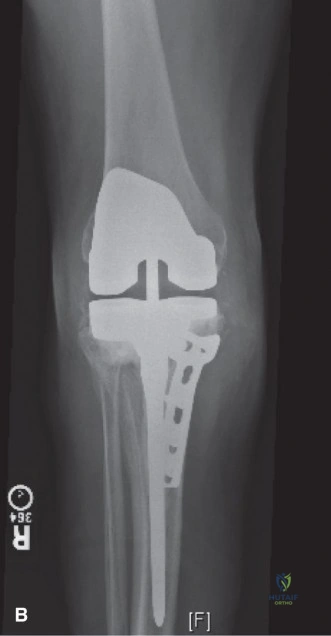
Clinical Image
Pre-operative Radiographic evaluation

Candidate: I would start by ruling out infection with serum markers (ESR/CRP). Clinically, I would assess the scar, range of motion, and stability. I am looking for signs of aseptic loosening such as pain on weight-bearing and mechanical symptoms like clunking. I would perform varus/valgus stress tests to assess ligamentous laxity and check for an extensor mechanism deficit.

❌ Common Pitfall (Poor Answer)

The candidate fails to provide a structured approach. They often jump to "revision surgery" without discussing the "unexplained pain" caveat. They also miss the importance of characterizing the instability (e.g., flexion vs. extension vs. global) and fail to mention that every painful TKA is infected until proven otherwise.

⭐ The Gold Standard (Perfect Answer)

Structure the response: 1. Infection exclusion: Mandatory ESR/CRP, if abnormal, proceed to joint aspiration for cell count, differential, and cultures (ICM criteria). 2. Mechanical evaluation: Differentiate instability types (extension, flexion, mid-flexion, global) and assess for aseptic loosening (radiographic lucencies, component subsidence). 3. Exam focus: Document ROM (assess for extension contracture), patellofemoral tracking, and perform stress testing in both full extension and 30 degrees of flexion to evaluate MCL/LCL integrity. Acknowledge that revision for "unexplained pain" is a contraindication.

👨‍⚕️ Examiner Scenario

Suppose you have determined the patient has significant medial collateral ligament (MCL) attenuation and bone loss consistent with AORI Type 2B. You are in the OR; how do you manage the exposure, and what is your decision-making process regarding the constraint ladder?

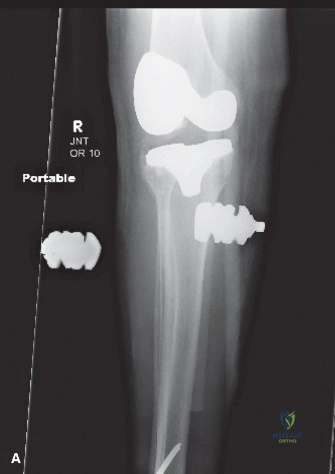
Clinical Image
Intraoperative Planning and Bone Loss Assessment

Candidate: I would start with a medial parapatellar arthrotomy. If that’s tight, I’d perform a quadriceps snip or a tibial tubercle osteotomy for better exposure. Regarding the constraint, I would use a Constrained Condylar Knee (CCK) since the MCL is compromised. I would use augments to manage the AORI 2B bone loss.

❌ Common Pitfall (Poor Answer)

Candidates often forget to mention joint line restoration. Simply "using augments" is insufficient; the examiner wants to know that distal femoral augments are used to prevent joint line elevation, which causes patella baja and mid-flexion instability.

⭐ The Gold Standard (Perfect Answer)

Structure the answer: 1. Exposure: Adhere to the 'least invasive' principle—start with a medial parapatellar approach, then progress to quadriceps snip, and finally a TTO if necessary for exposure. 2. Joint Line: Emphasize restoring the joint line to 25-30mm distal to the medial epicondyle using distal femoral augments. 3. Constraint: Utilize the 'Constraint Ladder'. Since the MCL is incompetent, move to a CCK. Only escalate to a Rotating Hinge if the epicondylar attachments are deficient or global instability persists. 4. Fixation: Use diaphyseal engaging stems for alignment/offloading and metaphyseal cones/sleeves for AORI 2B bone defects to provide immediate rigid fixation.

Detailed Chapters & Topics

Dive deeper into specialized chapters regarding painful-total-knee-replacement

15 Chapters
01
Chapter 1 14 min

Revision Total Knee Arthroplasty for Stiffness: An Intraoperative Masterclass

Master the complex revision total knee arthroplasty for stiffness. Learn surgical techniques to restore function, navig…

02
Chapter 2 16 min

Extensile Exposure in Revision TKA: Mastering the Tibial Tubercle Osteotomy

Master the Tibial Tubercle Osteotomy for extensile exposure in revision TKA. Learn key surgical anatomy to safely prote…

03
Chapter 3 17 min

Revision Total Knee Arthroplasty: Mastering Tibial Bone Loss with Metal Augments

Master Revision TKA and manage proximal tibial bone loss effectively. Learn to apply the AORI classification and metall…

04
Chapter 4 14 min

Mastering Revision Total Knee Arthroplasty: Tibial Bone Loss & Advanced Grafting Techniques

Master the complexities of revision total knee arthroplasty. Learn expert techniques for managing significant tibial bo…

05
Chapter 5 16 min

Revision Total Knee Arthroplasty with Extensor Mechanism Reconstruction: An Achilles Allograft Masterclass

Master revision total knee arthroplasty in this expert guide. Learn to reconstruct a ruptured patellar tendon using an …

06
Chapter 6 17 min

Regain Mobility: Surgical Techniques for Posttraumatic Knee Stiffness

Posttraumatic knee stiffness: Surgical techniques Pathological mechanisms and therapeutic outlooks for arthrofibrosis P…

07
Chapter 7 4 min

Revision Knee Replacement: Master Challenges with Expert Q&A

KNEE Structured oral examination question7: Revision knee replacement EXAMINER : Have a look at these images and tell m…

08
Chapter 8 17 min

Proximal Tibial Bone Loss: Augment Solutions for TKA Revision

Discover effective solutions for proximal tibial bone loss in TKA revision. Learn about the AORI classification system …

09
Chapter 9 13 min

Revision TKA: Safely Removing Well-Fixed Components by Targeting the Interface

Revision Total Knee Arthroplasty With Removal of Well-fixed Components DEFINITION Estimates indicate that by the year 2…

10
Chapter 10 12 min

Revision Arthroplasty with Tibial Bone Loss: Bone Grafting Solutions

Revision Total Knee Arthroplasty With Tibial Bone Loss: Bone Grafting DEFINITION Substantial bone loss and bone defects…

11
Chapter 11 16 min

Revision TKA: Correct Stiffness and Restore Full Knee Motion

Revision Total Knee Arthroplasty to Correct Stiffness DEFINITION At less than 90 degrees of active knee flexion, a tota…

12
Chapter 12 39 min

Revision TKA: Master Challenging Exposure with V-Y Quadroplasty

Revision Total Knee Arthroplasty With Extensile Exposure: V-Y Quadroplasty Ali Oliashirazi DEFINITION Gaining exposure …

13
Chapter 13 22 min

Diagnosing Painful Total Knee Replacement: A Comprehensive Guide to PJI & Aseptic Loosening

Experiencing persistent pain after a total knee replacement? Learn to accurately diagnose and differentiate between PJI…

14
Chapter 14 16 min

Periprosthetic Joint Infection in Total Knee Arthroplasty: Epidemiology, Risk Factors, and Foundational Principles

Master the principles of periprosthetic joint infection in total knee arthroplasty. Discover epidemiology, biofilm risk…

15
Chapter 15 17 min

Mastering Distal Femoral Replacement in Revision TKA: An Intraoperative Guide

Explore our intraoperative guide to mastering revision TKA. Learn how to manage distal femoral bone loss, safely extrac…

Dr. Mohammed Hutaif Clinic
Medically Verified Content by
Prof. Dr. Mohammed Hutaif Clinic
Consultant Orthopedic & Spine Surgeon
Guide Overview