Axial Plane Deformity of the Metatarsophalangeal Joint: A Comprehensive Surgical Guide
Key Takeaway
Axial plane deformities of the metatarsophalangeal joint, such as crossover toe or valgus deviation, present complex reconstructive challenges. Often associated with hallux valgus, these pathologies require meticulous soft tissue balancing and potential osseous correction. This guide details the biomechanics, indications, and step-by-step surgical techniques—including collateral ligament release, extensor digitorum brevis transfer, and metatarsal shortening osteotomies—to restore forefoot stability and alignment.
Introduction to Axial Plane Deformities of the Forefoot
Axial plane deformities of the lesser metatarsophalangeal (MTP) joints represent some of the most challenging and nuanced pathologies encountered in forefoot reconstructive surgery. Manifesting primarily as medially or laterally deviated toes, these deformities are frequently progressive, leading to significant pain, footwear intolerance, and altered gait mechanics.
Medial deviation is most classically observed in the "crossover toe" deformity, a condition that may occur in isolation but is overwhelmingly associated with concomitant hallux valgus. While the second MTP joint is the most frequently afflicted, the pathology can cascade to involve multiple lesser toes. Conversely, valgus deviation of the second toe (and subsequent lesser toes) also demonstrates a high correlation with hallux valgus.
Clinical Pearl: In the surgical management of hallux valgus, meticulous attention to adjacent lesser toe deformities is absolutely critical. Failure to recognize and correct an axial plane deformity of the second MTP joint leaves a void into which the hallux can drift, serving as a primary catalyst for hallux valgus recurrence.
The surgical management of these deformities demands a profound understanding of forefoot biomechanics, a systematic approach to soft tissue balancing, and the judicious application of osseous procedures.
Pathoanatomy and Biomechanics
The stability of the lesser MTP joints relies on a delicate interplay between static and dynamic restraints. The primary static stabilizers include the plantar plate, the proper collateral ligaments (PCL), the accessory collateral ligaments (ACL), and the deep transverse metatarsal ligament (DTML). Dynamic stability is conferred by the extrinsic flexor and extensor tendons, alongside the intrinsic musculature (lumbricals and interossei).
Axial plane deformities typically arise from an asymmetric attenuation or rupture of the collateral ligament complex, often preceded or accompanied by plantar plate insufficiency.
* Varus (Medial) Deviation: Typically results from attenuation or rupture of the lateral collateral ligament (LCL) complex, with subsequent contracture of the medial collateral ligament (MCL) and medial intrinsic musculature.
* Valgus (Lateral) Deviation: Arises from medial collateral ligament attenuation and lateral soft tissue contracture.
As the deformity progresses, the extrinsic tendons (extensor digitorum longus and flexor digitorum longus) shift from their central anatomic axes. Once subluxated medially or laterally, these tendons act as deforming forces, exacerbating the axial deviation and creating a vicious cycle of progressive subluxation.
Clinical Evaluation and Preoperative Planning
History and Physical Examination
Patients typically present with localized pain at the affected MTP joint, often describing a sensation of "walking on a marble" if plantar plate pathology is present. Clinical examination must assess:
1. Alignment: Evaluate the toe in both weight-bearing and non-weight-bearing states.
2. Instability: The dorsal-plantar drawer test (Lachman test of the MTP joint) is essential to grade plantar plate and collateral ligament competency.
3. Flexibility: Determine if the axial deviation is flexible, semi-rigid, or rigid. This directly dictates the surgical algorithm.
4. Associated Deformities: Rigorously evaluate for hallux valgus, metatarsus adductus, and gastrocnemius equinus.
Radiographic Assessment
Standard weight-bearing anteroposterior (AP), lateral, and oblique radiographs of the foot are mandatory.
* AP View: Assess the degree of medial/lateral subluxation, the presence of hallux valgus, and the metatarsal cascade (metatarsal parabola). A long second metatarsal is a known predisposing factor for MTP joint instability.
* Lateral View: Evaluate for dorsal subluxation or dislocation of the proximal phalanx base relative to the metatarsal head.
Surgical Indications and Decision-Making Algorithm
Surgical intervention is indicated for patients who have failed conservative measures (e.g., taping, orthotics, wide-toe box shoes) and continue to experience pain and functional limitation.
The surgical approach is dictated by the severity and flexibility of the deformity:
* Mild, Flexible Deformities: Can often be managed with isolated soft tissue procedures (collateral ligament release and imbrication).
* Moderate Deformities (Varus): May require dynamic stabilization, such as the Extensor Digitorum Brevis (EDB) tendon transfer.
* Severe, Rigid Deformities or Subluxated/Dislocated Joints: Necessitate osseous intervention, typically a metatarsal shortening osteotomy, combined with soft tissue balancing.
Surgical Warning: A shortening metatarsal osteotomy fundamentally alters the tension of the local soft tissue envelope. If a shortening osteotomy is performed, it will prevent the effective use of an EDB tendon transfer, as the required tension for the transfer will be lost. The surgeon must choose one primary modality of correction based on the joint's reducibility.
Surgical Techniques: Step-by-Step
1. Patient Positioning and Anesthesia
- Anesthesia: General or regional anesthesia (popliteal block) combined with a local ankle block.
- Positioning: The patient is placed supine on the operating table. A bump is placed under the ipsilateral hip to internally rotate the leg to a neutral position, ensuring the foot points directly upward.
- Tourniquet: A calf or thigh tourniquet is applied and inflated after exsanguination to provide a bloodless surgical field.
2. Surgical Approach
- A dorsal longitudinal incision is made centered over the affected MTP joint, extending from the distal third of the metatarsal to the mid-proximal phalanx.
- Careful blunt dissection is utilized to protect the dorsal cutaneous nerves and superficial venous plexus.
- The extensor hood is identified, and a longitudinal arthrotomy is performed. For a varus deformity, a lateral arthrotomy is preferred; for a valgus deformity, a medial arthrotomy is utilized.
3. Soft Tissue Balancing: Release and Imbrication
In the mildest cases of either varus or valgus deformity, addressing the collateral ligaments may be sufficient.
* Release: The contracted collateral ligament (medial for varus, lateral for valgus) is sharply released from its metatarsal origin. The release must be thorough, often requiring fractional lengthening of the corresponding intrinsic tendon (e.g., medial lumbrical for varus deformity).
* Imbrication: The attenuated collateral ligament on the opposite side is plicated. This is achieved by excising a small elliptical wedge of the redundant capsule and ligament, followed by repair using non-absorbable 2-0 or 3-0 sutures in a pants-over-vest fashion to restore tension and realign the proximal phalanx.
4. Extensor Digitorum Brevis (EDB) Tendon Transfer
For moderate, flexible varus deformities (crossover toe), the EDB tendon transfer provides an excellent dynamic lateral restraint.
Pitfall: A competent deep transverse metatarsal ligament (DTML) is an absolute prerequisite for this procedure. If the DTML is ruptured, the transferred tendon will lack the necessary fulcrum to correct the deformity.
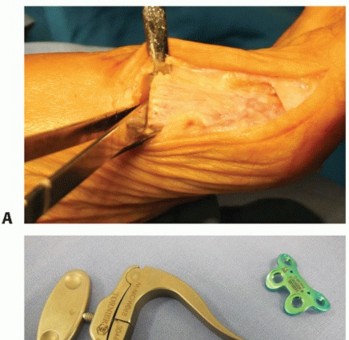
- Harvest: The EDB tendon to the affected toe is identified dorsally. It is traced distally to its insertion on the extensor expansion and transected as distally as possible to maximize length.
- Routing: A curved hemostat is passed from plantar to dorsal, navigating underneath the deep transverse metatarsal ligament on the lateral side of the affected MTP joint.
- Transfer: The free end of the EDB tendon is grasped and pulled proximally and plantarly through this pathway.
- Fixation: The toe is held in neutral alignment (correcting the varus and any dorsal subluxation). The EDB tendon is then tensioned and sutured to the lateral aspect of the proximal phalanx or woven into the lateral collateral ligament complex using non-absorbable sutures.
5. Metatarsal Shortening Osteotomy (Weil Osteotomy)
When the deformity is rigid, the joint is dislocated, or there is significant relative metatarsal overlength, a shortening osteotomy is required to decompress the joint and allow for reduction.
- Technique: An intra-articular osteotomy is performed starting at the dorsal aspect of the metatarsal head, just proximal to the articular cartilage.
- Trajectory: The saw blade is directed proximally and plantarly, strictly parallel to the plantar aspect of the foot (not the metatarsal shaft) to prevent plantar depression of the metatarsal head.
- Translation: The capital fragment is translated proximally by the desired amount (typically 2 to 5 mm) to decompress the joint.
- Fixation: The osteotomy is provisionally held with a K-wire and definitively fixed with one or two small fragment screws (e.g., 2.0 mm or 2.7 mm twist-off screws) directed from dorsal-proximal to plantar-distal.
- Interaction with Soft Tissues: As noted, this shortening decompresses the joint, rendering an EDB transfer ineffective due to loss of resting tendon tension. However, the shortening itself often corrects the axial instability by relaxing the contracted soft tissues.
6. Joint Stabilization and Kirschner Wire Fixation
Regardless of the soft tissue or bony procedures utilized, temporary stabilization of the MTP joint is highly recommended to protect the soft tissue repairs during the initial healing phase.
* A 0.045-inch or 0.062-inch Kirschner wire (K-wire) is driven antegrade through the tip of the toe, across the interphalangeal joints, and into the base of the proximal phalanx.
* The MTP joint is reduced to a neutral sagittal and axial alignment.
* The K-wire is then driven retrograde across the MTP joint and into the metatarsal shaft.
* The pin is bent and cut outside the skin to facilitate removal in the clinic.
Postoperative Care and Rehabilitation Protocol
Meticulous postoperative care is paramount to maintaining the surgical correction and preventing complications such as stiffness or recurrence.
Phase I: Immediate Postoperative (Weeks 0-2)
- Immobilization: The foot is placed in a bulky, compressive soft dressing.
- Weight-Bearing: Weight-bearing as tolerated is allowed strictly in a stiff-soled, multipurpose medical/surgical shoe. Heel weight-bearing is encouraged to offload the forefoot.
- Elevation: The foot must be kept strictly elevated above the level of the heart for the first 72 hours to minimize edema, followed by frequent elevation thereafter.
- Wound Care: The wound is inspected at 7 to 10 days postoperatively. Sutures are typically removed at 14 days if healing is progressing appropriately.
Phase II: Intermediate Healing (Weeks 2-4)
- Pin Care: The K-wire remains in place. The patient is instructed on daily pin site care (e.g., alcohol or betadine drops) to prevent superficial tract infections.
- Footwear: Continued use of the multipurpose medical/surgical shoe.
- Hardware Removal: The Kirschner wire is removed in the outpatient clinic at exactly 4 weeks postoperatively. This is a critical milestone; leaving the pin in longer increases the risk of permanent joint stiffness, while early removal risks loss of correction.
Phase III: Rehabilitation and Mobilization (Weeks 4-6)
- Taping: Once the K-wire is removed, the toe is immediately placed in a plantarflexion and neutral axial alignment taping construct (e.g., buddy taping to the adjacent normal toe). This taping is maintained for an additional 4 to 6 weeks.
- Range of Motion: Active and passive range of motion exercises for the MTP joint are initiated. Plantarflexion stretching is heavily emphasized to prevent dorsal contracture (floating toe).
- Weight-Bearing: The patient transitions from the surgical shoe to a wide-toe box, stiff-soled athletic shoe at the 6-week mark.
Complications and Pitfalls
Despite meticulous surgical technique, complications can arise when managing axial plane deformities of the MTP joint.
- Recurrence of Deformity: The most common complication, often resulting from under-correction of the soft tissues, failure to address a long metatarsal, or failure to correct concomitant hallux valgus.
- MTP Joint Stiffness: Some degree of stiffness is inevitable and should be discussed with the patient preoperatively. Prolonged K-wire fixation (>4 weeks) or failure to initiate aggressive postoperative physical therapy exacerbates this issue.
- Floating Toe Deformity: A common complication following Weil osteotomies, where the toe fails to purchase the ground during the stance phase of gait. This is caused by the intrinsic musculature shifting dorsal to the center of rotation of the metatarsal head. It can be mitigated by ensuring the osteotomy is parallel to the plantar foot and by aggressive postoperative plantarflexion stretching.
- Neurovascular Injury: Damage to the dorsal cutaneous nerves or proper digital nerves can lead to painful neuromas or sensory deficits. Careful blunt dissection and retraction are mandatory.
Conclusion
Axial plane deformities of the metatarsophalangeal joint require a highly analytical approach to forefoot reconstruction. By thoroughly evaluating the static and dynamic stabilizers, addressing concomitant hallux valgus, and executing precise soft tissue balancing—whether through collateral ligament imbrication, EDB transfer, or decompressive osteotomies—the orthopedic surgeon can successfully restore alignment, relieve pain, and return the patient to a high level of function. Strict adherence to postoperative protocols, particularly the timing of K-wire removal and subsequent taping, is the final, indispensable step in achieving a durable, excellent outcome.
You Might Also Like