Management of Electrical Burns in the Upper Extremity: A Comprehensive Surgical Guide
Key Takeaway
Electrical burns of the upper extremity present complex reconstructive challenges, often threatening limb viability. Tissue damage results from thermal, electrical, and metabolic factors, with deep muscle necrosis frequently disproportionate to cutaneous injury. Successful management requires a high index of suspicion for compartment syndrome, meticulous serial débridement, and strategic soft tissue coverage. This guide details the pathophysiology, diagnostic modalities, and step-by-step surgical protocols essential for optimizing functional outcomes in these devastating injuries.
INTRODUCTION TO UPPER EXTREMITY ELECTRICAL BURNS
Electrical burns represent one of the most devastating and complex trauma presentations encountered by the orthopedic and reconstructive surgeon. These injuries frequently involve the upper extremity, as the hands are the primary points of contact with high-voltage sources in both occupational and domestic settings. The dominant hand is disproportionately affected, leading to profound functional and socioeconomic consequences for the patient.
The severity of these injuries cannot be overstated; historically, up to 50% of severe high-voltage electrical injuries to the upper extremity result in some level of amputation. Unlike isolated thermal burns, electrical injuries produce a unique triad of tissue damage resulting from a combination of thermal, direct electrical, and metabolic cellular factors. The management of these injuries requires a multidisciplinary approach, a deep understanding of the underlying pathophysiology, and meticulous surgical execution.
PATHOPHYSIOLOGY AND BIOMECHANICS OF TISSUE INJURY
The extent of tissue destruction in an electrical burn is dictated by the fundamental principles of electricity and the specific characteristics of the injuring current. The primary determinants of injury severity include the voltage, amperage, the resistance of the involved tissues, the duration of contact with the current, and the individual patient’s physiological susceptibility.
The Physics of Electrical Injury
Tissue damage is primarily mediated by Joule heating, where electrical energy is converted into thermal energy as it passes through tissues with varying resistance.
Clinical Pearl: The resistance of human tissue to electrical current varies significantly. In ascending order of resistance: Nerve < Blood Vessel < Muscle < Skin < Tendon < Fat < Bone. Because bone has the highest resistance, it generates the most heat. Consequently, the deepest muscles immediately adjacent to the bone often suffer the most severe thermal necrosis—a phenomenon known as the "iceberg effect."
Mechanisms of Injury
Electrical injuries to the upper extremity generally manifest through three distinct mechanisms:
- Direct Electrical Injury (True High-Voltage): Current passes directly through the body, causing deep tissue necrosis, vascular thrombosis, and cellular electroporation (disruption of cell membranes leading to metabolic death).
- Thermal Burns (Flash and Flame): These occur when the electrical current ignites the patient's clothing or surrounding environment. Flash and flame burns are primarily thermal injuries and present with the classic appearance of standard thermal burns (erythema, blistering, eschar).
- Arcing Burns: An electrical arc occurs when current jumps from the source to the patient, or between two body parts, taking the path of least resistance. In the upper extremity, arcing burns are classically seen across flexor creases, specifically in the axilla, the antecubital fossa, and the volar distal forearm. The temperatures generated by an electrical arc can exceed 4,000°C, causing instantaneous, catastrophic localized tissue destruction.
Surgical Warning: There is absolutely no correlation between the size of the cutaneous skin injury and the actual extent of deep tissue necrosis. A pinpoint entry wound on the fingertip can mask complete necrosis of the deep flexor compartment of the forearm.
CLINICAL EVALUATION AND DIAGNOSTIC MODALITIES
Systemic Assessment
Patients sustaining high-voltage electrical injuries require immediate evaluation according to Advanced Trauma Life Support (ATLS) protocols. Cardiac arrhythmias are common, necessitating continuous ECG monitoring. Furthermore, massive muscle necrosis leads to rhabdomyolysis. Myoglobinuria is a critical clinical clue indicating the extent of deep muscle injury. Aggressive intravenous fluid resuscitation and alkalinization of the urine are mandatory to prevent acute kidney injury.
Local Extremity Assessment
The clinical assessment of the upper extremity focuses on identifying vascular compromise and compartment syndrome. Muscle injury is assessed clinically using standard methods:
* Palpation: Assessing for woody induration of the compartments.
* Active/Passive Motion: Evaluating for pain out of proportion to the apparent injury during passive stretch of the digits.
* Compartment Pressures: Direct measurement of tissue compartment pressures using a solid-state transducer or slit-catheter technique. A delta pressure (Diastolic Blood Pressure - Compartment Pressure) of less than 30 mmHg is highly indicative of compartment syndrome.
Advanced Diagnostic Imaging
Because extensive deep muscle damage may be entirely undetectable on standard clinical examination, advanced diagnostic modalities are often employed to map the zone of injury:
- Technetium-99m Pyrophosphate Scanning: This radionucleotide binds to calcium in necrotic muscle cells, helping to identify areas of deep myonecrosis.
- Arteriography: Useful for identifying segmental arterial thrombosis or vasospasm, which is common in high-voltage injuries.
- Xenon-133 Washout Technique: Utilized to assess regional muscle blood flow and viability.
- Gadolinium-Enhanced MRI: Currently the gold standard for non-invasive deep tissue assessment. Gadolinium contrast highlights areas of absent perfusion, accurately delineating the extent of deep muscle necrosis and aiding in preoperative planning for débridement.
SURGICAL INDICATIONS AND TIMING CONTROVERSIES
The surgical management of severe electrical injuries of the upper extremity is complex, and the timing of intervention remains a subject of academic debate. Patients with relatively minor, low-voltage electrical injuries without deep tissue involvement may not require surgical treatment beyond local wound care. However, for severe injuries, two primary management philosophies are advocated.
Method 1: Immediate Decompression and Débridement
This traditional approach advocates for immediate escharotomy, fasciotomy, and aggressive débridement of all visibly necrotic tissue upon presentation. This is followed by planned, serial repeat débridements every 24 to 48 hours until the wound bed is entirely viable and suitable for definitive closure (via skin grafts, remote flaps, or free tissue transfer). Decompression of peripheral nerves, notably the median nerve at the carpal tunnel, is a mandatory component of this initial procedure.
Method 2: Delayed Decompression
Because the true extent of tissue necrosis in electrical burns may not be clearly demarcated or detectable for 24 to 48 hours after the initial injury, some centers prefer a delayed approach. In this paradigm, decompression procedures and débridement are delayed to allow the zone of injury to declare itself, unless decreased distal perfusion or increasing compartmental pressures are clearly evident clinically.
Evidence-Based Pitfall: The timing of decompression can significantly impact limb salvage rates. A landmark study by Mann et al. reported an amputation rate of 45% in patients who underwent decompression within 24 hours of injury, compared to a rate of only 10% in patients undergoing delayed decompression and débridement. This suggests that premature surgical intervention in the absence of hard indications (like compartment syndrome) may inadvertently expose marginally viable tissue to desiccation and further injury. However, clinical compartment syndrome remains an absolute indication for emergent release.
OPERATIVE TECHNIQUE: STEP-BY-STEP SURGICAL MANAGEMENT
Management of severe electrical injuries must proceed in a progressive, logical manner: Decompression (when indicated) $\rightarrow$ Serial Débridement $\rightarrow$ Soft Tissue Coverage $\rightarrow$ Rehabilitation $\rightarrow$ Secondary Reconstruction.
1. Patient Positioning and Preparation
- Anesthesia: General anesthesia is preferred. Regional anesthesia is generally avoided in the acute setting as it masks the symptoms of evolving compartment syndrome.
- Positioning: The patient is positioned supine with the affected upper extremity extended on a radiolucent hand table.
- Tourniquet: A sterile tourniquet is applied high on the arm but is not inflated initially. It is reserved for catastrophic bleeding, as inflating the tourniquet exacerbates ischemia in already compromised tissues.
2. Escharotomy and Fasciotomy
When indicated by elevated compartment pressures or vascular compromise, decompression must be thorough and unroof all involved compartments.
- The Arm: Medial and lateral incisions are made to release the anterior (biceps/brachialis) and posterior (triceps) compartments. Care is taken to protect the ulnar nerve at the medial intermuscular septum.
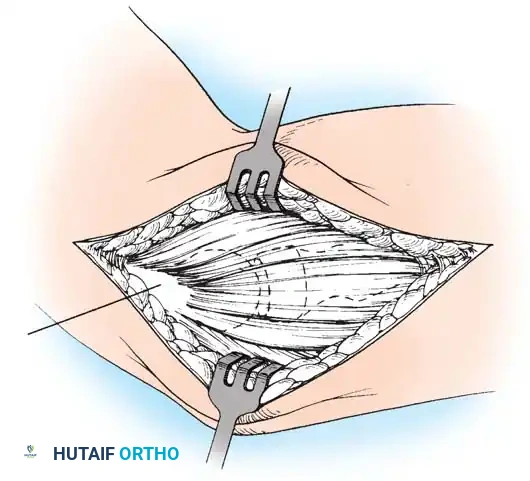
- The Forearm (Volar): An extended volar Henry approach or a standard ulnar-sided approach is utilized. The incision begins proximal to the antecubital fossa (releasing the lacertus fibrosus, a common site of median nerve compression), extends distally over the volar forearm, and crosses the wrist joint obliquely to avoid flexion contractures. The fascia over the superficial and deep flexor compartments must be completely incised.
- The Forearm (Dorsal): A longitudinal incision is made over the dorsal forearm, extending from the lateral epicondyle to the distal radioulnar joint, releasing the mobile wad and the dorsal extensor compartments.
- The Hand: Dorsal longitudinal incisions are made over the second and fourth metacarpals to release the dorsal and volar interossei. Separate incisions are required to release the thenar and hypothenar compartments.
3. Peripheral Nerve Decompression
Electrical current frequently travels along neurovascular bundles. Edema within the tight fibro-osseous canals rapidly leads to ischemic neuropathy.
* Carpal Tunnel Release: The transverse carpal ligament must be completely divided to decompress the median nerve.
* Guyon’s Canal Release: The volar carpal ligament is released to decompress the ulnar nerve at the wrist.
* Cubital Tunnel Release: The ulnar nerve is decompressed at the elbow, particularly if arcing burns are present in the antecubital or medial elbow region.
4. Serial Débridement
Initial débridement should focus on removing unequivocally dead tissue (muscle that is dark, non-contractile, and does not bleed when cut).
Surgical Pearl: "When in doubt, leave it out." Marginally viable muscle should be left in place during the index procedure. The patient must be scheduled for a "second look" débridement in 48 hours. The progressive nature of electrical necrosis means that tissue appearing viable on day 1 may be frankly necrotic by day 3.
SOFT TISSUE COVERAGE AND RECONSTRUCTION
Once the wound bed is completely clean, devoid of necrotic tissue, and shows healthy granulation, definitive coverage is undertaken. The choice of coverage follows the reconstructive elevator:
- Split-Thickness Skin Grafts (STSG): Suitable for large areas of healthy muscle beds. They are contraindicated over exposed bare bone, tendon without paratenon, or exposed nerves.
- Local and Regional Flaps: For smaller defects with exposed vital structures, local rotational flaps or regional pedicled flaps (e.g., radial forearm flap, groin flap) may be utilized.
- Free Tissue Transfer: In severe electrical burns, massive soft tissue defects with exposed bone, joints, and neurovascular bundles are common. Free tissue transfer (e.g., Anterolateral Thigh (ALT) flap, Latissimus Dorsi muscle flap) is often the only viable option for limb salvage. Microvascular anastomosis must be performed outside the zone of electrical injury, as the intimal lining of vessels within the injury zone is often damaged, leading to a high risk of flap thrombosis.
POSTOPERATIVE PROTOCOL AND REHABILITATION
The postoperative phase is critical for maximizing functional recovery in the salvaged limb.
- Splinting: Immediately post-operatively, the extremity is splinted in the "safe position" (intrinsic plus: wrist extended 30 degrees, MCP joints flexed 70-90 degrees, IP joints fully extended) to prevent debilitating contractures.
- Therapy: Early, aggressive occupational and physical therapy is instituted as soon as flap or graft viability is confirmed. Passive and active range of motion exercises are essential to prevent tendon adhesions and joint stiffness.
- Secondary Reconstruction: After a prolonged course of healing and rehabilitation (often 6 to 12 months), patients with electrical burns frequently require additional reconstructive procedures. These may include tenolysis, capsulotomies, nerve grafting for areas of segmental nerve loss, or tendon transfers to restore lost motor function.
COMPLICATIONS
Despite optimal surgical management, complications following high-voltage electrical burns are frequent and severe:
* Amputation: The extent and severity of the injury may ultimately make amputation inevitable, either acutely due to overwhelming necrosis or subacutely due to invasive infection.
* Neuropathy: Delayed onset peripheral neuropathy can occur months after the injury, likely due to progressive fibrosis and scarring around the nerve trunks.
* Heterotopic Ossification (HO): Electrical burns carry a high risk of HO, particularly around the elbow joint, which can lead to profound ankylosis requiring delayed surgical excision.
* Contractures: Severe burn scar contractures require diligent therapy and often necessitate secondary Z-plasties or full-thickness skin grafting.
📚 Medical References
- electrical burns to both hands, J Hand Surg 6A:269, 1981.
- Toh S, Narita S, Arai K, et al: Distraction lengthening by callostasis in the hand, J Bone Joint Surg 84B:205, 2002.
- Tsai TM, Yuen JC: A neurovascular island fl ap for volar-oblique fi ngertip amputations, J Hand Surg 21B:94, 1996.
- Verdan C: The reconstruction of the thumb, Surg Clin North Am 48:1033, 1968.
- Winspur I: Single-stage reconstruction of the subtotally amputated thumb: a synchronous neurovascular fl ap and Z-plasty, J Hand Surg 6A:70, 1981.
- Wilson ADH, Stone C: Reverse digital artery island fl ap in the elderly, Injury 35:507, 2004.
You Might Also Like