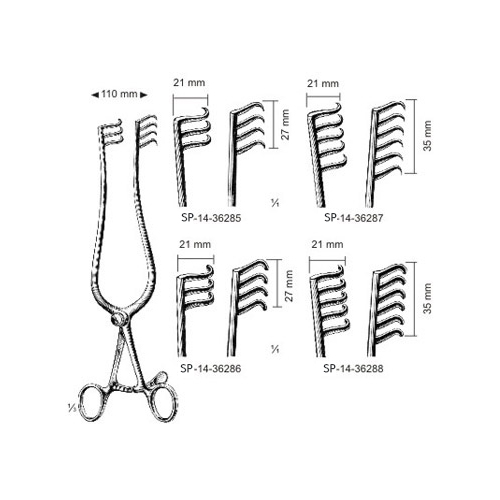
The Weitlaner Retractor: An Essential Tool in Orthopedic Surgery
Comprehensive Introduction & Overview
In the intricate world of orthopedic surgery, precision and clear visibility are paramount. Surgeons rely on a sophisticated array of instruments to achieve optimal patient outcomes. Among these, the Weitlaner Retractor stands out as a foundational and indispensable tool. This self-retaining surgical instrument is expertly designed to gently hold back tissue and muscle, thereby providing an unobstructed view of the surgical site. Its ingenious design allows surgeons to maintain constant exposure without requiring an assistant to manually hold the retractor, freeing up valuable hands for other critical tasks.
Developed in the early 20th century, the Weitlaner Retractor has undergone subtle refinements over the decades, solidifying its place in operating rooms worldwide. Its primary purpose is to enhance the surgeon's field of vision, which is crucial for the meticulous work involved in repairing fractures, performing joint replacements, or addressing soft tissue injuries. For patients, the use of such a precise instrument translates directly into safer procedures, potentially shorter operating times, and ultimately, improved recovery trajectories. Dr. Mohammed Hutaif and his team prioritize the use of high-quality, reliable instruments like the Weitlaner Retractor to ensure the highest standards of care.
Deep-Dive into Technical Specifications & Mechanisms
The effectiveness of the Weitlaner Retractor lies in its elegant simplicity and robust engineering. Understanding its technical specifications and biomechanical principles reveals why it's so highly valued in orthopedic settings.
Design & Materials
The Weitlaner Retractor is a self-retaining instrument, meaning it can be locked into position after opening, maintaining retraction without continuous manual force. Key design elements include:
- Ring Handles: Ergonomically designed for the surgeon's grip, facilitating controlled opening and closing.
- Shanks: The arms extending from the handles to the blades, providing the necessary leverage.
- Ratchet Lock Mechanism: This is the defining feature of a self-retaining retractor. Once the desired level of retraction is achieved, the ratchet system locks the instrument in place, ensuring stable and consistent tissue separation.
- Blades (Prongs): These are the working ends that engage with the tissue. Weitlaner blades typically feature:
- Curved or Straight Prongs: Depending on the surgical need and tissue depth.
- Sharp or Blunt Teeth: Sharp teeth offer a more secure grip on dense tissue, while blunt teeth are preferred for delicate structures to minimize trauma.
- Varying Tooth Configurations: Commonly seen as 3x4, 4x5, or 5x6 teeth per blade, indicating the number of prongs on each side. This configuration allows for even distribution of force.
- Inward-Curving Tips: Many designs incorporate a slight inward curve at the tips of the prongs to gently scoop and hold tissue without slipping.
Materials: The vast majority of Weitlaner Retractors are crafted from high-grade surgical stainless steel, often specified as German stainless steel. This material is chosen for several critical properties:
- Durability: Withstands repeated use and sterilization cycles.
- Corrosion Resistance: Essential for maintaining sterility and preventing degradation in a moist, saline-rich surgical environment.
- Biocompatibility: Non-reactive with human tissue, reducing the risk of adverse reactions.
- Ease of Sterilization: Can withstand high-temperature steam sterilization (autoclaving) without compromising integrity.
Biomechanics of Retraction
The Weitlaner Retractor's biomechanical advantage stems from its self-retaining nature and the design of its blades:
- Even Pressure Distribution: The multiple prongs on the blades distribute the retractive force across a wider area of tissue. This significantly reduces localized pressure points, minimizing the risk of tissue ischemia or damage compared to manual, uneven retraction.
- Stable & Consistent Exposure: Once locked, the retractor provides a constant, unwavering view of the surgical field. This stability is crucial for delicate procedures, allowing the surgeon to focus entirely on the task at hand without concerns about shifting tissue.
- Reduced Surgeon Fatigue: Eliminating the need for continuous manual holding preserves the surgeon's energy and focus, especially during lengthy procedures.
- Optimized Leverage: The design of the shanks and handles provides excellent leverage, allowing for effective tissue separation with minimal effort from the surgeon.
Extensive Clinical Indications & Usage
The versatility of the Weitlaner Retractor makes it a staple across a broad spectrum of orthopedic procedures. Its ability to provide consistent, hands-free retraction is invaluable in various anatomical regions and surgical contexts.
General Orthopedic Applications
Weitlaner Retractors are extensively used in:
- Joint Replacement Surgeries: Crucial for exposing the joint capsule and surrounding structures during total hip, knee, or shoulder arthroplasty. It helps hold back muscle layers to access deeper bone structures.
- Fracture Repair (Internal Fixation): When repairing bone fractures with plates, screws, or rods, the Weitlaner helps retract soft tissues to expose the fracture site and facilitate precise alignment and fixation.
- Spine Surgery: For less invasive or smaller exposure spine procedures like microdiscectomies, laminectomies, or anterior cervical discectomy and fusion (ACDF), a smaller Weitlaner can provide excellent local retraction.
- Soft Tissue Procedures: Used in tendon repairs (e.g., rotator cuff repair), ligament reconstructions (e.g., ACL reconstruction), and muscle repairs to expose the damaged structures.
- Trauma Surgery: Essential for managing acute injuries, including debridement of wounds and preparation for complex reconstructions.
- Hand and Foot Surgery: Smaller versions are ideal for delicate work in confined spaces, providing clear visibility of small bones, tendons, and nerves.
Specific Usage Instructions (Fitting & Usage)
Proper application of the Weitlaner Retractor is key to maximizing its benefits and minimizing risks:
- Selection: Choose the appropriate size (length, blade depth, sharp/blunt prongs) based on the depth of the incision and the type of tissue to be retracted.
- Placement: Carefully position the blades around the edges of the incision, ensuring no critical neurovascular structures are inadvertently caught or compressed.
- Gradual Expansion: Slowly open the retractor by squeezing the handles. The ratchet mechanism will click as it expands. This gradual process allows tissues to adapt and reduces the risk of sudden trauma.
- Securing: Once the desired exposure is achieved, ensure the ratchet lock is fully engaged, providing stable retraction.
- Monitoring: Throughout the procedure, the surgical team, under Dr. Hutaif's guidance, continuously monitors the retracted tissues for signs of excessive pressure, blanching, or impaired circulation.
- Removal: To remove, gently disengage the ratchet lock and slowly close the handles, releasing the tissue gradually.
Patient Outcome Improvements
The thoughtful use of the Weitlaner Retractor directly contributes to superior patient outcomes:
- Enhanced Surgical Precision: An unobstructed and stable view allows the surgeon to perform intricate maneuvers with greater accuracy, leading to better anatomical reconstruction and functional restoration.
- Reduced Operating Time: By eliminating the need for manual retraction, the surgical team can work more efficiently, potentially shortening the duration of the procedure.
- Minimized Tissue Trauma: The even distribution of force from the multiple prongs, coupled with the ability to choose blunt tips, reduces the likelihood of localized tissue damage, bruising, or nerve compression.
- Potentially Smaller Incisions: Controlled and stable retraction can sometimes allow for adequate exposure through smaller incisions, leading to less scarring and potentially faster healing.
- Lower Risk of Complications: Improved visibility reduces the chance of inadvertent injury to surrounding structures, contributing to a lower complication rate.
- Faster, Smoother Recovery: Less tissue trauma and more precise surgery can translate into less post-operative pain, reduced swelling, and a quicker return to normal activities for the patient.
Risks, Side Effects, or Contraindications
While highly beneficial, the Weitlaner Retractor, like any surgical instrument, carries potential risks if not used correctly.
- Tissue Damage: The most common risk is localized tissue injury, including:
- Nerve Compression: If a nerve is trapped or subjected to prolonged pressure.
- Vascular Injury: Compression of blood vessels leading to temporary ischemia (reduced blood flow) or, in rare cases, permanent damage.
- Skin Tears or Bruising: Particularly at the incision edges if retraction is too aggressive or prolonged.
- Muscle Damage: If muscles are overstretched or held under tension for extended periods.
- Pressure Necrosis: In extreme cases of prolonged, excessive pressure, tissue death (necrosis) can occur, though this is rare with proper surgical technique.
- Infection: As with any surgical instrument, improper sterilization can lead to surgical site infection.
- Not Suitable for All Cases: The Weitlaner Retractor is generally for moderate depth and width retraction. For very deep or wide exposures, larger, more specialized retractors (e.g., Bookwalter, Balfour) may be required.
- Contraindications: Extreme caution, or even contraindication, is warranted in areas with highly delicate or superficial neurovascular structures where even minimal pressure could cause significant harm.
Expert Tips from Dr. Mohammed Hutaif
Dr. Mohammed Hutaif, a leading orthopedic specialist, emphasizes the following best practices for the safe and effective use of the Weitlaner Retractor:
- "Always select the smallest effective size. Using an unnecessarily large retractor can lead to excessive tissue stretching and potential damage."
- "Prioritize gentle, gradual retraction. Never force the retractor open quickly. Allow tissues to yield slowly to minimize trauma."
- "Regularly inspect retracted tissue for signs of ischemia. Look for blanching or any changes in color that might indicate inadequate blood flow. If observed, release and reposition."
- "Proper positioning is key to avoid neurovascular compromise. Always be acutely aware of the anatomical structures surrounding your surgical field."
- "Ensure all surgical team members are trained in its correct application and monitoring. A vigilant assistant can help identify potential issues early."
- "Invest in high-quality instruments and maintain them meticulously. A well-maintained retractor functions reliably and safely."
Maintenance & Sterilization Protocols
Maintaining surgical instruments like the Weitlaner Retractor is critical for patient safety and longevity of the instrument.
- Immediate Post-Operative Cleaning: As soon as feasible after surgery, the retractor should be wiped clean of gross blood and tissue debris using a damp cloth or sponge. This prevents organic material from drying and hardening on the instrument.
- Pre-Soaking/Enzymatic Cleaner: Instruments are often soaked in an enzymatic solution to break down proteins and facilitate cleaning.
- Manual Cleaning: Scrubbing with a soft brush and surgical detergent to remove any remaining debris, paying close attention to the teeth and ratchet mechanism.
- Ultrasonic Cleaning: Instruments are placed in an ultrasonic cleaner, which uses high-frequency sound waves to dislodge microscopic particles from crevices.
- Rinsing: Thorough rinsing with distilled or deionized water to remove all detergent residues.
- Inspection: Meticulous inspection under magnification for any signs of damage (cracks, bends, dull teeth), corrosion, or impaired function (ratchet mechanism sticking). Any damaged instrument should be removed from circulation.
- Lubrication: Applying a water-soluble surgical lubricant to the ratchet mechanism ensures smooth operation and prevents wear.
- Sterilization: The standard method is steam sterilization (autoclaving). Instruments are typically placed in sterile trays or wraps and subjected to high-pressure saturated steam at specific temperatures and durations (e.g., 121°C for 20-30 minutes, or 132°C for 4-15 minutes, depending on the cycle).
- Storage: Sterilized instruments must be stored in a dry, clean, and protected environment to maintain their sterile integrity until needed for surgery.
Massive FAQ Section
Q1: What is a Weitlaner Retractor and what is its main purpose?
A1: The Weitlaner Retractor is a self-retaining surgical instrument used to hold back tissue and muscle, providing surgeons with a clear and unobstructed view of the surgical site. Its main purpose is to maintain constant wound exposure during orthopedic procedures without needing an assistant to manually hold it.
Q2: How does a Weitlaner Retractor differ from other types of surgical retractors?
A2: The key difference is its "self-reretaining" nature due to a ratchet lock mechanism. Unlike handheld retractors that require continuous manual force from an assistant, the Weitlaner locks into place, freeing up surgical hands and providing stable, consistent retraction.
Q3: What materials are Weitlaner Retractors typically made from?
A3: They are almost exclusively made from high-grade surgical stainless steel, often specified as German stainless steel. This material is chosen for its exceptional durability, corrosion resistance, biocompatibility, and ability to withstand repeated sterilization.
Q4: Is the Weitlaner Retractor used in all orthopedic surgeries?
A4: While highly versatile, it's not used in all orthopedic surgeries. It's particularly common in procedures requiring moderate depth and width retraction, such as joint replacements, fracture repairs, and various soft tissue surgeries. For very deep or broad exposures, larger, specialized retractors may be preferred.
Q5: How does the Weitlaner Retractor improve patient safety and outcomes?
A5: It improves patient safety by providing a stable, clear surgical field, allowing for greater surgical precision and reducing the risk of accidental injury to surrounding structures. This precision, combined with less tissue trauma from even retraction, can lead to faster recovery, reduced pain, and better long-term outcomes.
Q6: Are there different types or sizes of Weitlaner Retractors available?
A6: Yes, Weitlaner Retractors come in various lengths, blade depths, and prong configurations (e.g., sharp or blunt, 3x4, 4x5 teeth). Surgeons select the appropriate size and type based on the specific anatomical location and the delicacy of the tissues involved.
Q7: How is a Weitlaner Retractor sterilized after use?
A7: After thorough cleaning to remove all organic debris, Weitlaner Retractors are primarily sterilized using steam sterilization (autoclaving). This high-temperature, high-pressure steam method effectively kills all microorganisms, ensuring the instrument is safe for subsequent surgical use.
Q8: Can patients feel the Weitlaner Retractor during surgery?
A8: No, patients are under general or regional anesthesia during surgery and will not feel the retractor or any other surgical instruments being used. The surgical team ensures patient comfort and safety throughout the procedure.
Q9: What are the potential risks associated with the use of a Weitlaner Retractor?
A9: The primary risks include localized tissue damage such as nerve compression, vascular injury, or skin tears if the retractor is used improperly, applied with excessive force, or left in place for too long without monitoring. Proper technique and vigilant monitoring minimize these risks.
Q10: How does Dr. Mohammed Hutaif ensure the safe application of the Weitlaner Retractor in his practice?
A10: Dr. Hutaif emphasizes meticulous instrument selection, gentle and gradual application, continuous monitoring of retracted tissues for signs of ischemia, and thorough training of his surgical team. He advocates for the use of high-quality instruments and strict adherence to maintenance and sterilization protocols.
Q11: Is the Weitlaner Retractor a single-use or reusable instrument?
A11: The Weitlaner Retractor is a reusable surgical instrument. Made from durable surgical stainless steel, it is designed to withstand numerous cycles of cleaning, sterilization, and use, provided it is properly maintained and inspected regularly.
Q12: Have there been any significant advancements in Weitlaner Retractor technology?
A12: While the core design remains largely consistent due to its effectiveness, advancements primarily focus on material science (e.g., lighter, stronger alloys), ergonomic improvements in handle design, and specialized coatings for enhanced durability or reduced glare. The principle of self-retaining retraction remains a cornerstone.
Disclaimer: This content is for informational purposes only and is not medical advice. Always consult with a qualified healthcare professional for diagnosis and treatment.