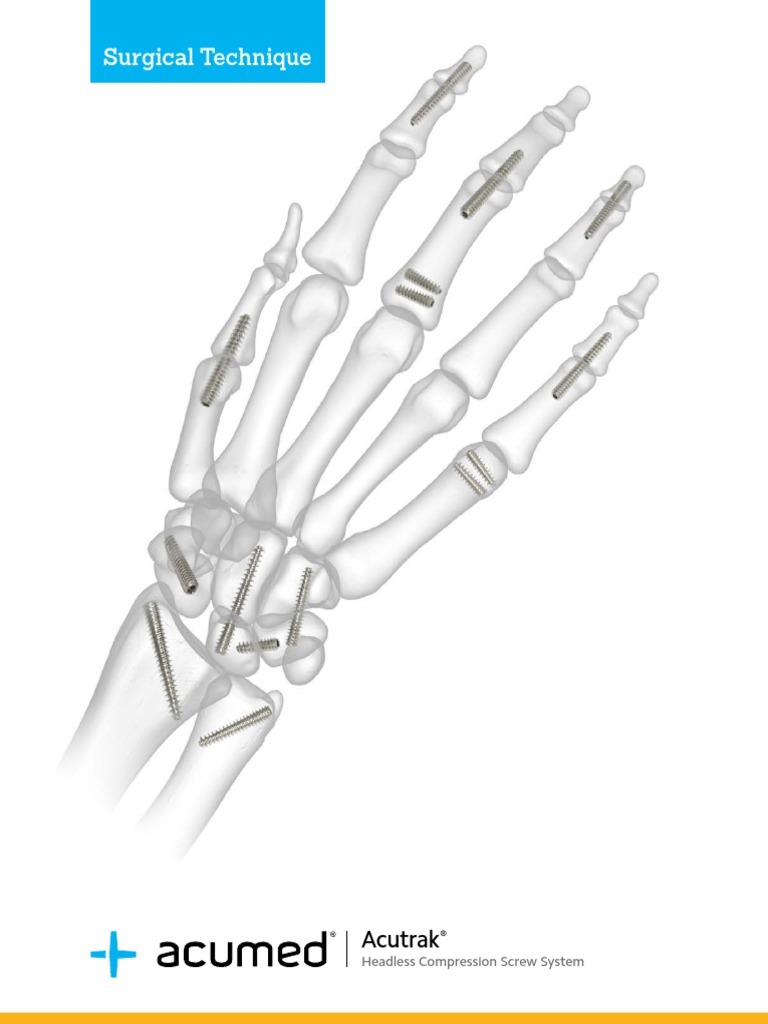
The Definitive Guide to Headless Compression Screws (Acutrak / Herbert - 2.5mm/3.0mm/4.0mm)
Headless compression screws represent a cornerstone in modern orthopedic and trauma surgery, offering precise internal fixation with minimal soft tissue irritation. These innovative implants are indispensable for achieving stable osteosynthesis in a wide range of small bone fractures, fusions, and osteotomies. This comprehensive guide delves into the world of headless compression screws, focusing on the renowned Acutrak and Herbert systems, available in versatile sizes such as 2.5mm, 3.0mm, and 4.0mm, and exploring their design, applications, biomechanics, and impact on patient outcomes.
1. Comprehensive Introduction & Overview
Headless compression screws are specialized orthopedic implants designed to provide interfragmentary compression and stable fixation without a prominent screw head. This "headless" design allows the screw to be fully embedded beneath the bone surface, eliminating potential soft tissue irritation and reducing the need for hardware removal. The core principle behind their function is differential thread pitch: the leading threads have a different pitch than the trailing threads. As the screw is inserted, this differential pitch draws bone fragments together, creating powerful and sustained compression across the fracture or fusion site.
The Acutrak and Herbert systems are two of the most widely recognized and utilized headless compression screw designs. While both operate on the differential pitch principle, they may differ subtly in thread geometry, instrumentation, and specific design optimizations. The availability of various diameters (e.g., 2.5mm, 3.0mm, 4.0mm) and lengths allows surgeons to select the most appropriate screw for the specific anatomical location and bone quality, ensuring optimal stability and patient-specific care.
2. Deep-Dive into Technical Specifications & Mechanisms
2.1. Design & Materials
Headless compression screws are typically cannulated, meaning they have a hollow core that allows for insertion over a guide wire. This cannulation facilitates precise placement, especially in complex fracture patterns or anatomically challenging areas.
- Headless Design: The defining feature. The absence of a screw head allows for subchondral or intra-articular placement without impinging on joint surfaces or irritating tendons and ligaments. This is crucial for small bones and joints where space is limited.
- Differential Thread Pitch: The fundamental mechanism for compression.
- Leading (Distal) Threads: Have a larger pitch, engaging the distal bone fragment.
- Trailing (Proximal) Threads: Have a smaller pitch, engaging the proximal bone fragment.
- As the screw is advanced, the differential in thread engagement pulls the fragments together, generating compression.
- Self-Drilling/Self-Tapping Features: Many modern headless screws incorporate flutes at the tip, allowing them to create their own pilot hole and tap their own threads, simplifying the surgical procedure and reducing the number of steps.
- Material Composition:
- Titanium Alloy (Ti-6Al-4V ELI): The most common material due to its excellent biocompatibility, high strength-to-weight ratio, and resistance to corrosion. It is also radiolucent, which can aid in postoperative imaging interpretation.
- Stainless Steel (316L): Less common for primary implants but sometimes used. Offers good mechanical properties but generally less biocompatible than titanium for long-term implantation.
2.2. Acutrak vs. Herbert Systems
While both systems are based on the headless compression principle, they have evolved with distinct characteristics:
- Acutrak Screws (e.g., Acutrak 2, Acutrak 4): Often characterized by a fully threaded design with a variable pitch throughout the screw body. They typically offer a wide range of sizes and lengths, designed for various applications from small bone fixation to larger fragment stabilization. The cannulation is precise, and the instrumentation is often color-coded for ease of use.
- Herbert Screws (e.g., Herbert-Whipple): Known for their specific thread patterns and typically have a smooth shaft portion between the leading and trailing threads, which can provide a gliding effect within the intermediate fragment, enhancing compression. The original Herbert screw was a pioneering design, and subsequent iterations have refined its biomechanical properties.
2.3. Screw Diameters and Their Applications
The choice of screw diameter (2.5mm, 3.0mm, 4.0mm) is critical and depends on the bone size, bone quality, and the specific fracture pattern.
- 2.5mm Headless Compression Screws: Ideal for very small bones and fragments.
- Applications: Phalangeal fractures (fingers/toes), metacarpal head fractures, small osteochondral fragments, specific scaphoid waist fractures, radial head fractures.
- 3.0mm Headless Compression Screws: A versatile intermediate size.
- Applications: Scaphoid fractures (most common size), small malleolar fractures, metatarsal fractures, capitellum fractures, certain osteotomies (e.g., chevron osteotomy of the foot).
- 4.0mm Headless Compression Screws: Used for larger fragments and bones requiring increased stability.
- Applications: Larger scaphoid non-unions, medial malleolus fractures, calcaneal fractures, talar neck fractures, certain long bone avulsion fractures.
3. Extensive Clinical Indications & Usage
Headless compression screws are incredibly versatile and have revolutionized the treatment of many orthopedic conditions. Their ability to achieve stable, buried fixation makes them ideal for juxta-articular and intra-articular fractures.
3.1. Upper Extremity Applications
- Scaphoid Fractures & Non-unions: This is perhaps the most classic indication. Headless screws provide stable compression across the fracture, promoting healing and minimizing the risk of avascular necrosis. The cannulated design allows for percutaneous or mini-open approaches.
- Common sizes: 3.0mm, 2.5mm (for smaller wrists or specific fracture patterns).
- Phalangeal & Metacarpal Fractures: Especially intra-articular fractures of the hand where a prominent screw head would impede joint motion or irritate tendons.
- Common sizes: 2.5mm.
- Radial Head Fractures: Small, displaced fragments can be fixed using headless screws, preserving articular congruity.
- Common sizes: 2.5mm.
- Capitellum Fractures: Intra-articular fractures of the distal humerus.
- Common sizes: 3.0mm, 2.5mm.
- Distal Radius Fractures: For specific styloid or articular fragment fixation.
- Common sizes: 2.5mm, 3.0mm.
- Clavicle Fractures: For certain displaced distal clavicle fractures or acromioclavicular (AC) joint separations.
- Common sizes: 3.0mm, 4.0mm.
3.2. Lower Extremity Applications
- Ankle Fractures (Malleolar Fractures): Particularly for fixation of the medial malleolus, where a headless screw can be placed flush with the articular surface, preventing hardware irritation.
- Common sizes: 3.0mm, 4.0mm.
- Fifth Metatarsal Fractures (Jones Fractures): Headless screws provide excellent intramedullary compression and stability, aiding in healing and return to activity.
- Common sizes: 3.0mm, 4.0mm.
- Metatarsal & Phalangeal Fractures of the Foot: Similar to the hand, intra-articular fractures benefit from buried fixation.
- Common sizes: 2.5mm, 3.0mm.
- Talar Neck & Body Fractures: Where stable fixation is paramount to prevent avascular necrosis.
- Common sizes: 3.0mm, 4.0mm.
- Calcaneal Fractures: For specific articular fragments or sustained compression.
- Common sizes: 4.0mm.
- Osteochondral Fragments: Fixation of osteochondral lesions, especially in the knee (e.g., OCD of the talus or femoral condyle), where the screw can be placed below the cartilage surface.
- Common sizes: 2.5mm, 3.0mm.
3.3. Arthrodesis (Fusion) Procedures
- Small Joint Fusions: Headless screws are excellent for fusing small joints in the hand and foot (e.g., DIP, PIP, MP joints, interphalangeal joints of the toes, TMT joints) to achieve permanent stability and pain relief.
- Common sizes: 2.5mm, 3.0mm, 4.0mm depending on the joint.
3.4. Osteotomies
- Corrective Osteotomies: For stabilizing bone cuts, such as in chevron osteotomies for bunion correction, or other realignment procedures where precise compression and flush hardware are desired.
- Common sizes: 2.5mm, 3.0mm.
3.5. Fitting & Usage Instructions (General Surgical Technique)
The precise surgical technique varies slightly between systems and specific indications, but the general steps involve:
- Patient Positioning & Incision: Appropriate positioning and sterile draping, followed by a surgical approach (open, mini-open, or percutaneous) that provides adequate access.
- Reduction: Accurate anatomical reduction of the fracture fragments is critical for optimal outcomes.
- Guide Wire Placement: A small-diameter guide wire (often K-wire) is inserted across the fracture site, ensuring proper trajectory and depth. This is the most crucial step for accurate screw placement.
- Measurement: A depth gauge is used over the guide wire to determine the appropriate screw length.
- Drilling (Optional/System Dependent): Some systems require a cannulated drill bit to create a pilot hole, while others use self-drilling screws. Over-drilling of the proximal fragment may be performed to allow for lag screw effect.
- Tapping (Optional/System Dependent): Some screws are self-tapping; others may require a cannulated tap over the guide wire.
- Screw Insertion: The headless compression screw is loaded onto a cannulated driver and advanced over the guide wire until it is fully countersunk beneath the bone surface. Gentle compression across the fracture should be observed.
- Confirmation: Intraoperative fluoroscopy or X-ray imaging confirms proper screw placement, fragment reduction, and adequate compression.
- Wound Closure: Standard sterile wound closure techniques.
4. Risks, Side Effects, or Contraindications
While highly effective, the use of headless compression screws, like any surgical procedure, carries potential risks and contraindications.
4.1. General Surgical Risks
- Infection: Risk of superficial or deep surgical site infection.
- Bleeding/Hematoma: Postoperative bleeding or blood clot formation.
- Nerve or Vascular Injury: Damage to adjacent nerves or blood vessels during surgery.
- Anesthesia Risks: Adverse reactions to anesthesia.
4.2. Hardware-Related Risks
- Screw Breakage: Though rare with proper surgical technique and appropriate screw size selection, screws can break under excessive load or in cases of non-union.
- Screw Loosening/Back-out: Can occur, especially with poor bone quality or inadequate compression.
- Loss of Reduction: If initial fixation is insufficient or if the patient places undue stress on the repair.
- Non-union/Malunion: Despite stable fixation, biological factors can lead to failure of the bone to heal or to heal in an improper alignment.
- Hardware Prominence (Rare): While designed to be buried, in very thin bone or specific anatomical locations, the screw might still be palpable or cause minor irritation, though significantly less common than with headed screws.
4.3. Contraindications
- Active Infection: Absolute contraindication at the surgical site.
- Severe Osteoporosis: Extremely poor bone quality may not provide adequate purchase for the threads, leading to screw pull-out or loosening.
- Insufficient Bone Stock: Not enough healthy bone to achieve stable fixation.
- Severe Comminution: Fractures with too many small fragments may not be amenable to headless screw fixation alone.
- Allergy to Implant Materials: Rare, but patients with known allergies to titanium or nickel (if present in trace amounts in stainless steel) would be contraindicated for that specific material.
- Unrealistic Patient Expectations/Non-compliance: Patients unwilling or unable to follow postoperative rehabilitation protocols.
5. Maintenance & Sterilization Protocols
Proper handling, cleaning, and sterilization of orthopedic surgical instruments, including headless compression screw systems, are paramount to patient safety and surgical efficacy.
5.1. Reprocessing & Cleaning
- Immediate Post-use: Instruments should be cleaned immediately after use to prevent drying of blood and tissue. This often involves manual cleaning with enzymatic detergents.
- Automated Cleaning: Ultrasonic cleaning and automated washer-disinfectors are commonly used to remove macroscopic debris and achieve high-level disinfection.
- Inspection: Thorough visual inspection after cleaning to ensure all residues are removed and instruments are free from damage (e.g., bent guide wires, dull drill bits, damaged screw drivers).
5.2. Sterilization
- Steam Sterilization (Autoclaving): This is the most common and effective method for heat-stable orthopedic instruments.
- Parameters: Typically involves exposure to saturated steam at specific temperatures (e.g., 121°C for 15-30 minutes or 132°C for 4-10 minutes) and pressure, as per manufacturer's instructions and institutional protocols.
- Packaging: Instruments are placed in sterile wraps, containers, or pouches that allow steam penetration but maintain sterility after processing.
- Other Methods (Less Common for Screws): Ethylene Oxide (EtO) or hydrogen peroxide gas plasma sterilization may be used for heat-sensitive items, but headless screws and their associated instruments are almost universally steam sterilized.
5.3. Storage
- Sterile instruments and implants must be stored in a clean, dry, and secure environment, protected from dust, moisture, and extreme temperatures, until the point of use.
- Implants are typically provided in pre-sterilized packaging by the manufacturer.
6. Biomechanics & Patient Outcome Improvements
6.1. Biomechanics of Headless Compression Screws
- Interfragmentary Compression: The primary biomechanical advantage. The differential pitch creates a "lag screw" effect, pulling bone fragments together, which enhances primary bone healing and stability. This compression resists shear forces and rotation.
- Load Sharing: The screw acts as an internal splint, sharing load with the bone fragments. This allows for controlled stress on the healing bone, which is beneficial for osteogenesis (Wolff's Law).
- Rotational Stability: The threads engaging both fragments provide inherent rotational stability, preventing uncontrolled twisting motions at the fracture site.
- Minimized Stress Risers: The buried nature of the screw means there is no prominent head to create a stress riser on the bone surface, which could potentially lead to refracture or peri-implant irritation.
- Improved Anatomical Contour: The flush placement allows for easier soft tissue closure and better anatomical restoration, especially in juxta-articular regions.
6.2. Patient Outcome Improvements
The biomechanical advantages directly translate into significant patient benefits:
- Reduced Pain & Discomfort: The headless design eliminates hardware prominence, which is a common source of irritation with traditional headed screws, leading to less pain and improved comfort.
- Faster Recovery & Rehabilitation: Stable fixation and reduced pain often allow for earlier mobilization and initiation of rehabilitation protocols, accelerating functional recovery.
- Improved Functional Outcomes: By preserving joint motion and reducing soft tissue impingement, patients often achieve a greater range of motion and overall better functional use of the affected limb.
- Reduced Need for Hardware Removal: The absence of a prominent head significantly decreases the incidence of symptomatic hardware, meaning fewer secondary surgeries for removal, saving healthcare costs and patient inconvenience.
- Enhanced Cosmesis: For fractures in visible areas (e.g., hand, foot), the buried screw results in a less noticeable implant, contributing to better aesthetic outcomes.
- Lower Infection Risk (Theoretical): While not definitively proven, a fully buried implant theoretically presents less surface area for bacterial colonization compared to an exposed or palpable screw head.
7. Massive FAQ Section
Here are 10+ frequently asked questions about headless compression screws:
Q1: What is the primary advantage of a headless compression screw over a traditional headed screw?
A1: The primary advantage is the headless design, which allows the screw to be fully embedded beneath the bone surface. This eliminates hardware prominence, reducing soft tissue irritation, preserving joint motion, and minimizing the need for subsequent hardware removal surgeries.
Q2: How does a headless compression screw achieve compression without a head?
A2: Headless compression screws utilize a differential thread pitch. The threads at the leading (distal) end have a larger pitch than the threads at the trailing (proximal) end. As the screw is inserted, this difference in thread engagement pulls the bone fragments together, generating powerful interfragmentary compression.
Q3: What are the common sizes of headless compression screws, and when are they used?
A3: Common sizes include 2.5mm, 3.0mm, and 4.0mm diameters.
* 2.5mm: Used for very small bones (e.g., phalanges, metacarpal heads, small osteochondral fragments).
* 3.0mm: A versatile size for scaphoid fractures, small malleolar fractures, metatarsal fractures, and capitellum fractures.
* 4.0mm: For larger fragments and bones (e.g., larger scaphoid non-unions, medial malleolus, calcaneal fractures). The choice depends on bone size, quality, and fracture pattern.
Q4: What is the difference between an Acutrak and a Herbert screw system?
A4: Both Acutrak and Herbert systems are types of headless compression screws that use differential thread pitch. Acutrak screws often feature a fully threaded design with variable pitch throughout, while Herbert screws (especially original designs) may have a smooth shaft portion between the leading and trailing threads, aiding in compression. Specific designs and instrumentation can also vary.
Q5: Are these screws removable, or are they permanent implants?
A5: Headless compression screws are generally intended to be permanent implants. Their buried nature means they rarely cause irritation that necessitates removal. However, if complications arise (e.g., infection, non-union, breakage), they can be surgically removed.
Q6: What materials are headless compression screws typically made from?
A6: The most common material is titanium alloy (Ti-6Al-4V ELI) due to its excellent biocompatibility, high strength, and resistance to corrosion. Some may also be made from stainless steel (316L).
Q7: What are the main clinical indications for using headless compression screws?
A7: They are widely indicated for fractures of small bones (e.g., scaphoid, phalanges, metacarpals, malleoli), osteochondral fragments, small joint fusions (arthrodesis), and certain corrective osteotomies, particularly where a prominent screw head would cause irritation or impede joint function.
Q8: What are the potential risks associated with headless compression screw surgery?
A8: Risks include general surgical complications (infection, bleeding, nerve/vascular injury), and hardware-specific issues such as screw breakage, loosening, loss of reduction, non-union/malunion, or, rarely, hardware prominence.
Q9: How are headless compression screws and their instruments sterilized?
A9: They are primarily sterilized using steam sterilization (autoclaving). Instruments are thoroughly cleaned and inspected, then packaged in sterile wraps or containers before being exposed to high-temperature, high-pressure steam according to manufacturer guidelines and institutional protocols.
Q10: Can headless compression screws be used in patients with osteoporosis?
A10: While they can be used, severe osteoporosis can be a relative contraindication. Poor bone quality may not provide adequate purchase for the screw threads, increasing the risk of screw pull-out or loosening, and potentially compromising fixation stability. Careful patient selection and surgical planning are essential.
Q11: How do headless screws contribute to improved patient outcomes?
A11: They lead to reduced pain and discomfort due to no hardware prominence, faster recovery and rehabilitation, improved functional outcomes (better joint motion), significantly reduced need for hardware removal, and enhanced cosmesis.
Q12: Is the surgical technique for headless screws minimally invasive?
A12: Often, yes. Many headless screw applications, particularly for scaphoid fractures, can be performed using percutaneous or mini-open techniques with the aid of fluoroscopy, minimizing tissue dissection and potentially leading to quicker recovery times.
This comprehensive guide underscores the critical role of headless compression screws in modern orthopedic surgery, highlighting their advanced design, broad applicability, and tangible benefits for patient recovery and long-term functional success.