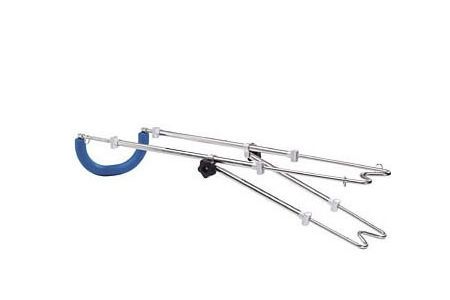
Comprehensive Introduction & Overview
The Thomas Splint with Pearson Attachment stands as a foundational and enduring device in orthopedic trauma management. Developed by the pioneering Welsh orthopedic surgeon Hugh Owen Thomas in the late 19th century, the original Thomas splint revolutionized the treatment of femoral fractures by providing effective immobilization and traction. Its ingenious design significantly reduced mortality rates associated with these injuries, particularly during wartime, and prevented many cases of malunion and non-union. The subsequent integration of the Pearson Attachment further enhanced the splint's utility, allowing for controlled knee flexion while maintaining traction, thereby addressing the critical need for early joint mobility and improved patient comfort.
At its core, the Thomas splint is a traction splint designed to stabilize lower limb fractures, primarily those of the femur. It works on the principle of applying continuous longitudinal traction to overcome muscle spasm, reduce displacement, and align bone fragments. The ischial ring provides a counter-traction point against the pelvis, while the distal end of the splint serves as an anchor for the traction force applied to the limb.
The Pearson Attachment, a hinged extension, is a crucial adjunct to the Thomas splint. It supports the lower leg, specifically the tibia and foot, and allows the knee to be gently flexed. This innovation is vital for preventing knee stiffness, facilitating nursing care, and enabling early rehabilitative exercises without compromising the stability achieved by the main splint. Together, the Thomas Splint with Pearson Attachment represents a robust, versatile, and highly effective system for both emergency stabilization and definitive management of complex lower limb injuries, maintaining its relevance even in an era of advanced internal fixation techniques.
Deep-dive into Technical Specifications / Mechanisms
Design & Materials
The efficacy of the Thomas Splint with Pearson Attachment is rooted in its simple yet robust design and the materials chosen for its construction.
Thomas Splint Components:
- Ischial Ring: This is the proximal component, typically made of padded metal (e.g., steel or aluminum alloy) or a stiff, molded plastic, often covered with leather or synthetic padding. Its elliptical or D-shape is designed to fit snugly against the ischial tuberosity and groin, providing the essential counter-traction against the pelvis. The padding is crucial to prevent pressure sores and ensure patient comfort.
- Sidebars (Metal Rods): Two parallel metal rods extend distally from the ischial ring. These are usually constructed from lightweight yet strong materials like stainless steel or high-grade aluminum alloys. Their length is critical, extending beyond the foot to allow for attachment of the traction mechanism. They are typically slightly divergent to accommodate the natural contour of the thigh.
- Distal Crossbar: A metal bar connects the two sidebars at their distal end. This serves as the primary attachment point for the traction cord and provides structural integrity to the splint.
- Padding and Straps: Various padding materials (e.g., felt, foam, sheepskin) are used along the sidebars to support the limb and prevent pressure points. Straps or bandages are used to secure the limb to the splint.
Pearson Attachment Components:
- Hinged Joint: This is the defining feature, allowing for controlled articulation. It consists of a robust pivot mechanism that attaches to the distal end of the Thomas splint's sidebars.
- Lower Leg Support Bars: Extending distally from the hinged joint, these two bars support the lower leg (tibia and fibula). They are typically shorter than the Thomas splint's sidebars.
- Foot Support: A distal crossbar or a specialized footplate connects the lower leg support bars, providing support for the foot and preventing foot drop. This also serves as an attachment point for foot traction if required.
- Materials: Similar to the Thomas splint, the Pearson attachment is constructed from durable, lightweight metals, ensuring structural integrity while minimizing added weight.
Traction System Components:
While not strictly part of the splint itself, the traction system is integral to its function.
* Skin Traction: Often involves adhesive strips (e.g., K-tape, specialized traction kits) applied to the limb, secured with elastic bandages, and connected to a spreader bar. The spreader bar prevents pressure on the malleoli.
* Skeletal Traction (less common with Thomas splint in field, but adaptable): Involves a Kirschner wire or Steinmann pin inserted through the bone (e.g., distal femur or proximal tibia), connected to a stirrup, then to the traction cord. This is typically for longer-term, heavier traction in a hospital setting.
* Cord, Pulley, and Weights: The traction cord connects the limb (via skin or skeletal traction) to a pulley system, which then suspends weights to apply continuous traction force.
Biomechanics
The biomechanical principles underlying the Thomas Splint with Pearson Attachment are elegant and highly effective for fracture management.
- Principle of Traction: The primary mechanism is continuous longitudinal traction. By applying a steady pull along the axis of the fractured bone, muscle spasm is overcome. This spasm, a natural physiological response to fracture, often leads to shortening and angular displacement of fragments. Traction counteracts this force, helping to realign the bone, reduce pain, and prevent further soft tissue damage.
- Counter-traction: The ischial ring of the Thomas splint provides the essential counter-traction. As the limb is pulled distally, the ring pushes proximally against the ischial tuberosity and the posterior aspect of the upper thigh/buttock. This opposing force creates a stable system, ensuring that the traction applied to the limb translates into effective reduction and maintenance of alignment.
- Three-Point Fixation: The Thomas splint effectively provides a three-point fixation system for the fractured femur. The first point is the ischial ring providing proximal counter-traction. The second point is the distal crossbar acting as the anchor for the traction force. The third point involves the sidebars supporting the limb, preventing excessive angulation and rotation.
- Role of Pearson Attachment: The Pearson Attachment is crucial for allowing controlled movement without compromising traction. Its hinged design permits varying degrees of knee flexion (typically up to 90 degrees).
- Prevention of Joint Stiffness: Prolonged immobilization of the knee in extension can lead to capsular contracture and quadriceps adhesion, resulting in significant knee stiffness. The Pearson attachment allows for early, passive, or active-assisted range of motion exercises, mitigating this risk.
- Facilitation of Nursing Care: The ability to flex the knee greatly improves access for wound care, skin hygiene, and bedpan use, enhancing patient comfort and reducing the risk of skin breakdown.
- Physiological Benefits: Early movement promotes synovial fluid circulation, maintains articular cartilage health, and prevents muscle atrophy more effectively than complete immobilization.
- Weight Distribution and Pressure Points: Proper application and padding are critical. The splint must distribute forces evenly to prevent localized pressure points that can lead to skin breakdown, nerve compression, or vascular compromise. The ischial ring, malleoli, heel, and popliteal fossa are particularly vulnerable areas requiring meticulous padding and regular inspection.
Extensive Clinical Indications & Usage
The Thomas Splint with Pearson Attachment remains an indispensable tool across various clinical scenarios, from pre-hospital emergency care to in-hospital definitive management and rehabilitation.
Primary Indications
- Fractures of the Femur: This is the most common and classic indication.
- Diaphyseal Femur Fractures: Fractures of the shaft of the femur, where significant muscle spasm causes shortening and displacement. The splint provides excellent stabilization and traction.
- Supracondylar Femur Fractures: Fractures just above the knee joint. The Pearson attachment is particularly beneficial here, allowing for early knee mobilization while maintaining fracture alignment.
- Tibial Plateau Fractures: While primarily a device for femoral fractures, it can be used for temporary immobilization of complex tibial plateau fractures, particularly when significant soft tissue swelling is present. Care must be taken to avoid excessive pressure on the popliteal fossa.
- Dislocated Hip (Post-Reduction Stabilization): After a successful reduction of a hip dislocation, the Thomas splint can be used to maintain immobilization and prevent re-dislocation, especially in unstable cases.
- Lower Limb Trauma (Temporary Stabilization for Transport): In emergency situations (e.g., road traffic accidents), the Thomas splint is invaluable for rapid stabilization of suspected femur or lower leg fractures, reducing pain, preventing further injury, and facilitating safe transport to a definitive care facility.
- Joint Infections (e.g., Septic Arthritis of the Hip or Knee): Immobilization can be beneficial in reducing pain and inflammation in severe joint infections.
- Post-operative Immobilization: Following certain orthopedic surgeries (e.g., internal fixation of femur fractures, complex knee ligament repairs, hip arthroplasty), the splint can provide protected immobilization and allow for controlled early range of motion with the Pearson attachment.
Detailed Surgical or Clinical Applications
Pre-hospital/Emergency Use:
In emergency medical services (EMS) and military settings, the Thomas splint is paramount for initial management of suspected femur fractures. Its rapid application significantly reduces pain, minimizes blood loss, and prevents further neurovascular compromise during transport. It's often applied with skin traction.
In-hospital Management:
- Fracture Reduction & Sustained Traction: Upon hospital admission, the Thomas splint can be used for definitive non-operative management of certain femur fractures, or as a temporary measure before surgical fixation. Traction weight can be adjusted precisely to achieve and maintain fracture reduction.
- Nursing Care: The design, especially with the Pearson attachment, greatly aids nursing care. Patients can be more easily repositioned for hygiene, bedpan use, and back care, reducing the risk of pressure sores. The ability to flex the knee allows for better access to the popliteal fossa and posterior thigh.
- Physiotherapy: The Pearson attachment is a game-changer for early rehabilitation. Physiotherapists can initiate passive or active-assisted knee range of motion exercises, crucial for preventing joint stiffness and maintaining muscle tone, even while the fracture is still healing and under traction.
Table: Fracture Types & Splint Application Considerations
| Fracture Type | Primary Benefit | Specific Considerations |
|---|---|---|