The Standard Folding Walker (4-Point): An Exhaustive Orthopedic Guide to Mobility and Recovery
In the realm of orthopedic rehabilitation and assistive devices, the Standard Folding Walker (4-Point) stands as a foundational and indispensable tool. Often underestimated in its simplicity, this device plays a critical role in restoring mobility, ensuring safety, and fostering independence for countless patients recovering from injury, surgery, or managing chronic conditions. As expert Medical SEO Copywriters and Orthopedic Specialists, we delve into the intricate details of this ubiquitous aid, offering an authoritative guide that covers its design, clinical applications, biomechanics, maintenance, and profound impact on patient outcomes.
1. Comprehensive Introduction & Overview
The standard folding walker, characterized by its four-point contact system and lightweight, foldable frame, is a primary choice for individuals requiring stable, bilateral support during ambulation. Unlike rolling walkers (rollators) that feature wheels, the standard walker requires the user to lift and advance the device with each step, providing a deliberate and highly stable gait pattern. This fundamental design principle makes it exceptionally suitable for initial stages of rehabilitation, balance training, and situations where maximum stability is paramount.
Its widespread adoption is a testament to its effectiveness in:
* Enhancing Stability: By significantly increasing the user's base of support.
* Reducing Weight Bearing: Allowing patients to offload pressure from injured or weakened lower extremities.
* Promoting Balance: Aiding individuals with impaired proprioception or vestibular function.
* Facilitating Gait Training: Encouraging a controlled and symmetrical walking pattern.
* Preventing Falls: A critical concern, especially in geriatric populations or post-surgical patients.
This guide will systematically unpack every facet of the standard folding walker, from its engineering marvel to its profound clinical utility, ensuring a holistic understanding for both healthcare professionals and patients alike.
2. Deep-dive into Technical Specifications / Mechanisms
The apparent simplicity of the standard folding walker belies thoughtful engineering focused on functionality, durability, and user-friendliness.
2.1. Design and Materials
The core design typically features an H-frame or U-frame configuration, providing a wide and stable base.
- Frame Construction:
- Material: Predominantly constructed from high-grade, anodized aluminum tubing. Aluminum is chosen for its optimal strength-to-weight ratio, making the walker robust enough to support significant weight while remaining light enough for easy lifting and maneuvering.
- Tubing Diameter: Typically ranges from 1 inch to 1.25 inches, offering structural integrity.
- Finish: Anodized finishes prevent corrosion and provide a smooth, aesthetic appearance.
- Four-Point Contact System:
- Each leg terminates in a durable, non-skid rubber ferrule (tip). These ferrules are crucial for grip on various surfaces and shock absorption. They are designed to be replaceable as they wear down.
- Handgrips:
- Material: Usually made from molded foam, soft rubber, or textured plastic. These materials are selected for comfort, grip, and ease of cleaning.
- Ergonomics: Designed to distribute pressure evenly across the palm, reducing the risk of hand fatigue or pressure sores during prolonged use.
- Folding Mechanism:
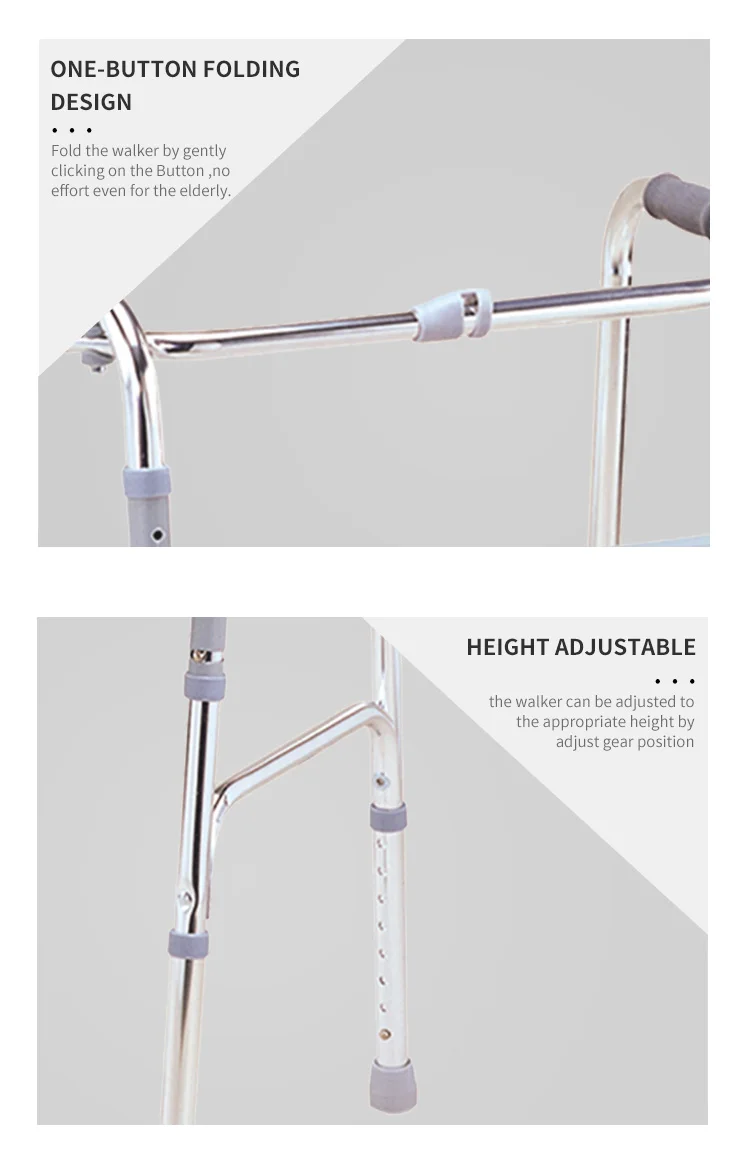
- Side-Release/Push-Button: Most standard walkers incorporate a simple, intuitive folding mechanism. This typically involves a push-button or lever-release system located on the side rails or cross-brace. This allows the walker to collapse into a compact form for storage and transport, a critical feature for patient convenience.
- Cross-Brace: Often reinforced, the cross-brace connects the side frames, adding rigidity when the walker is deployed.
2.2. Mechanical Adjustments and Weight Capacity
- Height Adjustment:
- Mechanism: Spring-loaded pins or push-buttons located on each leg allow for precise height adjustments. These pins securely lock into pre-drilled holes in the frame, ensuring stability at the desired height.
- Range: Standard walkers offer a wide range of height adjustability to accommodate users of varying statures, typically from 5' to 6'4" (though bariatric and pediatric models exist).
- Weight Capacity:
- Standard models typically support 250-300 lbs (approx. 113-136 kg).
- Bariatric models, constructed with heavier-gauge aluminum or steel and wider frames, can support 400 lbs (approx. 181 kg) or more, addressing the needs of a larger patient demographic.
2.3. Common Accessories
While the standard folding walker is inherently simple, several accessories can enhance its utility:
* Ski Glides: Replace rear ferrules, allowing the walker to slide more easily on certain surfaces, reducing the need to lift it entirely with each step.
* Wheels: Front wheels can be added, converting it into a two-wheeled walker, which offers a compromise between stability and ease of movement.
* Walker Bags/Baskets: Attachable storage for personal items, enhancing independence.
* Platform Attachments: For users unable to bear weight through their hands/wrists, these allow forearm support.
3. Extensive Clinical Indications & Usage
The standard folding walker is a cornerstone in orthopedic and general medical rehabilitation, indicated for a broad spectrum of conditions and scenarios. Its primary goal is to provide a safe means of ambulation when independent walking is compromised.
3.1. Post-Surgical Rehabilitation
- Total Hip Arthroplasty (THA) / Hip Fracture Repair: Crucial for early mobilization, allowing patients to maintain partial weight-bearing (PWB) or non-weight-bearing (NWB) status on the operated leg while providing bilateral support. It helps prevent falls during the critical initial weeks post-op.
- Total Knee Arthroplasty (TKA): Facilitates early ambulation, helps manage pain by offloading the knee, and supports gait retraining to restore a natural walking pattern.
- Spinal Surgeries (e.g., Laminectomy, Spinal Fusion): Provides trunk stability and reduces the risk of falls and undue stress on the healing spine during early mobilization.
- Lower Extremity Fracture Management (e.g., Tibia, Femur, Ankle Fractures): Essential for maintaining PWB or NWB, protecting the healing bone, and allowing controlled mobility.
3.2. Neurological Conditions
- Stroke (Cerebrovascular Accident - CVA) with Hemiparesis: Offers a wide base of support to compensate for weakness and balance deficits on one side of the body, aiding in gait retraining and fall prevention.
- Parkinson's Disease: Helps manage gait instability, freezing episodes, and balance impairments, promoting safer ambulation.
- Multiple Sclerosis (MS): Provides stability for individuals experiencing fatigue, weakness, and ataxia (lack of voluntary coordination of muscle movements).
- Peripheral Neuropathy: Compensates for sensory loss in the feet, which can impair balance and proprioception.
3.3. Orthopedic & Geriatric Conditions
- Severe Osteoarthritis (Hip/Knee): Reduces load on painful joints, allowing individuals to maintain activity levels and manage pain.
- Generalized Weakness & Deconditioning: Provides support for individuals recovering from prolonged illness or hospitalization, helping them regain strength and endurance.
- Balance Disorders: Offers external support for individuals with vestibular dysfunction, inner ear problems, or age-related balance decline.
- Fall Prevention: For elderly individuals at high risk of falls, the walker provides a constant, reliable support system, significantly reducing incident rates.
- Gait Instability of Undetermined Origin: When the cause of gait disturbance is unclear, a walker provides immediate safety and allows for further assessment.
3.4. Fitting and Usage Instructions
Proper fitting and technique are paramount for the safe and effective use of a standard folding walker.
3.4.1. Proper Fitting
- Stand Tall: The patient should stand upright with relaxed shoulders and arms hanging naturally at their sides.
- Handgrip Height: The top of the walker handgrips should align with the crease on the inside of the patient's wrist.
- Elbow Flexion: When gripping the walker, there should be a slight bend (approximately 20-30 degrees) in the elbows. This allows for proper weight-bearing and propulsion.
- Verification: If the walker is too high, the patient will shrug their shoulders; if too low, they will stoop, both leading to discomfort and inefficient use.
3.4.2. Safe Usage and Gait Patterns
The general principle is to move the walker first, then the affected leg, then the unaffected leg.
- Standard (3-Point) Gait:
- Advance Walker: Lift and move the walker forward about one arm's length (approximately 6-12 inches). Ensure all four tips are firmly on the ground.
- Advance Affected Leg: Step forward with the affected or weaker leg, placing it within the walker's frame, but not past the front bar. Bear weight through the hands and the unaffected leg.
- Advance Unaffected Leg: Bring the unaffected or stronger leg forward, stepping past the affected leg, even with the affected leg, or slightly past it, depending on stability and balance.
- Repeat: Maintain a smooth, rhythmic motion.
- Swing-To Gait (for NWB/PWB):
- Advance Walker: Lift and move the walker forward.
- Swing Body: While bearing weight through the hands on the walker, swing the body and legs forward, landing with the feet even with the back legs of the walker. The affected leg does not bear weight.
- Safety Tips:
- Clear Pathways: Remove rugs, cords, and clutter.
- Proper Footwear: Wear supportive, non-skid shoes.
- Use Both Hands: Always use both hands to grip the walker.
- Walk, Don't Push: Lift and move the walker; do not slide or push it unless equipped with glides/wheels.
- Avoid Stairs/Escalators: Walkers are generally unsafe on stairs; use handrails or assistance.
- Sitting/Standing: Back up to the chair until the back of the legs touch, reach for the armrests, then slowly lower. Reverse for standing.
4. Risks, Side Effects, or Contraindications
While highly beneficial, the standard folding walker is not without potential risks or contraindications. Proper assessment and patient education are crucial.
4.1. Potential Risks and Side Effects
- Increased Energy Expenditure: Compared to independent walking, using a walker requires more upper body strength and can be more metabolically demanding, especially for deconditioned patients. This can lead to fatigue.
- Upper Extremity Overuse Injuries: Prolonged or improper use can lead to carpal tunnel syndrome, de Quervain's tenosynovitis, or shoulder pain due due to repetitive weight-bearing through the hands and arms.
- Improper Posture: A poorly fitted walker (too high or too low) can lead to stooping, slouching, or excessive trunk extension, causing back pain, neck strain, or an inefficient gait.
- Tripping Hazards: The walker itself can become a tripping hazard if not lifted adequately or if the user's feet catch on the frame.
- Reduced Gait Speed: The nature of the standard walker's gait pattern inherently slows down ambulation, which might impact functional independence in some contexts.
- Skin Breakdown: Poorly cushioned handgrips or excessive pressure can lead to calluses, blisters, or skin irritation on the palms.
- Falls: While designed to prevent falls, improper use (e.g., leaning too far forward, not lifting the walker, using it on uneven terrain) can still lead to falls.
4.2. Contraindications
- Severe Cognitive Impairment: Patients with significant cognitive deficits may struggle to understand and consistently follow instructions for safe walker use, increasing fall risk.
- Severe Upper Extremity Weakness: Individuals unable to bear adequate weight through their arms and hands (e.g., severe shoulder injury, advanced rheumatoid arthritis in wrists/hands) may not be able to safely use a standard walker.
- Certain Cardiac Conditions: For patients with severe cardiovascular compromise, the increased energy expenditure required for walker use might be contraindicated, necessitating a thorough medical assessment.
- Unstable Angina or Acute Myocardial Infarction: In such cases, any activity that significantly increases cardiac demand must be carefully monitored or avoided.
- Severe Balance Deficits with Impaired Vision: When combined, these factors can make safe walker use challenging, potentially requiring a different assistive device or constant supervision.
5. Maintenance and Sterilization Protocols
Regular maintenance and, in clinical settings, proper sterilization are essential to ensure the longevity, safety, and hygiene of a standard folding walker.
5.1. Routine Maintenance (Home Use)
- Regular Cleaning:
- Wipe down the frame, handgrips, and legs regularly with a damp cloth and mild soap.
- For deeper cleaning, use disinfectant wipes (e.g., alcohol-based wipes) on handgrips and frame.
- Dry thoroughly after cleaning to prevent corrosion.
- Inspection of Ferrules (Rubber Tips):
- Frequency: Check monthly or more frequently with heavy use.
- What to Look For: Worn, cracked, split, or missing ferrules. Worn tips reduce grip and stability, increasing fall risk.
- Replacement: Replace all four ferrules simultaneously if any show significant wear. Replacement tips are readily available.
- Handgrip Integrity:
- Inspection: Check for tears, flattening, or excessive wear. Worn handgrips can reduce comfort and grip.
- Replacement: Replace if damaged or uncomfortable.
- Folding Mechanism:
- Functionality: Periodically test the folding mechanism to ensure it operates smoothly and locks securely when deployed.
- Lubrication: A light spray of silicone lubricant can be applied to moving parts if they become stiff, avoiding excessive application that could attract dirt.
- Height Adjustment Pins:
- Functionality: Ensure the spring-loaded pins retract and engage fully and securely in the height adjustment holes.
- Integrity: Check for bent or damaged pins.
- Frame Integrity:
- Visual Inspection: Look for cracks, bends, or loose joints in the aluminum frame.
- Tighten Screws/Bolts: If the walker has any visible screws or bolts, periodically check and tighten them (without overtightening).
- Weight Capacity: Adhere strictly to the manufacturer's stated weight capacity to prevent structural failure.
5.2. Sterilization Protocols (Clinical/Multi-Patient Use)
In healthcare facilities where walkers are reused by multiple patients, stringent cleaning and disinfection protocols are critical to prevent cross-contamination.
- Pre-Cleaning:
- Remove any visible dirt, dust, or bodily fluids using a detergent and water solution. This step is crucial as disinfectants are less effective in the presence of organic matter.
- Disinfection:
- Use an EPA-registered hospital-grade disinfectant solution. Ensure the chosen disinfectant is effective against a broad spectrum of pathogens (bacteria, viruses, fungi).
- Follow the manufacturer's instructions for contact time, dilution, and application method. Typically, this involves wiping all surfaces of the walker, especially handgrips and areas frequently touched.
- Rinsing (if required): Some disinfectants require rinsing with water after the prescribed contact time.
- Drying: Allow the walker to air dry completely or dry with a clean, lint-free cloth.
- Storage: Store cleaned and disinfected walkers in a designated clean area, away from potential contaminants, until needed.
- Personal Protective Equipment (PPE): Staff performing cleaning and disinfection should wear appropriate PPE, including gloves and eye protection.
6. Biomechanics of the Standard Folding Walker
Understanding the biomechanical principles behind the standard folding walker illuminates its effectiveness in providing stability and supporting ambulation.
6.1. Expanding the Base of Support (BOS)
- Fundamental Principle: The most critical biomechanical contribution of the walker is its ability to significantly expand the user's base of support. The BOS is the area enclosed by the points of contact with the ground.
- Impact: A wider BOS directly correlates with greater stability. By providing four additional points of contact (the walker's legs), the walker creates a much larger and more stable base than the user's feet alone, making it harder to lose balance.
6.2. Shifting the Center of Gravity (COG)
- Anterior Support: The walker provides anterior support, allowing the user to lean slightly forward and shift their center of gravity (COG) forward into the walker. This helps initiate and maintain forward momentum during ambulation.
- Stability Control: The ability to shift the COG within a larger BOS provides the user with a greater margin for error before losing balance.
6.3. Load Bearing and Offloading
- Upper Extremity Weight Bearing: The user can bear a significant amount of their body weight through their upper extremities (hands, wrists, forearms, shoulders) onto the walker.
- Reduction of Lower Extremity Load: This offloads pressure from painful, injured, or surgically repaired lower extremity joints (hips, knees, ankles) or weakened muscles. This is crucial for adhering to weight-bearing precautions (e.g., NWB, PWB, Touch-Down Weight Bearing - TDWB) and reducing pain during walking.
- Musculoskeletal Engagement: While offloading the lower limbs, the walker engages the upper limb and core musculature. The triceps, deltoids, and shoulder girdle muscles are actively recruited for pushing down and forward, while core muscles stabilize the trunk.
6.4. Gait Cycle Modification
- Slower, More Controlled Gait: The standard walker necessitates a deliberate, step-by-step gait pattern. This slows down the walking speed, which can be beneficial for patients with balance deficits or those learning new gait patterns.
- Improved Symmetry: By providing bilateral support, the walker encourages a more symmetrical gait, reducing compensatory patterns that might arise from unilateral weakness or pain.
- Reduced Stride Length and Cadence: Users typically take shorter steps (reduced stride length) and fewer steps per minute (reduced cadence) compared to unassisted walking, further enhancing stability.
7. Patient Outcome Improvements
The judicious use of a standard folding walker yields a multitude of positive patient outcomes, extending beyond mere physical assistance.
7.1. Enhanced Mobility and Functional Independence
- Restored Ambulation: For many, the walker is the gateway to regaining the ability to walk after an event that severely limited mobility.
- Activities of Daily Living (ADLs): Enables patients to perform essential ADLs such as moving from bed to chair, going to the bathroom, and navigating their home environment with greater ease and safety.
- Community Participation: Facilitates participation in social activities, appointments, and light errands, preventing social isolation.
7.2. Significant Reduction in Fall Risk
- Primary Prevention: By providing a stable base and support, the walker is a critical tool in preventing falls, especially in the elderly and those with balance impairments.
- Improved Confidence: Knowing they have reliable support reduces "fear of falling," which itself is a major risk factor for falls.
7.3. Accelerated and Safer Rehabilitation
- Early Mobilization: Allows for earlier initiation of movement post-surgery or injury, which is vital for preventing complications like deep vein thrombosis (DVT), pneumonia, and muscle atrophy.
- Protection of Healing Structures: Ensures that surgical sites or healing fractures are protected from excessive stress during the initial recovery phases, optimizing healing.
- Gait Retraining: Provides the necessary support and feedback for physical therapists to retrain proper gait patterns, muscle activation, and balance.
7.4. Psychological and Emotional Well-being
- Increased Confidence: Successfully navigating their environment with the walker boosts patient confidence and self-efficacy.
- Reduced Anxiety/Fear: Alleviates anxiety associated with movement and the fear of falling, promoting a more positive outlook on recovery.
- Maintenance of Dignity: Allows individuals to maintain a sense of independence and control over their daily lives.
7.5. Prevention of Secondary Complications
- Muscle Atrophy and Deconditioning: By facilitating movement, it helps prevent the rapid muscle wasting and overall physical deconditioning that can result from prolonged immobility.
- Joint Stiffness: Encourages movement through the joints, helping to maintain range of motion and prevent stiffness.
- Pressure Injuries: Reducing bed rest and encouraging movement helps prevent pressure ulcers.
8. Massive FAQ Section
Here are answers to frequently asked questions about the standard folding walker, providing clear, authoritative guidance.
Q1: Who typically needs a standard folding walker?
A1: Individuals who need significant support, stability, and assistance with balance. This often includes patients recovering from lower extremity surgeries (hip, knee, ankle), spinal surgeries, those with neurological conditions affecting gait (e.g., stroke, Parkinson's), generalized weakness, or elderly individuals at high risk of falls.
Q2: How do I properly adjust the height of my walker?
A2: Stand upright with your shoulders relaxed and arms hanging naturally. The top of the walker's handgrips should align with the crease on the inside of your wrist. When you grasp the handgrips, your elbows should have a slight bend of approximately 20-30 degrees. Adjust each leg using the spring-loaded pins until this position is achieved.
Q3: What is the main difference between a standard folding walker and a rolling walker (rollator)?
A3: A standard folding walker has four non-skid rubber tips and must be lifted and advanced with each step, providing maximum stability. A rolling walker (rollator) has wheels (typically 3 or 4) and often includes a seat and handbrakes. Rollators are easier to maneuver and require less energy, but offer less stability than a standard walker and are generally not suitable for non-weight-bearing (NWB) situations.
Q4: Can I use my standard folding walker on stairs?
A4: No, standard folding walkers are generally not safe for use on stairs or escalators. Attempting to navigate stairs with a walker can lead to a severe fall. For stairs, it's recommended to use handrails, have assistance, or use alternative methods as advised by your physical therapist.
Q5: How do I fold my walker for storage or transport?
A5: Most standard folding walkers have a push-button or lever-release mechanism located on the side rails or cross-brace. You typically push a button or lift a lever on both sides, allowing the walker's sides to collapse inward, making it compact. Always refer to your specific walker's instruction manual.
Q6: How often should I check the rubber tips (ferrules) on my walker?
A6: You should visually inspect the rubber tips at least monthly, or more frequently if you use your walker extensively. Look for signs of wear, cracks, flattening, or if they are missing. Worn tips compromise safety and stability. Replace all four tips simultaneously if any show significant wear.
Q7: What if my hands hurt or get callused from the walker grips?
A7: Hand pain or calluses can occur from prolonged use or improper grip. You can try padded handgrip covers, which are available commercially, or wrap the existing grips with soft material. Ensure your walker height is correctly adjusted to prevent excessive pressure. Consult your physical therapist for ergonomic advice.
Q8: Is a standard folding walker covered by insurance?
A8: In many countries, including the United States (Medicare, Medicaid, and most private insurers), a standard folding walker is considered Durable Medical Equipment (DME) and may be covered if deemed medically necessary by a physician. You will typically need a prescription. It's best to check with your specific insurance provider for coverage details.
Q9: What's the best way to get up from a chair or toilet using my walker?
A9: Back up to the chair or toilet until the back of your legs touch it. Reach for the armrests of the chair (or the toilet's grab bars if available) with both hands, not the walker. Push up from the armrests to a standing position. Once stable, then grasp your walker. Reverse this process for sitting down: back up until your legs touch the chair, reach for the armrests, and slowly lower yourself.
Q10: Can I attach wheels to my standard folding walker?
A10: Yes, many standard folding walkers are designed to accommodate front wheel attachments, converting them into a two-wheeled walker. This can make the walker easier to maneuver as you don't have to lift the front legs with each step. However, it slightly reduces stability compared to a four-point standard walker. Always ensure the wheels are compatible with your specific walker model.
Q11: How do I safely navigate doorways with my walker?
A11: Approach the doorway straight on. If the doorway is wide enough, simply walk through with the walker. If it's narrow, you may need to fold one side of the walker slightly or angle it to fit. Always ensure the walker is stable and fully open before continuing to walk. If the doorway has a threshold, lift the walker over it carefully, then step over.
Q12: How do I know when I might be ready to transition from a walker to a cane or no assistive device?
A12: This transition should always be guided by your physical therapist or physician. They will assess your strength, balance, endurance, and gait stability. Key indicators might include consistent balance, ability to bear full weight without pain, improved single-leg stance, and confidence in walking without the comprehensive support of the walker. Do not transition prematurely, as it can increase your fall risk.
This comprehensive guide underscores the pivotal role of the standard folding walker in orthopedic care and rehabilitation, emphasizing its technical aspects, clinical utility, and profound impact on patient recovery and quality of life.