-
Transverse Ligament Rupture (Traumatic C1–C2 Instability)
- This rare, usually fatal, injury is seen mostly in older age groups (50s to 60s).
- The mechanism of injury is forced flexion.
- The clinical picture ranges from severe neck pain to complete neurologic compromise.
- Rupture of the transverse ligament may be determined by:
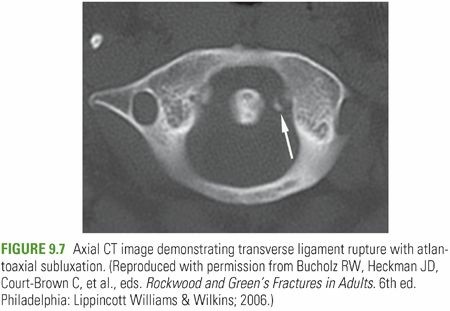
- Visualizing the avulsed lateral mass fragment on CT scan.
- Atlantoaxial offset >6.9 mm on an odontoid radiograph.
- ADI >3 mm in adults. An ADI >5 mm in adults also implies rupture of the alar ligaments.
- Direct visualization of the rupture on MRI.
- Treatment
- Initial treatment includes halo traction/immobilization.
- In the cases of avulsion, halo immobilization is continued until osseous healing is documented.
-
C1–C2 fusion is indicated for tears of the transverse ligament without bony avulsion, chronic instability, or pain (
Fig.
9.7).

Transverse Ligament Rupture: Recognizing & Treating This Serious Injury
Updated: Feb 2026
79 Views
Key Medical Takeaway
We review everything you need to understand about Transverse Ligament Rupture: Recognizing & Treating This Serious Injury. A transverse ligament rupture is a rare, often fatal C1-C2 spinal injury usually seen in older adults, caused by forced flexion. It presents with symptoms from severe neck pain to neurological compromise. Diagnosis involves CT, MRI, or specific atlantoaxial measurements. Initial treatment often includes halo immobilization, while C1-C2 fusion is indicated for tears without avulsion or chronic instability.

Keywords