Score: 0%
Orthopedics Online MCQs
-
A patient has a grade 2 open tibial fracture with 70% cross sectional bone loss that extends 2 cm in length. Treatment consists of stabilization with a nonreamed interlocking nail and successful secondary wound closure. Four months after the injury, no callus is visible. Management at this time should include which of the following?
A patient has a grade 2 open tibial fracture with 70% cross sectional bone loss that extends 2 cm in length. Treatment consists of stabilization with a nonreamed interlocking nail and successful secondary wound closure. Four months after the injury, no callus is visible. Management at this time should include which of the following?
-
A patient who had been previously treated for multiple injuries as a result of a motor vehicle accident is now requesting all medical records for unspecified reasons. A review of the patient record shows numerous office visits, all carrying a large unpaid balance. With regard to the release of records, the patient should be informed that
A patient who had been previously treated for multiple injuries as a result of a motor vehicle accident is now requesting all medical records for unspecified reasons. A review of the patient record shows numerous office visits, all carrying a large unpaid balance. With regard to the release of records, the patient should be informed that
-
Which of the following findings is the most specific for ankylosing spondylitis?
Which of the following findings is the most specific for ankylosing spondylitis?
-
A 7-year old boy has a painless abductor limp and limited hip abduction. Radiographs show varus of the proximal femur, with a narrow upper femoral epiphysis that has the shape of an inverted "Y". Which of the following factors best predicts the risk that the deformity will become worse?
A 7-year old boy has a painless abductor limp and limited hip abduction. Radiographs show varus of the proximal femur, with a narrow upper femoral epiphysis that has the shape of an inverted "Y". Which of the following factors best predicts the risk that the deformity will become worse?
-
A 17-year old boy who sustained a closed clavicle fracture after he was ejected from an all-terrain vehicle was treated with a figure-of-8 brace 1 year ago. He now reports continuous pain at the site of the fracture and is unable to actively raise his arm above his head. A radiograph is shown in Figure 1. Management should now include
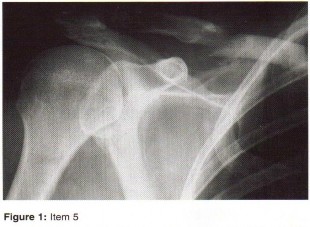
A 17-year old boy who sustained a closed clavicle fracture after he was ejected from an all-terrain vehicle was treated with a figure-of-8 brace 1 year ago. He now reports continuous pain at the site of the fracture and is unable to actively raise his arm above his head. A radiograph is shown in Figure 1. Management should now include
-
In revision hip arthroplasty, which of the following is the 5- to 10-year reported graft failure rate when using structural acetabular allografts in the repair of acetabular deficiencies?
In revision hip arthroplasty, which of the following is the 5- to 10-year reported graft failure rate when using structural acetabular allografts in the repair of acetabular deficiencies?
-
What is the treatment of choice for an adult who has an isolated fracture of the ulna at the junction of the distal and middle thirds, with 5 degrees apex dorsal angulation and 25% displacement?
What is the treatment of choice for an adult who has an isolated fracture of the ulna at the junction of the distal and middle thirds, with 5 degrees apex dorsal angulation and 25% displacement?
-
Physical exam of a high school soccer player who sustains a knee ligament injury reveals grade III tears of the anterior cruciate and medial collateral ligaments. In addition, an MRI scan reveals a lateral meniscus injury. Delaying an anterior cruciate ligament surgery until the patient has full, pain-free range of motion will decrease the risk of
Physical exam of a high school soccer player who sustains a knee ligament injury reveals grade III tears of the anterior cruciate and medial collateral ligaments. In addition, an MRI scan reveals a lateral meniscus injury. Delaying an anterior cruciate ligament surgery until the patient has full, pain-free range of motion will decrease the risk of
Spondyloepiphyseal dysplasia congenita and tarda, precocious osteoarthropathy, and Stickler syndrome are caused by a mutation in the gene coding for
Which of the following techniques is most commonly used to classify tissue type in soft-tissue tumors?
-
An 18-year-old man with hemophilia A has a painful ankle, which is an isolated target injury. Range of motion of the ankle is from neutral to 15 degrees of plantar flexion. Radiographs show the ankle joint space to be irregular and almost obliterated. The remaining joints in the foot appear normal. Which of the following procedures will most likely provide lasting pain relief?
An 18-year-old man with hemophilia A has a painful ankle, which is an isolated target injury. Range of motion of the ankle is from neutral to 15 degrees of plantar flexion. Radiographs show the ankle joint space to be irregular and almost obliterated. The remaining joints in the foot appear normal. Which of the following procedures will most likely provide lasting pain relief?
-
A patient who had previously undergone a salvage pelvic (Chiari) osteotomy now requires a total hip arthroplasty. The most frequent complication of this procedure is
A patient who had previously undergone a salvage pelvic (Chiari) osteotomy now requires a total hip arthroplasty. The most frequent complication of this procedure is
A patient reports a sudden recurrence of sciatica on her left side after undergoing a successful left L4-L5 diskectomy 15 months ago. Which of the following imaging modalities is most accurate in differentiating recurrence of the disk herniation from postoperative epidural scar tissue?
-
A 55 year-old man has multiple lytic lesions in the humeri, clavicles, and scapulae. Which of the following diagnostic studies best confirms a diagnosis of multiple myeloma?
A 55 year-old man has multiple lytic lesions in the humeri, clavicles, and scapulae. Which of the following diagnostic studies best confirms a diagnosis of multiple myeloma?
-
Analysis of which of the following proteins is used to establish the diagnosis of Becker muscular dystrophy?
Analysis of which of the following proteins is used to establish the diagnosis of Becker muscular dystrophy?
A 9-month-old infant with torticollis has failed to gain weight and has recurrent lower respiratory tract infections. Neurologic examination is normal, and there is no palpable mass in the sternocleidomastoid muscle. Radiographs of the neck show no bony anomalies. Management should now include
-
Which of the following radiographic findings would be characteristic of the knee joints of a patient with neuropathic osteoarthropathy of the knee?
Which of the following radiographic findings would be characteristic of the knee joints of a patient with neuropathic osteoarthropathy of the knee?
-
Radiographs of the cervical spine of a 73-year-old man who fell down stairs reveal cervical spondylosis without evidence of fracture or dislocation. MRI and CT scans are consistent with the plain radiographs. After 72 hours, neurologic evaluation reveals intact sensation; however, weakness of the upper extremities is greater than that of the lower extremities. What is the most likely diagnosis?
Radiographs of the cervical spine of a 73-year-old man who fell down stairs reveal cervical spondylosis without evidence of fracture or dislocation. MRI and CT scans are consistent with the plain radiographs. After 72 hours, neurologic evaluation reveals intact sensation; however, weakness of the upper extremities is greater than that of the lower extremities. What is the most likely diagnosis?
-
A 23 year old man has a minimally comminuted midshaft fracture of the femur with 2cm entrance and exit wounds as a result of a low-velocity gunshot. Definitive management should be
A 23 year old man has a minimally comminuted midshaft fracture of the femur with 2cm entrance and exit wounds as a result of a low-velocity gunshot. Definitive management should be
-
Which of the following events is most likely to occur following a complete transection of a peripheral nerve?
Which of the following events is most likely to occur following a complete transection of a peripheral nerve?
-
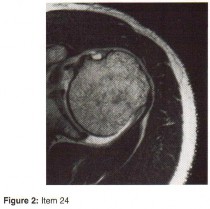
A right-handed, 53 year old man reports pain in the left shoulder following a fall on an abducted externally rotated shoulder 3 months ago. Examination reveals pain on elevation and tenderness localized to the anterior aspect of the shoulder. Results of the lift-off test are
inconclusive due to limited internal rotation. Figure 2 shows the T1-weighted axial image from an MRI-arthrogram. Treatment should include
A right-handed, 53 year old man reports pain in the left shoulder following a fall on an abducted externally rotated shoulder 3 months ago. Examination reveals pain on elevation and tenderness localized to the anterior aspect of the shoulder. Results of the lift-off test are
inconclusive due to limited internal rotation. Figure 2 shows the T1-weighted axial image from an MRI-arthrogram. Treatment should include
-
Figures 3a and 3b show the finger deformity that a 13-year-old girl has had since birth. What is the most likely diagnosis?
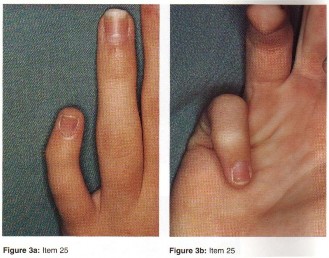
Figures 3a and 3b show the finger deformity that a 13-year-old girl has had since birth. What is the most likely diagnosis?
-
Which of the following provides the most stable fixation for comminuted fractures of the posterior acetabular wall?
Which of the following provides the most stable fixation for comminuted fractures of the posterior acetabular wall?
-
What posterior pelvic ring injury is most commonly associated with neurologic compromise?
What posterior pelvic ring injury is most commonly associated with neurologic compromise?
-
A patient has a noncomminuted displaced fracture of the radial head with a distal radioulnar dissociation. What is the most appropriate treatment for the radial head?
A patient has a noncomminuted displaced fracture of the radial head with a distal radioulnar dissociation. What is the most appropriate treatment for the radial head?
-
In a patient with T10-level spinal cord injury, which of the following prognostic signs most likely suggests functional recovery in the lower extremities?
In a patient with T10-level spinal cord injury, which of the following prognostic signs most likely suggests functional recovery in the lower extremities?
-
Examination of a 45 year old construction worker who was crushed by falling dirt and buried to midchest level reveals hemodynamic instability; however, radiographs of the chest are normal, and results of a diagnostic peritoneal lavage are negative. Despite the administration of a fluid bolus and packed red blood cells, hemodynamic instability persists. A radiograph of the pelvis is shown in Figure 4. The next step in the management should be
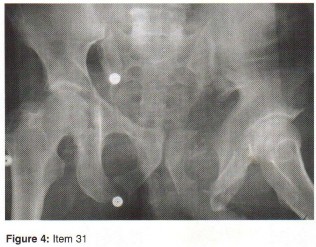
Examination of a 45 year old construction worker who was crushed by falling dirt and buried to midchest level reveals hemodynamic instability; however, radiographs of the chest are normal, and results of a diagnostic peritoneal lavage are negative. Despite the administration of a fluid bolus and packed red blood cells, hemodynamic instability persists. A radiograph of the pelvis is shown in Figure 4. The next step in the management should be
-
A 12 month old infant has congenital complete absence of the tibia. Examination reveals that the femur in the abnormal limb is 3 cm short, with a normal ipsilateral hip. The patient has an intact fibula, an equinovarus foot with four rays, and moderate popliteal skin webbing. Management should consist of
A 12 month old infant has congenital complete absence of the tibia. Examination reveals that the femur in the abnormal limb is 3 cm short, with a normal ipsilateral hip. The patient has an intact fibula, an equinovarus foot with four rays, and moderate popliteal skin webbing. Management should consist of
A 12-year-old child with L4 myelomeningocele who is schedules for foot surgery has a functioning ventriculoperitoneal shunt and has no history of allergies. Management should include
-
An 8-year-old girl has a supracondylar fracture of the distal humerus. Her neurovascular status is intact. Radiographs show hyperextension of 10 degrees of the distal fragment and an angle between the humeral shaft and capitellar physis (Baumann’s angle) of 88 degrees. Management should consist of
An 8-year-old girl has a supracondylar fracture of the distal humerus. Her neurovascular status is intact. Radiographs show hyperextension of 10 degrees of the distal fragment and an angle between the humeral shaft and capitellar physis (Baumann’s angle) of 88 degrees. Management should consist of
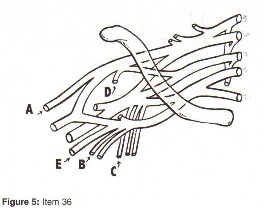
A 27-year-old man sustained a nondisplaced fracture of the clavicle. The fracture is healed; however, the patient has atrophy and absent function of the clavicular head of the pectoralis major muscle. Which of the labeled structures in Figure 5 was most likely injured?
-
Item Deleted by AAOS Question 38 -
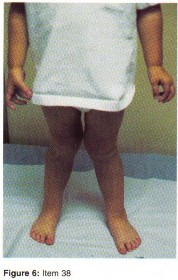
Figure 6 shows the clinical photograph of a 3-year-old boy who started to walk at the age of 10 months and has a gait that is appropriate for his age. His height is in the 40th percentile for his age. Management should consist of
Item Deleted by AAOS Question 38 -
Figure 6 shows the clinical photograph of a 3-year-old boy who started to walk at the age of 10 months and has a gait that is appropriate for his age. His height is in the 40th percentile for his age. Management should consist of
Item Deleted by AAOS Question 40 -
Figure 8 shows the AP radiograph of a 38-yea-old woman who has
constant pain in her shoulder as the results of a motor vehicle accident. Examination reveals marked restriction in external rotation. Which of the following studies should be ordered to aid in making a diagnosis?
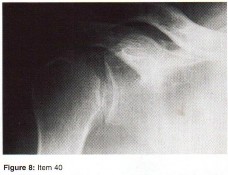
Figure 8 shows the AP radiograph of a 38-yea-old woman who has
constant pain in her shoulder as the results of a motor vehicle accident. Examination reveals marked restriction in external rotation. Which of the following studies should be ordered to aid in making a diagnosis?
-
A 39-year-old woman jammed her long finger playing softball 24 hours ago. She is unable to actively extend the proximal interphalangeal joint; however, when the joint is brought passively into full extension, she is able to maintain that position. Management should consist of
A 39-year-old woman jammed her long finger playing softball 24 hours ago. She is unable to actively extend the proximal interphalangeal joint; however, when the joint is brought passively into full extension, she is able to maintain that position. Management should consist of
-
Posterior cruciate insufficiency diagnosed using the quadriceps active test is confirmed with tibial translation
Posterior cruciate insufficiency diagnosed using the quadriceps active test is confirmed with tibial translation
Evaluation of an 8-year-old girl for scoliosis reveals a normal gestation, birth, and family history. Her parents state that she stopped gaining new motor skills at age 6 months. Examination shows the patient can sit independently, but she is nonverbal and she makes repetitive hand clapping movements. She has a 30-degree thoracolumbar kyphoscoliosis, and mildly increased tone in the hamstrings and gastrocnemius-soleus complex. What is the most likely diagnosis?
-
In a fatigue test, the maximum stress under which the material will not fail, regardless of how many loading cycles are applied, is defined as
In a fatigue test, the maximum stress under which the material will not fail, regardless of how many loading cycles are applied, is defined as
-
A skeletal survey is more accurate than a bone scan for detecting skeletal involvement in which of the following neoplastic diseases?
A skeletal survey is more accurate than a bone scan for detecting skeletal involvement in which of the following neoplastic diseases?
At the time of acetabular revision, retention of well-fixed femoral components inserted with first-generation cementing technique is most commonly associated with which of the following factors?
-
What is the primary mechanism of wear of polyethylene acetabular components?
What is the primary mechanism of wear of polyethylene acetabular components?
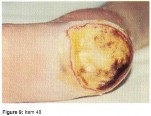
A 53-year-old man with insulin-dependent diabetes has the ulcer on his heel shown in Figure 9. Radiographs and an MRI scan are consistent with osteomyelitis of the calcaeus, contiguous with the ulcer itself. Arterial flow to the foot is adequate. Management should consist of
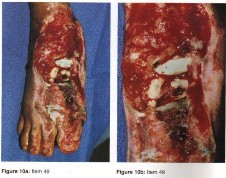
A 4-year-old boy sustains the injury shown in Figures 10a and 10b as a result of being hit and dragged by a car. Wound closure is best accomplished by
-
A 32-year-old man has swelling of the knee as a result of falling with the knee flexed and his foot in plantar flexion. A Lachman’s test reveals an apparent increase in anterior translation. Passive external tibial rotation at 30 degrees and 90 degrees is equal to the contralateral side, and the quadriceps active test is positive on the affected side. The neurovascular examination is normal. Treatment should consist of
A 32-year-old man has swelling of the knee as a result of falling with the knee flexed and his foot in plantar flexion. A Lachman’s test reveals an apparent increase in anterior translation. Passive external tibial rotation at 30 degrees and 90 degrees is equal to the contralateral side, and the quadriceps active test is positive on the affected side. The neurovascular examination is normal. Treatment should consist of
-
Which of the following is considered an advantage of an unreamed intramedullary nail over a reamed intramedullary nail?
Which of the following is considered an advantage of an unreamed intramedullary nail over a reamed intramedullary nail?
A 4-year-old girl who is undergoing chemotherapy for acute lymphocytic leukemia sustains a displaced fracture through an osteolytic lesion in the metaphysis of the distal femur as a result of a fall. Treatment should include
-
Which of the following conditions associated with a closed fracture of the clavicle indicates the need for open reduction and internal fixation?
Which of the following conditions associated with a closed fracture of the clavicle indicates the need for open reduction and internal fixation?
-
Figure11 shows the shoulder radiograph of a 52-year-old woman who has severe pain in the shoulder as a result of a bicycle accident 9 months ago. Management should consist of
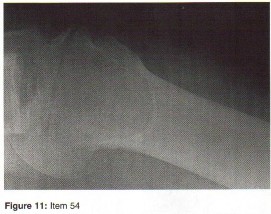
Figure11 shows the shoulder radiograph of a 52-year-old woman who has severe pain in the shoulder as a result of a bicycle accident 9 months ago. Management should consist of
A 47-year-old woman with no history of trauma has had a painful, stiff shoulder for the past 3 months. Treatment consisting of subacromial injection and nonsteroidal anti-inflammatory drugs has been ineffective. Her active range of motion is painful and is limited to 90 degrees of abduction, 60 degrees of elevation, 30 degrees of external rotation, and internal rotation to the posterior superior iliac spine. Plain radiographs of the cervical spine and shoulder are normal. Management at this time should consist of
-
The Injury Severity Score (ISS), using point scores from five different body systems, is a method that aids in predicting the chances of mortality in a patient with multiple injuries by
The Injury Severity Score (ISS), using point scores from five different body systems, is a method that aids in predicting the chances of mortality in a patient with multiple injuries by
-
Figure 12 shows the frog-lateral radiograph of a 45-year-old man who has a painful left hip. What is the most likely diagnosis?
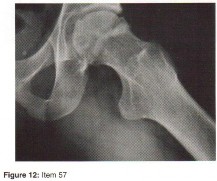
Figure 12 shows the frog-lateral radiograph of a 45-year-old man who has a painful left hip. What is the most likely diagnosis?
A 30-year-old man has had a slowly enlarging mass on the plantar medial aspect of the foot for the past 6 months. The mass is now 1 cm in diameter, adherent to the plantar fascia, and painful with weightbearing. The overlying skin is mobile. Management at this time should consist of
-
A 60-year-old man with no history of cancer has a destructive lesion in the proximal femur. He has a long history of tobacco use, but stopped smoking 5 years ago. A needle biopsy specimen of the lesion shows adenocarcinoma. Which of the following studies will most likely pinpoint the source of the primary tumor?
A 60-year-old man with no history of cancer has a destructive lesion in the proximal femur. He has a long history of tobacco use, but stopped smoking 5 years ago. A needle biopsy specimen of the lesion shows adenocarcinoma. Which of the following studies will most likely pinpoint the source of the primary tumor?
-
What factor is most commonly associated with malignant transformation of a giant cell tumor?
What factor is most commonly associated with malignant transformation of a giant cell tumor?
-
A 69-year-old man has neurogenic claudication after walking one block, but he does not report significant back pain. Management consisting of exercise, nonsteroidal anti-inflammatory drugs, and epidural steroids over a period of 6 months has failed to provide relief. Plain radiographs show degenerative changes, but no abnormality in alignment or instability. CT myelography shows central and lateral recess at L3-4 and L4-5, and foraminal stenosis bilaterally at L3-
4/. Treatment should now include
A 69-year-old man has neurogenic claudication after walking one block, but he does not report significant back pain. Management consisting of exercise, nonsteroidal anti-inflammatory drugs, and epidural steroids over a period of 6 months has failed to provide relief. Plain radiographs show degenerative changes, but no abnormality in alignment or instability. CT myelography shows central and lateral recess at L3-4 and L4-5, and foraminal stenosis bilaterally at L3-
4/. Treatment should now include
-
Item Deleted by AAOS Question 63 -
A 27-year-old woman has recurrent subluxation and pain in the elbow 1
year after sustaining a right posterolateral dislocation of the elbow with an associated fracture involving the tip of the coronoid process. What is the most likely cause of the persistent instability?
Item Deleted by AAOS Question 63 -
A 27-year-old woman has recurrent subluxation and pain in the elbow 1
year after sustaining a right posterolateral dislocation of the elbow with an associated fracture involving the tip of the coronoid process. What is the most likely cause of the persistent instability?
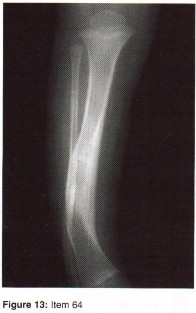
An 18-month-old child has a congenital anterolateral bowing of the tibia. The radiograph shown in Figure 13 reveals increased density with obliteration of the medullary canal at the apex of the 40-degree bow. Treatment should consist of
-
When taken concomitantly with which of the following, erythromycin can cause an increase in the blood level of
When taken concomitantly with which of the following, erythromycin can cause an increase in the blood level of
-
What is the most important surface geometry design parameter associated with decreased contact stress and wear reduction in total knee prostheses?
What is the most important surface geometry design parameter associated with decreased contact stress and wear reduction in total knee prostheses?
-
A 40-year old man has limited, painful motion in dorsiflexion at the metatarsophalangeal (MTP) joint of the right great toe, despite nonsurgical treatment. Radiographs show dorsal and medial osteophytes and minimal narrowing of the articular space. Treatment should consist of
A 40-year old man has limited, painful motion in dorsiflexion at the metatarsophalangeal (MTP) joint of the right great toe, despite nonsurgical treatment. Radiographs show dorsal and medial osteophytes and minimal narrowing of the articular space. Treatment should consist of
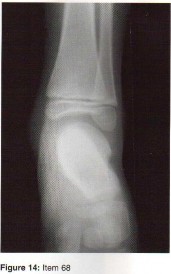
Which of the following conditions is typically associated with the ankle deformity shown in figure 14?
-
Crush fractures of the vertebral body are a particularly common problem in type 1 (postmenopausal) osteoporosis because
Crush fractures of the vertebral body are a particularly common problem in type 1 (postmenopausal) osteoporosis because
Which of the following changes in the parameters of the gait cycle occurs in the transition from normal walking to running?
-
A 67-year-old woman has chronic left foot pain that has failed to improve despite appropriate brace and shoe modifications. Examination reveals the absence of single limb heel rise on the affected side, an obvious unilateral flatfoot deformity, loss of posterior tibial tendon function, mild subfibular tenderness, and fixed hindfoot valgus. The best surgical option available for this patient is
A 67-year-old woman has chronic left foot pain that has failed to improve despite appropriate brace and shoe modifications. Examination reveals the absence of single limb heel rise on the affected side, an obvious unilateral flatfoot deformity, loss of posterior tibial tendon function, mild subfibular tenderness, and fixed hindfoot valgus. The best surgical option available for this patient is
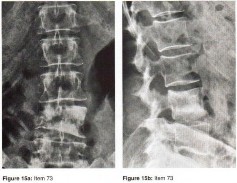
Figures 15a and 15b show the AP and lateral radiographs of the lumbar spine of a 51 year old woman who has had back pain that radiates into the right thigh for the past 3 months. Her medical history is unremarkable except for a mastectomy for breast cancer 12 years ago. What is the most likely diagnosis?
-
A patient sustained a joint depression-type fracture of the calcaneus that healed despite lack of treatment. The loss of dorsiflexion the patient is now experiencing is most likely the result of
A patient sustained a joint depression-type fracture of the calcaneus that healed despite lack of treatment. The loss of dorsiflexion the patient is now experiencing is most likely the result of
A radiograph of a 27 month old child with bilateral genu valgum and internal tibial torsion shows the metaphyseal-diaphyseal angle of Levine and Drennen is 12 degrees on the right and 13 degrees on the left. Based on this finding, management should consist of
-
A 50 year old man who has insulin-dependent diabetes mellitus with associated neuropathy has a stress fracture of the fourth metatarsal. Examination of the foot reveals acute swelling, warmth, and erythema; however, the patient reports very little pain. Treatment should include
A 50 year old man who has insulin-dependent diabetes mellitus with associated neuropathy has a stress fracture of the fourth metatarsal. Examination of the foot reveals acute swelling, warmth, and erythema; however, the patient reports very little pain. Treatment should include
-
Which of the following types of sarcoma of the bone is most sensitive to external beam radiation?
Which of the following types of sarcoma of the bone is most sensitive to external beam radiation?
-
Which of the following injuries is most commonly associated with a fracture of the scapular body?
Which of the following injuries is most commonly associated with a fracture of the scapular body?
-
Which of the following shoulder girdle muscles is most active during forward flexion?
Which of the following shoulder girdle muscles is most active during forward flexion?
-
Figure 16 shoes the AP radiograph of a 32-year-old man with a fracture cephalad to the fovea of the femoral head. A CT scan shows a single head fragment. After closed reduction of the hip, there is 5 mm of residual articular incongruity. Management should now include
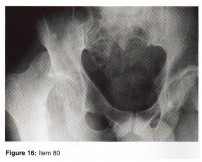
Figure 16 shoes the AP radiograph of a 32-year-old man with a fracture cephalad to the fovea of the femoral head. A CT scan shows a single head fragment. After closed reduction of the hip, there is 5 mm of residual articular incongruity. Management should now include
-
Figure 17a shows the postoperative AP hip radiograph of a 35-year-old woman who sustained an isolated fracture of the femoral neck while skiing 7 months ago. Treatment consisted of open reduction and screw fixation. She now reports continuous pain in the groin and an inability to bear weight. AP and
lateral radiographs shown in Figures 17b and 17c reveal no evidence of healing of the fracture. Management at this time should consist of
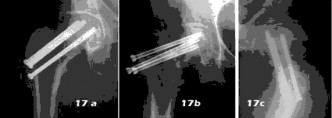
Figure 17a shows the postoperative AP hip radiograph of a 35-year-old woman who sustained an isolated fracture of the femoral neck while skiing 7 months ago. Treatment consisted of open reduction and screw fixation. She now reports continuous pain in the groin and an inability to bear weight. AP and
lateral radiographs shown in Figures 17b and 17c reveal no evidence of healing of the fracture. Management at this time should consist of
-
Examination of a 32-year old woman who has pain in her shoulder as a result of a head-on motor vehicle accident reveals tenderness directly over the scapula and painful motion of the shoulder. Radiographs show a displaced extra-articular fracture of the scapula. Which of the following studies would best detect commonly associated injuries?
Examination of a 32-year old woman who has pain in her shoulder as a result of a head-on motor vehicle accident reveals tenderness directly over the scapula and painful motion of the shoulder. Radiographs show a displaced extra-articular fracture of the scapula. Which of the following studies would best detect commonly associated injuries?
-
Which of the following surgical approaches to the hip is associated with the highest incidence of heterotopic ossification?
Which of the following surgical approaches to the hip is associated with the highest incidence of heterotopic ossification?
A 25-year-old volleyball player reports pain and clicking in his dominant shoulder during overhand serving. Three months of physical therapy fail to provide relief. Radiographs are normal, and an MRI scan is shown in figures 18a and 18b. Atrophy and weakness are most likely to be localized to which of the following muscles?
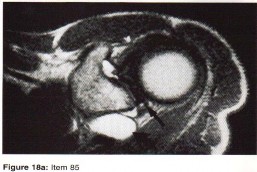
Figure 19 shows the radiograph of an 18-year-old recreational soccer player who has had pain in the lateral foot for the past 4 weeks. He reports no specific injury and has not undergone any treatment. Initial management should consist of
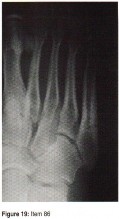
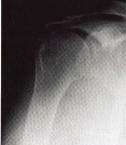
Figure 20 shows the plain radiograph of a 70-year-old woman who has shoulder pain and is unable to reach above chest level as a result of a fall 3 months ago. An MRI scan of the shoulder shows a large rotator cuff tear. Examination reveals atrophy of the infraspinatus muscle, active forward elevation of 40 degrees, active external rotation of 30 degrees, passive forward elevation of 150 degrees, and passive external rotation of 60 degrees. The patient has no external rotation strength against resistance. Treatment should include
-
Which of the following factors is used to determine torsional rigidity of a long bone fracture under internal or external fixation?
Which of the following factors is used to determine torsional rigidity of a long bone fracture under internal or external fixation?
A 33-year-old woman reports a 3-month history of pain in both feet while running. Examination reveals bilateral point tenderness over the plantar fascia at its origin, and the pain is accentuated when the ankle is dorsiflexed. Management should consist of
-
Radiographs of a 10-year-old boy who has a painless limp show widening of the symphysis pubis and bilateral coxa vara. Examination reveals frontal bossing, limited hip abduction, scoliosis, a bilateral Trendelenburg gait, and height in the 20th percentile for his age. Which of the following conditions is also likely to be present?
Radiographs of a 10-year-old boy who has a painless limp show widening of the symphysis pubis and bilateral coxa vara. Examination reveals frontal bossing, limited hip abduction, scoliosis, a bilateral Trendelenburg gait, and height in the 20th percentile for his age. Which of the following conditions is also likely to be present?
Which of the following ligaments provides the major static restraint to lateral patellar displacement?
-
Which of the following rehabilitation methods should be used for the first 24 hours following a blunt injury to the quadriceps musculature to avoid short-term stiffness?
Which of the following rehabilitation methods should be used for the first 24 hours following a blunt injury to the quadriceps musculature to avoid short-term stiffness?
-
Which of the following procedures is associated with the highest risk of osteonecrosis of the metatarsal head?
Which of the following procedures is associated with the highest risk of osteonecrosis of the metatarsal head?
A patient reports changes in vocal quality after undergoing a right-sided anterior cervical approach to C6. Which of the following nerves has most likely been injured?
-
A 30-year-old man underwent replantation of his dominant thumb at the metacarpophalangeal joint level 2 days ago. Since replantation, the temperature of the thumb has been between 87.8 F (31 C) and 93.2 F (34 C). The temperature is now 82.4 F (28 C), and there is brisk capillary refill and venous engorgement. Management at this time should include
A 30-year-old man underwent replantation of his dominant thumb at the metacarpophalangeal joint level 2 days ago. Since replantation, the temperature of the thumb has been between 87.8 F (31 C) and 93.2 F (34 C). The temperature is now 82.4 F (28 C), and there is brisk capillary refill and venous engorgement. Management at this time should include
-
Surgery is being considered for a 30-month-old child who has the deformity shown in Figure 21. Which of the following studies should be ordered before proceeding with surgery?
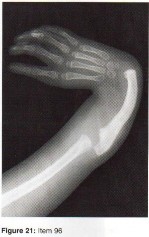
Surgery is being considered for a 30-month-old child who has the deformity shown in Figure 21. Which of the following studies should be ordered before proceeding with surgery?
-
A 15-year-old dancer who has had brief episodes of back pain over the past 2 years now reports a 3 month history of low back pain and a decreased tolerance for dance. Figure 22a-c show flexion and extension x-rays and CT scan. She reports no leg pain, nor any bowel or bladder difficulties. Management should now consist of


A 15-year-old dancer who has had brief episodes of back pain over the past 2 years now reports a 3 month history of low back pain and a decreased tolerance for dance. Figure 22a-c show flexion and extension x-rays and CT scan. She reports no leg pain, nor any bowel or bladder difficulties. Management should now consist of
Midfoot pain in a professional ballet dancer who has been amenorrheic for more than 6 months is most likely to be a
-
A right-handed 35-year old man who underwent a Putti-Platt repair for recurrent anterior instability 20 years ago now has increasing shoulder pain and stiffness. Examination of the shoulder reveals internal rotation to the posterior superior iliac spine and external rotation to 10 degrees with the shoulder adducted. The supraspinatus and infraspinatus are moderately atrophied. What is the most likely diagnosis?
A right-handed 35-year old man who underwent a Putti-Platt repair for recurrent anterior instability 20 years ago now has increasing shoulder pain and stiffness. Examination of the shoulder reveals internal rotation to the posterior superior iliac spine and external rotation to 10 degrees with the shoulder adducted. The supraspinatus and infraspinatus are moderately atrophied. What is the most likely diagnosis?
-
Which of the following acetabular/femoral head components would be expected to show an optimal combination of linear and volumetric wear?
Which of the following acetabular/femoral head components would be expected to show an optimal combination of linear and volumetric wear?
-
Work-related injuries to the lower back are most often related to which of the following risk factors?
Work-related injuries to the lower back are most often related to which of the following risk factors?
Flow cytometry of tumors measures the
-
Which of the following nerves supply the muscles on each side of internervous plane identified when performing the anterior (Smith-Petersen) approach to the hip?
Which of the following nerves supply the muscles on each side of internervous plane identified when performing the anterior (Smith-Petersen) approach to the hip?
Which of the following terms describe a rehabilitative exercise in which the foot is mobile and the motion of the knee is independent of hip and ankle motion?
Following irrigation and debridement, what is the preferred method of fixation for a displaced open tibia fracture with a 16-cm clean wound?
-
Which of the following radiographic views best shows the size and displacement of a posterior wall fracture of the acetabulum?
Which of the following radiographic views best shows the size and displacement of a posterior wall fracture of the acetabulum?
-
What is the primary immediate source of energy for muscle?
What is the primary immediate source of energy for muscle?
-
A 13-year-old quarterback feels a “pop” in his knee while being tackled. Radiographs of the knee and results of a Lachman’s test are normal. Examination reveals tenderness over the distal femoral physis. To help confirm the diagnosis, management should first include
A 13-year-old quarterback feels a “pop” in his knee while being tackled. Radiographs of the knee and results of a Lachman’s test are normal. Examination reveals tenderness over the distal femoral physis. To help confirm the diagnosis, management should first include
-
A 47-year-old woman who reports mild, aching pain in her knee has no history of trauma. Examination of the knee is normal. Figure 23a shows the AP radiograph. A bone scan shows increased uptake at this site only. Figure 23b shows the CT scan, and Figure 23c shows the histology from the CT scan-guided needle biopsy. Treatment should include
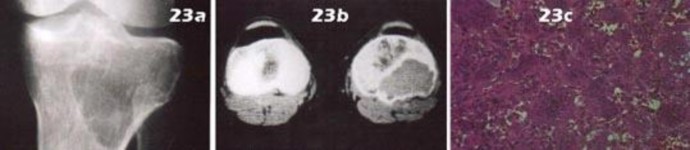
A 47-year-old woman who reports mild, aching pain in her knee has no history of trauma. Examination of the knee is normal. Figure 23a shows the AP radiograph. A bone scan shows increased uptake at this site only. Figure 23b shows the CT scan, and Figure 23c shows the histology from the CT scan-guided needle biopsy. Treatment should include
-
Figure 24 shows the AP radiograph of a 22-year-old woman who has pain with activity and crepitus at he second metatarsophalangeal joint. Despite nonsurgical treatment, the pain has become progressively worse over the past year. Treatment should include
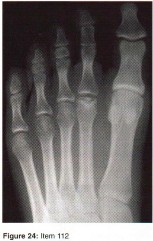
Figure 24 shows the AP radiograph of a 22-year-old woman who has pain with activity and crepitus at he second metatarsophalangeal joint. Despite nonsurgical treatment, the pain has become progressively worse over the past year. Treatment should include
-
Figure 25a shows the initial postoperative AP radiograph, and Figures 25b and 25c show the current AP and lateral radiographs of a 46-year-old woman who underwent open reduction and internal fixation of a distal fibula fracture and placement of a syndesmosis screw 15 months ago. She has full function, but the ankle swells with activity. The radiographs reveal that
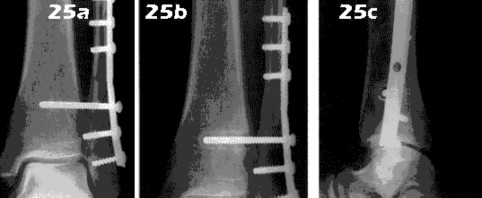
Figure 25a shows the initial postoperative AP radiograph, and Figures 25b and 25c show the current AP and lateral radiographs of a 46-year-old woman who underwent open reduction and internal fixation of a distal fibula fracture and placement of a syndesmosis screw 15 months ago. She has full function, but the ankle swells with activity. The radiographs reveal that
-
An MRI scan of the brain of a patient with spastic diplegia will most likely
show
An MRI scan of the brain of a patient with spastic diplegia will most likely
show
-
Which of the following laws describes the mechanical effects believed to play a role in the etiology of adolescent tibia vara?
Which of the following laws describes the mechanical effects believed to play a role in the etiology of adolescent tibia vara?
-
Which of the following statements best describes the tension in the different components of the posterior cruciate ligament when the knee is taken from full extension to 90 degrees of flexion?
Which of the following statements best describes the tension in the different components of the posterior cruciate ligament when the knee is taken from full extension to 90 degrees of flexion?
Which of the following Orthosis best relieves symptomatic hyperpronation of the feet in a patient who runs regularly?
What is the most common complication following metatarsal osteotomy for a bunion deformity in an adolescent?
The best indication for a knee fusion after a failed total knee replacement
is
is
-
An infected total knee replacement with symptoms occurring within 4 weeks of surgery and no radiographic signs of osteomyelitis would be best managed with
An infected total knee replacement with symptoms occurring within 4 weeks of surgery and no radiographic signs of osteomyelitis would be best managed with
-
A 16-year-old girl who swims on her high school team reports pain in the shoulder after swimming. History reveals a glenohumeral dislocation at age 14 years while doing the backstroke. Examination shows a positive anterior apprehension sign. Treatment at this time should consist of
A 16-year-old girl who swims on her high school team reports pain in the shoulder after swimming. History reveals a glenohumeral dislocation at age 14 years while doing the backstroke. Examination shows a positive anterior apprehension sign. Treatment at this time should consist of
A 20-year-old man sustains an unsalvageable crush injury to his foot and undergoes a below-knee amputation at the midtibial level. The stump is now healed and painless, and the patient has been fitted with a temporary prosthesis. Which of the following prosthetic components would best enable the patient to play basketball and other recreational sports?
Which of the following types of osteosarcoma is associated with the best prognosis & long survival?
A patient undergoes anterior spinal decompression through a left retroperitoneal approach as treatment of an L2 burst fracture. Following surgery, examination reveals the temperature of the right foot is cool when compared with the left foot. Which of the following neurologic structures has most likely been disrupted?
-
A 14-year-old patient who has homocystinuria and is Risser 3 is referred for surgical treatment of scoliosis. In addition to the usual risks associated with posterior spinal fusion, the family should be advised that the patient ‘s underlying condition significantly increases the perioperative risk of
A 14-year-old patient who has homocystinuria and is Risser 3 is referred for surgical treatment of scoliosis. In addition to the usual risks associated with posterior spinal fusion, the family should be advised that the patient ‘s underlying condition significantly increases the perioperative risk of
-
Radiographs of a 20-year-old college athlete who sustained an injury to the ankle reveal no fractures or widening of the ankle mortise. Examination shows swelling at the ankle region and pain with medial lateral compression of the distal tibiofibular joint. Which of the following studies would best help in confirming a diagnosis?
Radiographs of a 20-year-old college athlete who sustained an injury to the ankle reveal no fractures or widening of the ankle mortise. Examination shows swelling at the ankle region and pain with medial lateral compression of the distal tibiofibular joint. Which of the following studies would best help in confirming a diagnosis?
-
A healed fracture of the tibia that demonstrates 25 degrees apex posterior angulation and 28 degrees varus angulation on AP and lateral radiographs is most accurately described as a
A healed fracture of the tibia that demonstrates 25 degrees apex posterior angulation and 28 degrees varus angulation on AP and lateral radiographs is most accurately described as a
A normal functioning posterior tibialis tendon is best confirmed by which of the following physical findings?
-
A forward bend examination of an asymptomatic premenarchal 12-year-old girl who has waist asymmetry reveals a right thoracolumbar angle of trunk rotation of 12 degrees. The radiograph shown in Figure 26 reveals a curve that measures 31 degrees between T6 and T11 with the apex to the right. She is Risser 1 and her triradiate cartilage has closed. Management should consist of
1/. An MRI scan
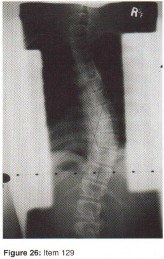
A forward bend examination of an asymptomatic premenarchal 12-year-old girl who has waist asymmetry reveals a right thoracolumbar angle of trunk rotation of 12 degrees. The radiograph shown in Figure 26 reveals a curve that measures 31 degrees between T6 and T11 with the apex to the right. She is Risser 1 and her triradiate cartilage has closed. Management should consist of
1/. An MRI scan
-
Which of the following advantages does the use of a vascularized fibula graft have over a nonvascularized fibula graft?
Which of the following advantages does the use of a vascularized fibula graft have over a nonvascularized fibula graft?
-
A 14-year-old girl has idiopathic scoliosis with a 52-degree right thoracic curve and a 36-degree left lumbar curve. The rotation of the apical vertebra appears greater in the thoracic curve. A sagittal view radiograph shows the spine to be virtually straight. The iliac apophyses are Risser 2. Treatment should consist of
A 14-year-old girl has idiopathic scoliosis with a 52-degree right thoracic curve and a 36-degree left lumbar curve. The rotation of the apical vertebra appears greater in the thoracic curve. A sagittal view radiograph shows the spine to be virtually straight. The iliac apophyses are Risser 2. Treatment should consist of
-
A 20-year-old college football player sustains a forceful hyperextension injury to his shoulder 4 months after undergoing an anterior capsular shift. Examination 2 weeks later reveals anterior tenderness. He is unable to lift the dorsum of his hand away from his back. What is the most likely diagnosis?
A 20-year-old college football player sustains a forceful hyperextension injury to his shoulder 4 months after undergoing an anterior capsular shift. Examination 2 weeks later reveals anterior tenderness. He is unable to lift the dorsum of his hand away from his back. What is the most likely diagnosis?
-
The familial occurrence of Legg-Calve-Perthes disease may, in some cases, be attributed to
The familial occurrence of Legg-Calve-Perthes disease may, in some cases, be attributed to
-
Which of the following methods of treatment of a displaced Lisfranc fracture-dislocation will most reliably lead to good functional results?
Which of the following methods of treatment of a displaced Lisfranc fracture-dislocation will most reliably lead to good functional results?
-
Which of the following metastatic tumors to bone carries the greatest risk of complications from intraoperative bleeding?
Which of the following metastatic tumors to bone carries the greatest risk of complications from intraoperative bleeding?
A 15-year-old boy has a fracture of the proximal tibia extending from the apophysis of the tubercle up through the posterior part of the proximal tibial epiphysis and into the joint. What is the most likely mechanism of injury?
-
Figures 27a through 27c show the radiographs of the femur of a 46-year-old man who has a fracture of the right humerus, multiple rib fractures, and fractures of the right femur as a result of a motor vehicle accident. There is a 10-cm clean wound over the anteromedial thigh that communicates with the femoral shaft fracture. The
neurovascular examination of the right leg is normal. After meticulous irrigation and debridement, management of the femoral fractures should consist of
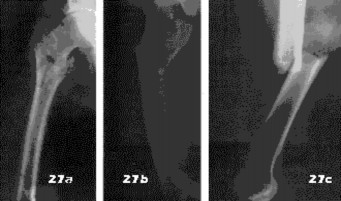
Figures 27a through 27c show the radiographs of the femur of a 46-year-old man who has a fracture of the right humerus, multiple rib fractures, and fractures of the right femur as a result of a motor vehicle accident. There is a 10-cm clean wound over the anteromedial thigh that communicates with the femoral shaft fracture. The
neurovascular examination of the right leg is normal. After meticulous irrigation and debridement, management of the femoral fractures should consist of
-
A high school distance runner reports a 3-week history of heel pain while running. Examination elicits no pain with dorsiflexion or with palpitation of the plantar fascia; however, pain is evident with palpitation over the muscular origin of the abductor hallucis. What is the most likely etiology of the pain?
A high school distance runner reports a 3-week history of heel pain while running. Examination elicits no pain with dorsiflexion or with palpitation of the plantar fascia; however, pain is evident with palpitation over the muscular origin of the abductor hallucis. What is the most likely etiology of the pain?
A 56-year-old laborer sustained a subcoracoid dislocation of the shoulder as a result of falling off a scaffold 3 weeks ago. He now is unable to actively raise his arm and has constant pain. What is the most likely diagnosis?
-
A 40-year-old woman has progressive pain and limited range of motion in her long finger. Figure 28a shows the radiograph, and Figure 28b shows a biopsy specimen of the same lesion. What is the most likely diagnosis?
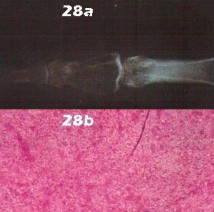
A 40-year-old woman has progressive pain and limited range of motion in her long finger. Figure 28a shows the radiograph, and Figure 28b shows a biopsy specimen of the same lesion. What is the most likely diagnosis?
-
A patient reports persistent pain in the wrist 6 months after undergoing open reduction and internal fixation of a Galleazi fracture. Radiographs of the wrist in a neutral position are normal. Which of the following studies would best evaluate the reduction of the distal radioulnar joint?
A patient reports persistent pain in the wrist 6 months after undergoing open reduction and internal fixation of a Galleazi fracture. Radiographs of the wrist in a neutral position are normal. Which of the following studies would best evaluate the reduction of the distal radioulnar joint?
-
A form of renal osteodystrophy that is characterized by pure osteomalacia is caused by
A form of renal osteodystrophy that is characterized by pure osteomalacia is caused by
-
A 25-yo man sustains the injury shown in Figures 29a and 29b as a result of high-speed trauma. Examination reveals diffuse weakness in the lower extremities that is slightly worse on the right side, and decreased rectal tone and sensation. A CT scan is shown in figures 29c and 29d. Definitive treatment of the injury to the spine is delayed because of a severe pulmonary contusion. At 15 days after the injury, the patient’s neurological status remains unchanged. Management should now consist of

A 25-yo man sustains the injury shown in Figures 29a and 29b as a result of high-speed trauma. Examination reveals diffuse weakness in the lower extremities that is slightly worse on the right side, and decreased rectal tone and sensation. A CT scan is shown in figures 29c and 29d. Definitive treatment of the injury to the spine is delayed because of a severe pulmonary contusion. At 15 days after the injury, the patient’s neurological status remains unchanged. Management should now consist of
-
A patient is in respiratory distress as a result of a high-speed motor vehicle accident. After emergent intubation, the arterial blood is poorly oxygenated, and examination shows left-sided tracheal deviation, absence of breath sounds on the right side and tympany on percussion over the right side of the chest. Management should include
A patient is in respiratory distress as a result of a high-speed motor vehicle accident. After emergent intubation, the arterial blood is poorly oxygenated, and examination shows left-sided tracheal deviation, absence of breath sounds on the right side and tympany on percussion over the right side of the chest. Management should include
The axial stability of a 4-pin uniplanar external fixator used to treat a patient who has a transverse midthird fracture of the tibia with a 5-mm fracture gap can be most greatly increased by
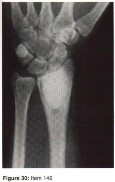
Figure 30 shows the current radiograph of a 32-year-old woman who had a giant cell tumor of the distal radius that was treated with curettage/burring and packed with polymethylmethacrylate 2 years ago. What is the most likely diagnosis?
-
A 40-year-old woman has had pain in the metatarsophal joint of the second toe for the past 6 months despite nonsurgical treatment. A dorsalplantar stress test reproduces the pain, and there is 10 mm of dorsal subluxation of the toe. Radiographs show a normal second metatarsophalangeal joint. Surgical treatment should consist of synovectomy and
A 40-year-old woman has had pain in the metatarsophal joint of the second toe for the past 6 months despite nonsurgical treatment. A dorsalplantar stress test reproduces the pain, and there is 10 mm of dorsal subluxation of the toe. Radiographs show a normal second metatarsophalangeal joint. Surgical treatment should consist of synovectomy and
-
A 25-year-old patient who was wearing a seat belt in the back chair of a car involved in a head-on collision undergoes a laparotomy. During surgery, an injury to the sigmoid colon is identified and treated. Two days later the patient has back pain when sitting in a chair. What is the most likely diagnosis?
A 25-year-old patient who was wearing a seat belt in the back chair of a car involved in a head-on collision undergoes a laparotomy. During surgery, an injury to the sigmoid colon is identified and treated. Two days later the patient has back pain when sitting in a chair. What is the most likely diagnosis?
A 65-year-old man undergoes total shoulder arthroplasty. Examination in the recovery room reveals the absence of voluntary deltoid and biceps contraction, weakness of wrist extension, and absence of sensation over the lateral arm and radial forearm. Management should now consist of
-
A 76-year-old woman who underwent primary total knee arthroplasty 9 months ago falls and sustains a transverse fracture of the proximal third of the patella that is displaced 5 mm. Although the knee is painful, she is able to ambulate and has a 5-degree extension lag. The component appears to be well fixed. Treatment should now include
A 76-year-old woman who underwent primary total knee arthroplasty 9 months ago falls and sustains a transverse fracture of the proximal third of the patella that is displaced 5 mm. Although the knee is painful, she is able to ambulate and has a 5-degree extension lag. The component appears to be well fixed. Treatment should now include
Lymphatic metastasis is a common feature of which of the following lesions?
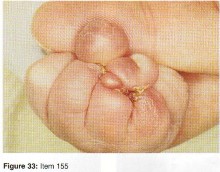
Which of the following conditions is most commonly associated with the congenital hand problem shown in Figure 33?
-
A 35-year-old machinist sustains a crush injury to the forearm in an industrial accident. Figure 34 shows the arm following skeletal stabilization and fasciotomy. Wound closure is best accomplished by
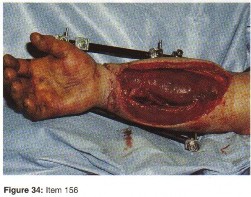
A 35-year-old machinist sustains a crush injury to the forearm in an industrial accident. Figure 34 shows the arm following skeletal stabilization and fasciotomy. Wound closure is best accomplished by
-
Figure 35 shows a postoperative radiograph of a femur fracture proximal to a total knee prosthesis that was treated by open reduction and blade plate fixation 9 months ago. What is the most likely reason the previously well seated screw has backed out of the central portion of the plate?
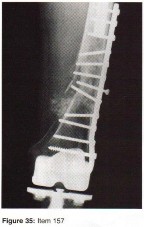
Figure 35 shows a postoperative radiograph of a femur fracture proximal to a total knee prosthesis that was treated by open reduction and blade plate fixation 9 months ago. What is the most likely reason the previously well seated screw has backed out of the central portion of the plate?
-
Figures 37a & 37b show radiographs of a right handed, 78 year old man who had painful G-H arthritis, moderate limitation of motion, and good strength prior to replacement of the humeral head 2 years ago. At the time of treatment, the rotator cuff was intact. He now has limited motion, weakness, and persistent pain in the shoulder. What is the most likely diagnosis?
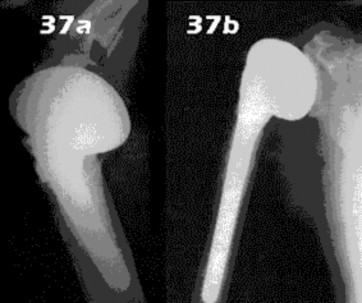
Figures 37a & 37b show radiographs of a right handed, 78 year old man who had painful G-H arthritis, moderate limitation of motion, and good strength prior to replacement of the humeral head 2 years ago. At the time of treatment, the rotator cuff was intact. He now has limited motion, weakness, and persistent pain in the shoulder. What is the most likely diagnosis?
-
What is the primary reason for choosing a bone graft substitute rather than an autologous cancellous graft in the treatment of distal radius fractures with metaphyseal comminution and impaction?
What is the primary reason for choosing a bone graft substitute rather than an autologous cancellous graft in the treatment of distal radius fractures with metaphyseal comminution and impaction?
-
Figures 38a & 38b show radiographs of a 40 year old man who underwent a Putti-Platt repair for recurrent dislocations at age 22. He reports increasing pain in the shoulder and limited motion for five years. Examination reveals 130 degrees of elevation and 15 degrees of external rotation. Non-surgical treatment has failed. Treatment should now consist of what?
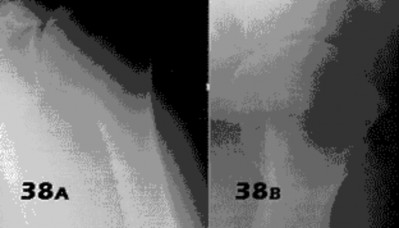
Figures 38a & 38b show radiographs of a 40 year old man who underwent a Putti-Platt repair for recurrent dislocations at age 22. He reports increasing pain in the shoulder and limited motion for five years. Examination reveals 130 degrees of elevation and 15 degrees of external rotation. Non-surgical treatment has failed. Treatment should now consist of what?
-
A 50-year-old alcoholic man has erythema and swelling in his entire dominant upper extremity. He has a WBC of 15,000/mm3, a temp of 101 oF (38.3 oC), and a blood pressure of 90/60 mm Hg. After hemodynamic stabilization, the cellulitic forearm is longitudinally incised dorsally and volarly. The forearm muscles are normal in appearance; however, the subcutaneous fat is necrotic. A culture will most likely reveal
A 50-year-old alcoholic man has erythema and swelling in his entire dominant upper extremity. He has a WBC of 15,000/mm3, a temp of 101 oF (38.3 oC), and a blood pressure of 90/60 mm Hg. After hemodynamic stabilization, the cellulitic forearm is longitudinally incised dorsally and volarly. The forearm muscles are normal in appearance; however, the subcutaneous fat is necrotic. A culture will most likely reveal
-
A 15-year-old girl has a thoracic kyphosis that causes mild pain. Examination reveals a sagittal curve measuring 55 degrees and wedging of the eighth through tenth vertebrae. The iliac apophyses are Risser 4. Management should include
A 15-year-old girl has a thoracic kyphosis that causes mild pain. Examination reveals a sagittal curve measuring 55 degrees and wedging of the eighth through tenth vertebrae. The iliac apophyses are Risser 4. Management should include
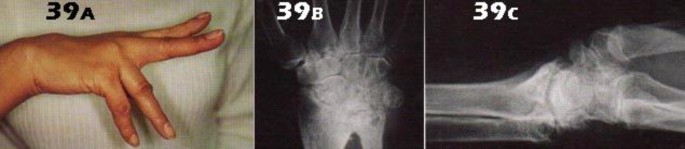
Figures 39a through 39c show a clinical photograph and the radiographs of a 32-year-old woman who has been unable to actively extend her dominant ring and small finger for the past two weeks. She has no history of trauma and has minimal pain. Examination reveals full passive range of motion (ROM) of the fingers. Active ROM of the wrist is extension of 40 degrees and flexion of 35 degrees. Active forearm pronation is 45 degrees, and supination is 50 degrees. Treatment should consist of
-
A 75-year-old woman who has groin pain states that she had total hip arthroplasty 15 years ago. The radiograph shown in Figure 40 reveals that the left acetabular component is grossly loose. Revision of the acetabular component should include use of a
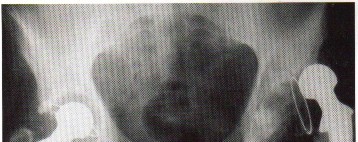
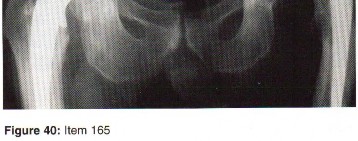
A 75-year-old woman who has groin pain states that she had total hip arthroplasty 15 years ago. The radiograph shown in Figure 40 reveals that the left acetabular component is grossly loose. Revision of the acetabular component should include use of a
-
An 8-1/2-month-old male infant who has developmental dysplasia of the hip was treated in a Pavlick harness for 3 months. At follow-up, examination of the hip reveals full flexion and extension and abduction to 80 degrees. Figure 41a shows an AP arthrogram and Figure 41b an arthrographic view in flexion and abduction. Management should now consist of
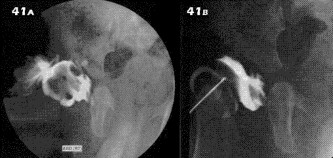
An 8-1/2-month-old male infant who has developmental dysplasia of the hip was treated in a Pavlick harness for 3 months. At follow-up, examination of the hip reveals full flexion and extension and abduction to 80 degrees. Figure 41a shows an AP arthrogram and Figure 41b an arthrographic view in flexion and abduction. Management should now consist of
Which of the following findings is more suggestive of neurogenic rather than vascular claudication in the differential diagnosis of leg pain?
-
Injury to the C7 nerve root results in weakness primarily of the
Injury to the C7 nerve root results in weakness primarily of the
-
Which of the following conditions is most likely inherited as an autosomal dominant trait?
Which of the following conditions is most likely inherited as an autosomal dominant trait?
Which of the following surgical options after resection of a sarcoma about the knee would require a patient to expend the greatest amount of energy while walking?
-
Chronic flatfoot deformity is most commonly associated with a contracture
of the
Chronic flatfoot deformity is most commonly associated with a contracture
of the
-
The pharmacologic action of botulinum-A toxin can be best described as
The pharmacologic action of botulinum-A toxin can be best described as
With respect to femoral component design, stress relief osteopenia in the proximal femur following noncemented total hip arthroplasty appears to be most strongly influenced by the
-
The stability of the longitudinal arch of the foot during standing with equal weight on both feet is due primarily to
The stability of the longitudinal arch of the foot during standing with equal weight on both feet is due primarily to
-
A 32-year-old has diffuse pain, weakness, and limited overhead motion in the shoulder as a result of falling on his outstretched arm 2 months ago. Examination reveals medial scapular winging, and an electromyogram shows denervation of the long thoracic nerve. Management should consist of
A 32-year-old has diffuse pain, weakness, and limited overhead motion in the shoulder as a result of falling on his outstretched arm 2 months ago. Examination reveals medial scapular winging, and an electromyogram shows denervation of the long thoracic nerve. Management should consist of
-
A 45-year-old man who has medial compartment disease and chronic medial knee pain with varus alignment of 5 degrees is best treated with a
A 45-year-old man who has medial compartment disease and chronic medial knee pain with varus alignment of 5 degrees is best treated with a
-
Which of the following factors is most likely to predispose a patient to dislocation of the patellar component following total knee arthoplasty?
Which of the following factors is most likely to predispose a patient to dislocation of the patellar component following total knee arthoplasty?
-
What is the most common sequela of turf toe (hyperextension of the first metatarsophalangeal joint)?
What is the most common sequela of turf toe (hyperextension of the first metatarsophalangeal joint)?
A radiograph of a 12-year-old boy who has had an insidious onset of pain in the right hip for the past 6 weeks shows diffuse narrowing of the joint space. Examination reveals that he is afrebile, and the range of motion of the hip is less than 50% of normal in all planes. Laboratory studies show an erythrocyte sedimentation rate of 21 mm/hr and a WBC of 11,000/mm3. What is the most likely diagnosis?
-
Figures 42a and 42b show the sagittal and axial MRI scans of a 24-year-old patient who has sciatia. Which of the following combinations of physical findings is most consistent wit the MRI studies?


Figures 42a and 42b show the sagittal and axial MRI scans of a 24-year-old patient who has sciatia. Which of the following combinations of physical findings is most consistent wit the MRI studies?
-
An otherwise healthy 65-year-old man has had chronic pain in his prosthetic knee for the past 9 months. Repeated aspirations reveal a coagulase-negative staphylococcus infection. To eradicate the infection while maintaining the best possible joint function, management should consist of
An otherwise healthy 65-year-old man has had chronic pain in his prosthetic knee for the past 9 months. Repeated aspirations reveal a coagulase-negative staphylococcus infection. To eradicate the infection while maintaining the best possible joint function, management should consist of
-
Figures 43a and 43b show the radiographs of an 8-year-old boy who was referred by his gym teacher because of an awkward running pattern. The patient denies any pain in his hips. Examination reveals a mild Trendelenberg gait and decreased internal rotation of the left hip to 25 degrees compared to 40 degrees on the right. What is the most likely diagnosis?
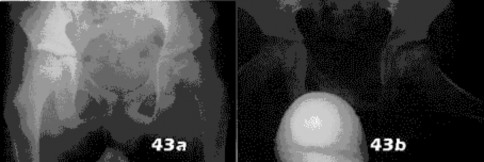
Figures 43a and 43b show the radiographs of an 8-year-old boy who was referred by his gym teacher because of an awkward running pattern. The patient denies any pain in his hips. Examination reveals a mild Trendelenberg gait and decreased internal rotation of the left hip to 25 degrees compared to 40 degrees on the right. What is the most likely diagnosis?
-
A 31-year-old man who is a recent immigrant from Guatemala has had pain in his back and thighs for the past 12 months. History notes a recent diagnosis of gout, and the patient reports falling a distance of 3 feet on his buttocks immediately before the pain began. Examination reveals that he is neurologically intact. Plain radiographs are shown in Figures 44a and 44b, and T2-weighted MRI scans are shown in Figures 44c and 44d. The most likely cause of the pathologic fracture is


A 31-year-old man who is a recent immigrant from Guatemala has had pain in his back and thighs for the past 12 months. History notes a recent diagnosis of gout, and the patient reports falling a distance of 3 feet on his buttocks immediately before the pain began. Examination reveals that he is neurologically intact. Plain radiographs are shown in Figures 44a and 44b, and T2-weighted MRI scans are shown in Figures 44c and 44d. The most likely cause of the pathologic fracture is
Osteoarthritic cartilage is characterized by decreased
-
Which of the following metastatic carcinomas has the worst long-term prognosis?
Which of the following metastatic carcinomas has the worst long-term prognosis?
-
The Magnetic resonance imaging signal characteristics of a high-grade soft-tissue sarcoma are best described as
The Magnetic resonance imaging signal characteristics of a high-grade soft-tissue sarcoma are best described as
A “p value” of 4% (p=0.04) indicates that the
-
What is the predominant collagen type in osteoarthritic articular cartilage?
What is the predominant collagen type in osteoarthritic articular cartilage?
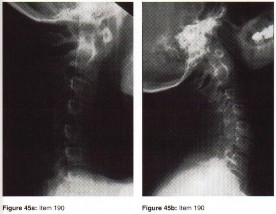
Which of the following conditions associated with rheumatoid arthritis of the cervical spine is shown in the flexion-extension views in figures 45a and 45b?
-
A patient undergoes an acute repair of a laceration of the median nerve in the antecubital fossa. A lack of functional recovery 6 months later is most likely due to
A patient undergoes an acute repair of a laceration of the median nerve in the antecubital fossa. A lack of functional recovery 6 months later is most likely due to
To prevent injury to the posterior interosseous nerve during the approach for reduction and fixation of a fracture of the radial head, anterior retraction should be performed with the forearm
-
A 25 year-old amateur baseball player sustained a dorsal fracture-dislocation of the proximal interphalangeal joint of his long finger. He underwent closed reduction 3 hours ago. Examination reveals mild laxity of the radial collateral fragment involving 30% of the volar articular surface of the middle phalanx. Management should now include
A 25 year-old amateur baseball player sustained a dorsal fracture-dislocation of the proximal interphalangeal joint of his long finger. He underwent closed reduction 3 hours ago. Examination reveals mild laxity of the radial collateral fragment involving 30% of the volar articular surface of the middle phalanx. Management should now include
-
An orthopaedic surgeon who is the developer of a knee arthroplasty system is discussing treatment options with a patient who has tricompartmental osteoarthritis. As a part of this discussion, the orthopaedic surgeon has an obligation to disclose
An orthopaedic surgeon who is the developer of a knee arthroplasty system is discussing treatment options with a patient who has tricompartmental osteoarthritis. As a part of this discussion, the orthopaedic surgeon has an obligation to disclose
-
Which of the following nerves lying between the gluteus medius and minimus is at risk for injury in a lateral approach to the hip?
Which of the following nerves lying between the gluteus medius and minimus is at risk for injury in a lateral approach to the hip?
Figure 46 shows the lateral radiograph of a 5 year-old girl who has a fracture of the left tibia as a result of minimal trauma. Examination shows no skin lesions or birthmarks, and family history is unremarkable. Laboratory studies are normal. Management at this time should include
1/. open biopsy and plating
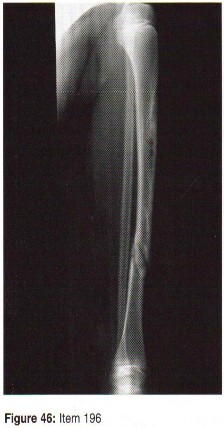
1/. open biopsy and plating
-
A patient sustains a closed dorsal dislocation of the proximal interphalangeal joint of the middle finger without an associated fracture. Closed treatment results in a cocentric stable reduction. The finger is not immobilized. Which of the following conditions may appear 1 year later?
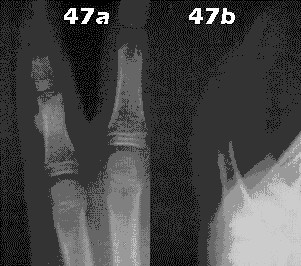
A patient sustains a closed dorsal dislocation of the proximal interphalangeal joint of the middle finger without an associated fracture. Closed treatment results in a cocentric stable reduction. The finger is not immobilized. Which of the following conditions may appear 1 year later?
What is the standard interval for placement of an anterolateral portal in ankle arthroscopy?
-
A clinical trial is being conducted on a new orthopaedic device that is different from existing devices that are moderately successful, but have frequent complications when used to treat fractures in the elderly. To comply with international standards for clinical trials, the investigator must include in the study design
A clinical trial is being conducted on a new orthopaedic device that is different from existing devices that are moderately successful, but have frequent complications when used to treat fractures in the elderly. To comply with international standards for clinical trials, the investigator must include in the study design
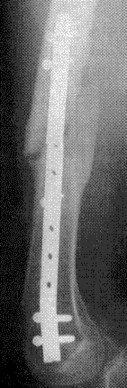
Figure 48 shows a current lateral radiograph of a 23-year-old man who sustained a closed femoral diaphyseal fracture 5 months ago. Treatment consisted of placement of a retrograde femoral nail for the femoral fracture. The patient now reports a sudden onset of pain in the midthigh and cannot bear weight on his leg. Management should consist of
-
To maximally resist apex anterior angulation in the tibia, the pins of a unilateral external fixator should be oriented in which of the following planes?
To maximally resist apex anterior angulation in the tibia, the pins of a unilateral external fixator should be oriented in which of the following planes?
-
Resurfacing the patella during a total knee replacement is strongly indicated when the diagnosis is
Resurfacing the patella during a total knee replacement is strongly indicated when the diagnosis is
A 34-year- woman has pain at the base of the thumb that worsens é pinching activities. Nonsurgical treatment has failed to provide relief. Examination reveals that the basilar joint is hypermobile, tender and painful when stressed. A radiograph of the trapeziometacarpal joint shows normal contour with widening when compared with the opposite side. Management should consist of
-
The change over time in strain of a material under a constant load is defined as
The change over time in strain of a material under a constant load is defined as
-
What is the usual mechanism of injury for the fracture shown in Figures 49a and 49b?
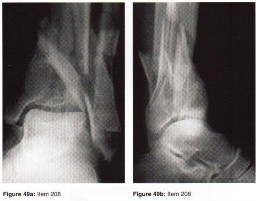
What is the usual mechanism of injury for the fracture shown in Figures 49a and 49b?
-
Gamma ray irradiation for sterilization of ultra-high molecular weight polyethylene in an oxygen environment can have what effect on the material?
Gamma ray irradiation for sterilization of ultra-high molecular weight polyethylene in an oxygen environment can have what effect on the material?
-
The radiograph shown in Figure 50a and the CT scan shown in Figure 50b reveal a lesion in the left femoral neck of a 12-year-old boy who has pain in the left hip. The most likely cause of the osteopenia of the left proximal femur is
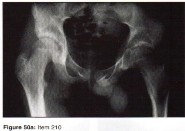
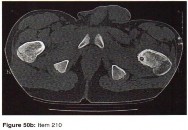
The radiograph shown in Figure 50a and the CT scan shown in Figure 50b reveal a lesion in the left femoral neck of a 12-year-old boy who has pain in the left hip. The most likely cause of the osteopenia of the left proximal femur is
-
Which of the following neurovascular structures is at greatest risk during the introduction of acetabular component fixation screws during total hip replacement?
Which of the following neurovascular structures is at greatest risk during the introduction of acetabular component fixation screws during total hip replacement?
ofhat parameter is most commonly used to estimate the maximum tension a muscle can generating?
-
Demyelination diseases as multiple sclerosis and Guillain-Barre $ create neurologic symptoms by
Demyelination diseases as multiple sclerosis and Guillain-Barre $ create neurologic symptoms by
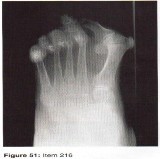
Figure 51 shows the standing AP radiograph of a 56-year old woman who has multiple toe deformities and pain beneath the metatarsal heads. Shoe modification has failed to provide relief. In addition to correction of the proximal interphalangeal joint deformities, surgical treatment should consist of
An active, right-handed 71-year-old woman fell on her left shoulder and sustained the injury shown in the radiographs in 52a and 52b and the CT scan in 52c. Management should consist of
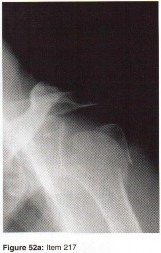
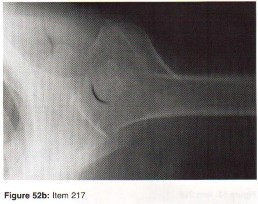
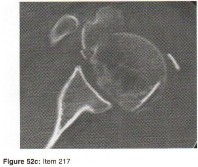
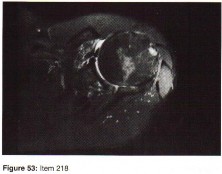
Figure 53 shows the MRI scan of a 53-year-old carnival worker who has pain and swelling in the left shoulder as a result of attempting to stop a roller coaster car with his arm. Examination reveals decreased ROM, apprehension, and inability to move the dorsum of his hand away from his back. Treatment should consist of
-
A 45-year-old man sustains the shoulder injury shown in the radiographs in Figure 55a and 55b and the CT scan in Figures 55c and 55d. Management should consist of
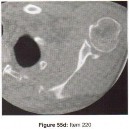
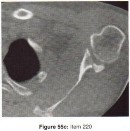
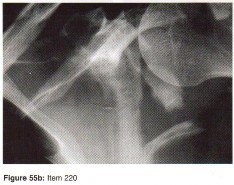
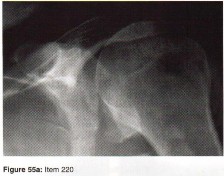
A 45-year-old man sustains the shoulder injury shown in the radiographs in Figure 55a and 55b and the CT scan in Figures 55c and 55d. Management should consist of
-
Figure 56 shows the radiograph of a 38-year-old patient with polyarticular rheumatoid arthritis who has severe pain in the shoulder. Non-surgical treatment has failed to provide relief. Treatment should now consist of
1/. Arthrodesis
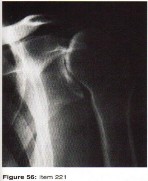
Figure 56 shows the radiograph of a 38-year-old patient with polyarticular rheumatoid arthritis who has severe pain in the shoulder. Non-surgical treatment has failed to provide relief. Treatment should now consist of
1/. Arthrodesis
Figure 57a and 57b show the radiographs of a 57-year-old man who has pain in
the ulnar side of the wrist and hand. Examination shows tenderness at the base of the hypothenar area. Additional diagnostic testing should include
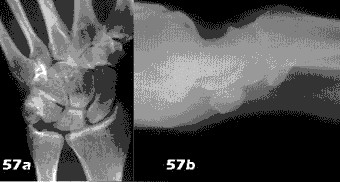
the ulnar side of the wrist and hand. Examination shows tenderness at the base of the hypothenar area. Additional diagnostic testing should include
-
Acondroplasia and other chondrodysplasias are caused by mutations in
the
receptors of which of the following families of growth factors?
Acondroplasia and other chondrodysplasias are caused by mutations in
the
receptors of which of the following families of growth factors?
-
The diagnostic distinction between a benign enchondroma and a low-
grade
intramedually chondrosarcoma is based primarily on the
The diagnostic distinction between a benign enchondroma and a low-
grade
intramedually chondrosarcoma is based primarily on the
-
The flap outlined in Figure 58 is based on septocutaneous perforators from what artery?
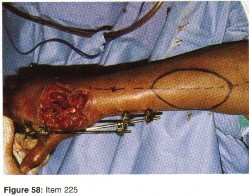
The flap outlined in Figure 58 is based on septocutaneous perforators from what artery?
What defect in collagen synthesis is caused by a lack of vitamin C?
-
While under a physician’s care, a 45-year-old man verbally abuses the staff and nurses who are attempting to carry out orders. A decision to discharge the patient is best carried out by
While under a physician’s care, a 45-year-old man verbally abuses the staff and nurses who are attempting to carry out orders. A decision to discharge the patient is best carried out by
-
A consecutive series of 50 patients is randomized to receive either treatment A or treatment B. At a 10-year follow up, patient satisfaction with treatment is measured. Which of the following statistical calculations will provide the most information regarding the magnitude of possible differences between the two groups of patients?
A consecutive series of 50 patients is randomized to receive either treatment A or treatment B. At a 10-year follow up, patient satisfaction with treatment is measured. Which of the following statistical calculations will provide the most information regarding the magnitude of possible differences between the two groups of patients?
-
A 19-year-old man sustains a complete spinal cord injury at the C7 level as a result of diving into a lake. He has a blood pressure of 90/50 mm Hg, a pulse of 60/min, and respirations of 20/min. These values most likely signify
A 19-year-old man sustains a complete spinal cord injury at the C7 level as a result of diving into a lake. He has a blood pressure of 90/50 mm Hg, a pulse of 60/min, and respirations of 20/min. These values most likely signify
-
Figures 59a and 59b show the plain radiographs, and Figures 59c and 59d show the CT scan of a 77-year-old woman who has had pain in her back and both buttocks for the past 6 months. She reports that the pain radiates down her right thigh and leg when she is standing. What is the most likely diagnosis?
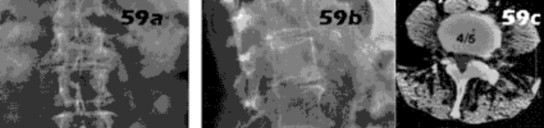
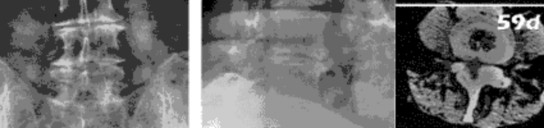
Figures 59a and 59b show the plain radiographs, and Figures 59c and 59d show the CT scan of a 77-year-old woman who has had pain in her back and both buttocks for the past 6 months. She reports that the pain radiates down her right thigh and leg when she is standing. What is the most likely diagnosis?
A 65-year-old man has had “catching” in front of his knee since he had a total knee arthroplasty 9 months ago. Examination reveals a palpable and audible snap in the anterior aspect of the knee at about 40 degrees of flexion as the knee is being actively extended. A radiograph of the prosthetic knee will most likely show
Which of the following radiographic findings indicates that the injury to the great toe shown in Figures 60a and 60b should be reducible by closed manipulation?








Osteolysis, after total knee arthroplasty performed without cement, most often occurs in the
Figure 61 shows the radiograph of a 28-year-old professional football player who sustained a hyperextension injury to the great toe. He continued to play with pain and loss of push-off strength. What is the most likely diagnosis?
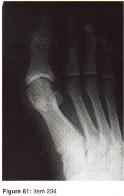
Figures 62a and 62b show the radiographs of a 50-year-old man who has a long-standing history of wrist pain. What is the most likely cause of pain?
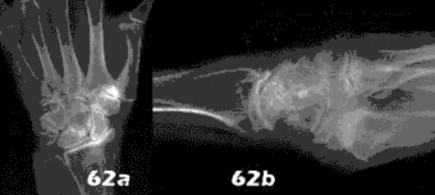
Figure 63 shows the AP radiograph of the arm of a 9-year-old boy who has pain in his right shoulder as a result of falling off his bicycle. The most appropriate next step in management is
1/. Immobilization with a sling
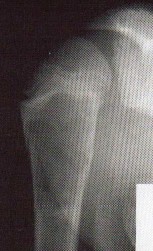
1/. Immobilization with a sling
An elderly woman with radiographic evidence of spinal stenosis reports difficulty walking and calf pain that is relieved by rest and a change of position. The most likely cause of pain is ischemia of the
-
The concept of an “effective joint space” surrounding a prosthetic hip replacement refers to the
The concept of an “effective joint space” surrounding a prosthetic hip replacement refers to the
-
Almost 50% of all long-term complications following total knee arthroplasty are due to
Almost 50% of all long-term complications following total knee arthroplasty are due to
-
A 6-year-old boy sustained a fracture of the medial malleolus as a result of twisting his ankle. The fracture line extends from the joint surface proximally and medially to include a small fragment of the metaphysis, with a displacement of 3
mm. Management should consist of
A 6-year-old boy sustained a fracture of the medial malleolus as a result of twisting his ankle. The fracture line extends from the joint surface proximally and medially to include a small fragment of the metaphysis, with a displacement of 3
mm. Management should consist of
A 37-year-old laborer sustained a fracture of the posterior acetabular wall. Two years following operative management, the patient reports severely limited hip motion and back pain. Radiographs reveal extensive mature heterotopic ossification with preservation of the hip joint space. Management should now consist of
A 4-year-old boy who was struck by a motor vehicle has a right pneumothorax requiring placement of a chest tube, an open (Gustilo) grade IIIA midshaft fracture of the left femur, and a closed displaced subtrochanteric fracture of the right femur. He also sustained a subdural hematoma that requires neurosurgical intervention. In addition to irrigation and debridement of the left femur, treatment should include
A 6-year-old boy has had increasing pain and a mass in the suprapatellar region of the right femur for the past week. Examination of the mass reveals it may be firm, immobile, and tender to palpitation. The patient has no systemic symptoms. Laboratory studies show a WBC of 7000 per cubic millimeter, a hematocrit of 40%, and an erythrocyte sedimentation rate of 10 mm/hr. radiographs are normal. Figures 64a and 64b show saggital and axial T1-weighted MRI scans. Figure 64c shows frozen section pathology of the biopsy specimen. What is the most likely diagnosis?
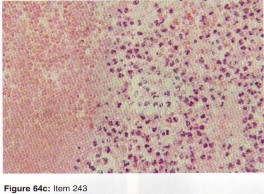
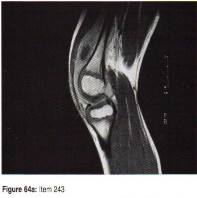
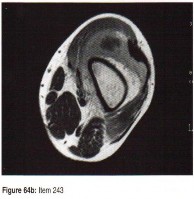
The bending stiffness of a slotted stainless steel intramedullary nail will be increased most by
-
Figures 66a and 66b show the radiographs of an 8-year-old girl who has a form, immobile mass of her middle finger at the proximal interphalangeal joint. Figure 66c shows the histopathology of the biopsy specimen. What is the most likely diagnosis?
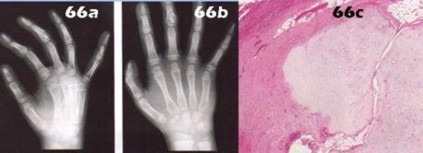
Figures 66a and 66b show the radiographs of an 8-year-old girl who has a form, immobile mass of her middle finger at the proximal interphalangeal joint. Figure 66c shows the histopathology of the biopsy specimen. What is the most likely diagnosis?
To be an expert orthopaedic witness in a trial, an orthopaedic surgeon
must
must
-
A 12-year-old Little League pitcher has had pain in the dominant shoulder for the past week that prevents him from pitching. Examination reveals normal strength, full range of motion, normal stability, and mild tenderness about the
proximal humerus. Radiographs with comparison views of the opposite shoulder show widening of the proximal humerus physis. Management should include
A 12-year-old Little League pitcher has had pain in the dominant shoulder for the past week that prevents him from pitching. Examination reveals normal strength, full range of motion, normal stability, and mild tenderness about the
proximal humerus. Radiographs with comparison views of the opposite shoulder show widening of the proximal humerus physis. Management should include
-
The lateral fragment of bone (Segond fracture) associated with an injury of the anterior cruciate ligament is the result of an avulsion of the
The lateral fragment of bone (Segond fracture) associated with an injury of the anterior cruciate ligament is the result of an avulsion of the
-
Successful healing of a meniscal repair is most likely associated é which of the following tear patterns?
Successful healing of a meniscal repair is most likely associated é which of the following tear patterns?
At what position is the anterior inferior glenohumeral ligament the primary constraint to anterior glenohumeral translation?
Which of the following nerves is most commonly injured during arthroscopy of the ankle?
-
The primary effect of deep freezing on musculoskeletal allografts is a reduction of
The primary effect of deep freezing on musculoskeletal allografts is a reduction of
-
A physician who is currently in a fellowship program receives notification of a pending malpractice suit that refers to an incident that occurred 2 years ago when the physician was a resident. The physician would be insured if the residency program provided what type of insurance coverage?
A physician who is currently in a fellowship program receives notification of a pending malpractice suit that refers to an incident that occurred 2 years ago when the physician was a resident. The physician would be insured if the residency program provided what type of insurance coverage?
Which of the following plain radiographic views of the shoulder best reveals a Hill-Sachs lesion of the humeral head?
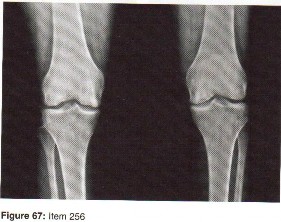
-
Figure 67 shows the AP radiograph of both knees of a 26-year-old woman. A review of the patient’s medical record will most likely reveal a history of
Figure 67 shows the AP radiograph of both knees of a 26-year-old woman. A review of the patient’s medical record will most likely reveal a history of
Figure 68 shows the MRI scan of a 13-year-old boy who has had knee pain and swelling following training lessons for ski racing for the past 6 months. The only abnormal finding on physical examination is an effusion. Management should consist of
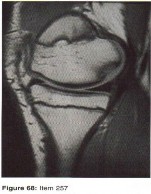
-
Following closed reduction for the injury shown in Figures 69a and 69b, treatment should consist of
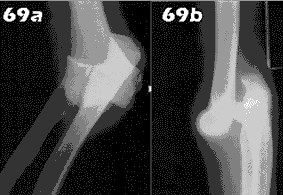
Following closed reduction for the injury shown in Figures 69a and 69b, treatment should consist of
A 3-year old child from an isolated mountain area is evaluated for multiple medical problems, including vomiting, loss of appetite, polyuria, and failure to thrive. History reveals the child was normal at birth. The parents, who appear healthy, are second cousins and have two other children who are normal. The parents state that they know of another family member who died at age 6 years after a similar medical history. Radiographs of the lower extremities show bowing of the long bones with cupping and widening of the physes. What is the most likely diagnosis?
-
A 26 year-old marathon runner reports lateral knee pain after hill training. Examination reveals no effusion; and results of Ober’s test are positive. What is the most likely diagnosis?
A 26 year-old marathon runner reports lateral knee pain after hill training. Examination reveals no effusion; and results of Ober’s test are positive. What is the most likely diagnosis?
A patient in the recovery room has weakness of the extensor hallucis longus and tibialis anterior muscles following a total knee replacement. Initial management should consist of
A 45-year-old woman has a deep soft-tissue mass in the thigh. The MRI scan Shows a 12-cm heterogenous mass that is deep to the fascia, and the CT scan Shows three small (5 to 10 mm) peripheral, noncalcified pulmonary nodules. What is the stage of disease according to the staging system of the Musculoskeletal Tumor Society?
1/. 1
2/. 2
1/. 1
2/. 2
In total hip arthroplasty, increasing the perpendicular distance from the
center
line of the femur to the center of rotation of the femoral head (femoral offset) results in
center
line of the femur to the center of rotation of the femoral head (femoral offset) results in
-
For which of the following conditions will a rehabilitation program for shoulder instability most likely result in a satisfactory response?
For which of the following conditions will a rehabilitation program for shoulder instability most likely result in a satisfactory response?
-
A branch of what nerve is at risk for injury when vigorous superior/medial retraction is applied to the interval between the teres minor and the infraspinatus during a posterior approach to the shoulder?
A branch of what nerve is at risk for injury when vigorous superior/medial retraction is applied to the interval between the teres minor and the infraspinatus during a posterior approach to the shoulder?
Figures 70a and 70b show the sagittal MRI scan and axial CT of a patient who has decreased range of motion in the cervical spine. In which of the following directions would the cervical motion be most significantly limited?
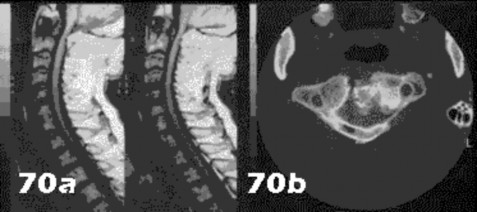
A 32 yr old man with oxalosis is scheduled for a surgical treatment of spinal stenosis. Which of the following organs is most likely to show signs of systemic oxalosis during a preoperative assessment?
-
Which of the following lists the correct order of the branches of the axillary artery from proximal to distal?
Which of the following lists the correct order of the branches of the axillary artery from proximal to distal?