KNEE Structured oralexamination question5: Unicondylar knee arthroplasty (UKA) versus total knee replacement (TKR)
EXAMINER : Have a look at these radiographs. What can you see?
(Figure 3.5.)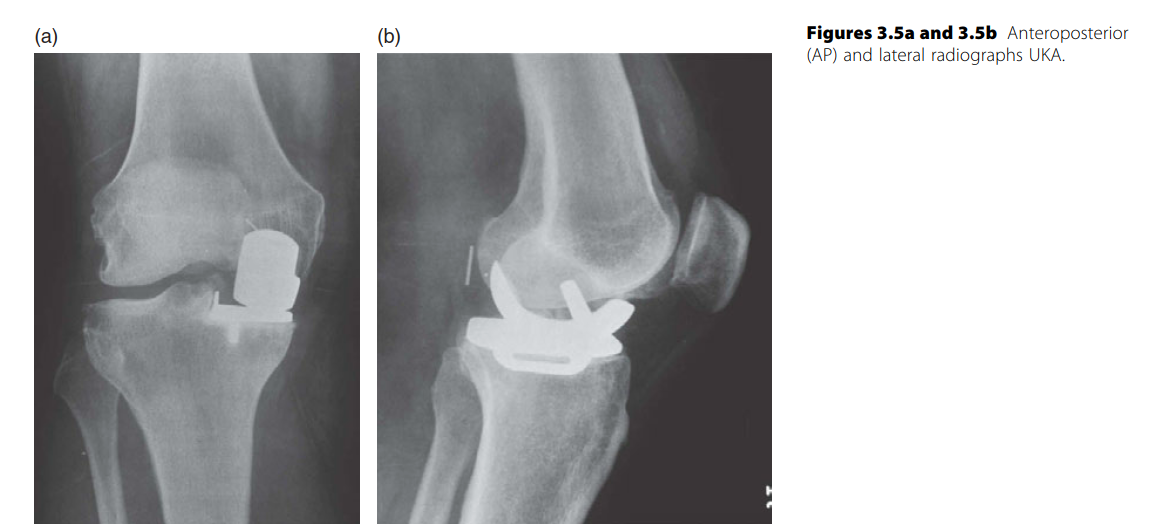
Preservation of bone stock.
Faster recovery and return to normal function.
Prevention of PFJ overload.
Retention of knee kinematics and increased flexion.
Less blood loss, infection rate and reduced risk of thromboembolism.
Easier revision to TKA than HTO. EXAMINER : Does UKA perform as well as TKA? CANDIDATE : Careful patient selection for UKA is critical if consistent and reliable results are to be obtained. In the early 1980s UKA became gradually unpopular mainly because of poor results due to poor patient selection, operative technique and polyethylene wear. With improvement in patient selection, operative technique and prosthesis design, the results of UKA became comparable to TKA. Latest reports show highly satisfactory survival rate and patient satisfaction for UKA particularly in activities requiring ROM such as going down stairs and kneeling. In a recent report from the Finnish Arthroplasty Registry, Koskinen et al. published a 10-year survival rate of between 53% and 81% depending on prosthetic model implanted. The UK National Joint Registry (NJR) 8th Report showed an overall 5-year revision rate of TKA and UKA of 3% and 9.4% respectively.
Koskinen E, Paavolainen P, Eskelinen A, Pulkkinen P, Remes V. Unicondylar knee replacement for primary osteoarthritis. A prospective follow-up study of 1,819 patients from the Finnish Arthroplasty Register. Acta Ortho Scand 2007;78(1):128–135.
