Intramedullary and Dorsal Plate Fixation of Distal Radius Fractures
DEFINITION
Distal radius fractures typically originate in the radial metaphysis and occasionally enter the radiocarpal joint and distal radioulnar joint (DRUJ).These fractures may be stable or unstable, intra-articular or extra-articular, and have significant incidences of associated bony and soft tissue injuries about the wrist.Distal radius fractures are most commonly dorsally displaced or angulated (apex volar).Treatment is based on fracture stability, comminution, articular segment displacement, articular surface displacement, and the functional demand of the patient.Stability is related to initial fracture displacement, residual dorsal angulation after closed reduction, dorsal comminution, age of the patient, and associated distal ulnar fracture and intra-articular fracture extension. 9,11
ANATOMY
The distal radius has articulations at the scaphoid fossa, lunate fossa, and sigmoid notch.The normal bony anatomy includes volar tilt of 10 degrees, radial height of 11 mm, and radial inclination of 22 degrees.Ulnar variance (the length of the radius relative to the ulnar head at the sigmoid notch) is variable and patient dependent.Dorsal ligamentous structures include the dorsal intercarpal ligament and the dorsal radiocarpal ligament. The dorsal radiocarpal ligament originates from the dorsal lip of the radius and attaches on the ulnar carpus.The dorsal intercarpal ligament represents a capsular thickening on the dorsum of the carpus, of which the fiber alignment is perpendicular to the long axis of the radius.Volar ligamentous origins include the radioscaphocapitate ligament, the long radiolunate ligament, and the short radiolunate ligament, among others.The triangular fibrocartilage complex (TFCC) consists of the triangular fibrocartilage and volar radioulnar and dorsal radioulnar ligaments.The volar radioulnar and dorsal radioulnar ligaments originate from the volar and dorsal edges of the sigmoid notch, respectively, become confluent, and then insert together at the base of the ulnar styloid.The extensor retinaculum lies superficial to the extensor tendons and deep to the subcutaneous tissues. It has septations creating six dorsal compartments ( FIG 1).The first compartment lies over the radial styloid and contains the abductor pollicis longus and the extensor pollicis brevis tendons (each may have multiple slips).The second compartment, containing the extensor carpi radialis longus and extensor carpi radialis brevis, lies radial to the tubercle of Lister.The third compartment, containing the extensor pollicis longus (EPL), lies ulnar to the tubercle of Lister.The fourth compartment, containing the extensor indicis proprius and extensor digitorum communis, lies over the dorsoulnar distal radius.The fifth compartment, containing the extensor digiti minimi, lies over the DRUJ.The sixth compartment, containing the extensor carpi ulnaris, lies over the distal ulna.
PATHOGENESIS
Distal radius fractures typically occur due to a fall on an outstretched hand.Fractures occur when the force of axial loading exceeds the failure strength of cortical and trabecular bone. 14The fracture pattern is determined by the magnitude and direction of the force applied and the position of the hand during impact. 5,13Dorsally displaced or angulated fractures occur when the wrist is neutral or extended and an axially or dorsally directed force is applied to the carpus.Osteoporosis, metabolic bone diseases, and bone tumors increase the risk of fracture.
NATURAL HISTORY
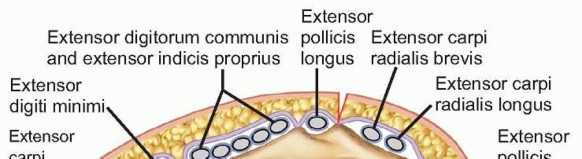
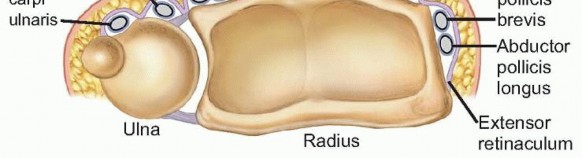
FIG 1 • Anatomy of the distal radius. The six dorsal extensor compartments at the level of the extensor retinaculum.P.294Displaced, unstable, and comminuted fractures often require operative treatment.The goals of surgical treatment are to provide stability and improve bony alignment in order to achieve pain control, improve range of motion, and increase function. 1,8Two millimeter or more of the articular surface displacement of the distal radius leads to degenerative changes in young adults. 8,12Ten degrees of dorsal tilt (dorsal fracture angulation of 20 or more degrees) is considered unacceptable and may lead to pain, decreased motion, and grip strength.Postreduction radial shortening of more than 3 degrees is considered unsatisfactory because it results in increase load across the ulnocarpal joints, leading to painful impaction syndrome. 10,12
PATIENT HISTORY AND PHYSICAL FINDINGS
IMAGING AND OTHER DIAGNOSTIC STUDIES
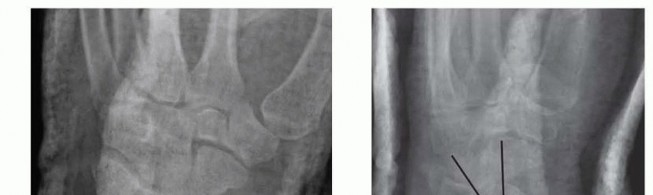
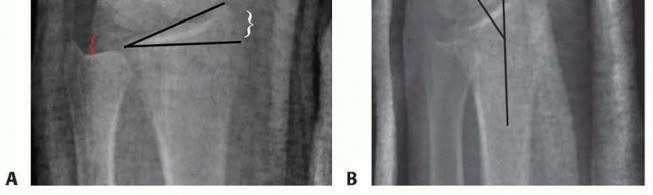
Posteroanterior (PA), lateral, and oblique radiographic views are critical in evaluating all suspected distal radius fractures.Consider imaging the uninjured wrist for comparison and to serve as a template for surgical reconstruction.Radiographs of the elbow should be obtained in almost all cases, especially if any tenderness, swelling, or deformity is detected clinically.Radiographic measurements taken from the PA view ( FIG 2A) include the following14,24:Radial inclination, which is the angle between a line perpendicular to the shaft of the radius at the articular margin and a line along the radial articular marginNormal angle: 21 degreesRadial length, which is the distance from a line tangential to the ulnar articular margin to a line drawn perpendicular to the long axis of the radius at the radial styloid tipNormal length 4: 9 to 11 mmUlnar variance, which is the distance from a line perpendicular to the long axis of the radius at the sigmoid notch and a line tangential to the ulnar articular surfaceNormal length 4: 0 mmLateral articular (volar) tilt is the angle between a line for the articular surface of the radius and a perpendicular line to the long axis of the radius.Normal angle: 11 degrees volar tilt ( FIG 2B)4,14,24Computed tomography (CT) scans can fully elucidate the anatomy of the fracture, particularly articular disruption or incongruity. They also help to determine the necessary surgical approach by defining the location and extent of comminution.CT scans increase the interobserver reliability of treatment plans and may actually alter the initial treatment plan based on plain radiographs. 7P.295Axial views provide a clear view of the DRUJ, which aids to identify subluxation, dislocation, bony fragments, and radioulnar ligament avulsions. 19Magnetic resonance imaging (MRI) is used in cases when the presence of a fracture is uncertain. 19MRI can be useful in evaluating for concomitant ligamentous injuries, TFCC injuries, stress fractures, and occult carpal fractures.
DIFFERENTIAL DIAGNOSIS
Bony contusion Wrist dislocationScaphoid or other carpal fracture Carpal instability or dislocation Distal ulnar fractureWrist ligament or TFCC sprain or tear
NONOPERATIVE MANAGEMENT
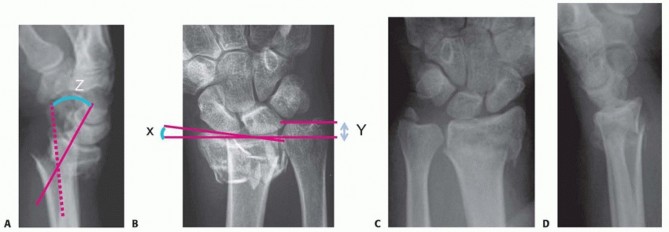
FIG 3 • A. PA radiograph (A) and lateral radiograph (B) of a healed distal radius fracture fixed with an intramedullary plate. C,D. PA and lateral radiographs showing an unstable metaphyseal distal radius fracture. (C,D: Copyright Thomas R. Hunt III, MD.)
SURGICAL MANAGEMENT
Open reduction and internal fixation with a dorsal plate can be used successfully in the treatment of displaced, unstable, comminuted fractures of the distal radius that fail to respond to closed treatment.Dorsal plating buttresses the fracture to correct deformity and maintain fracture reduction.New intramedullary implants have been designed to alleviate some of the complications associated with traditional dorsal plates and allow a less invasive option for fixation of dorsally displaced fractures ( FIG 3A,B).Indications for plating include the following:Severe initial dorsal displacement ( >20 degrees from normal, ≥10 degrees dorsal tilt)10Marked dorsal comminution (≥50% of the diameter of the radius shaft on the lateral radiograph) Residual (after reduction) dorsal tilt greater than 10 degrees past neutralPostreduction greater than 3 mm of radius shortening 10Dorsal intra-articular fragment displacement or step-off of more than 2 mm 10Stabilization using an intramedullary device is indicated for distal radius fractures without extensive articular involvement in which a limited incision and shorter procedure are desired (see TECH FIG 4E).3Comminution of the volar metaphysis is a relative contraindication for the use of a dorsal intramedullary implant.Intramedullary fixation should not be used to treat marginal or sagittal shear-type intra-articular fractures or displaced fragments from intra-articular fractures. 3,15The surgeon should be prepared to change management intraoperatively and therefore, in advance of the procedure, must have additional stabilization options available such as percutaneous pins or an external fixator.
PREOPERATIVE PLANNING
All radiographic imaging must be reviewed before surgery.It is helpful to compare radiographs of the injured wrist to the uninjured wrist.Displaced intra-articular fragments must be identified and consideration given to the value of obtaining CT.P.296Dorsal comminution must be evaluated to determine fracture stability and the need for bone grafting. The distal extent of the fracture must be determined to enable the buttress plate to function properly. Bone should be evaluated for osteopenia, osteoporosis, and tumors.
POSITIONING
The patient is placed supine on a regular operating table.A tourniquet is placed near the axilla with the splint in place.After anesthesia has been administered, the arm is placed on a radiolucent hand table ( FIG 4). Motion of the shoulder and elbow should be adequate to allow adequate reduction and positioning.Image intensification using fluoroscopy should be performed throughout the procedure to assess fracture reduction and the position of the hardware.
APPROACH
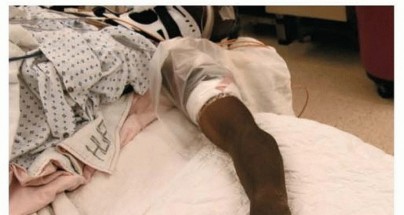
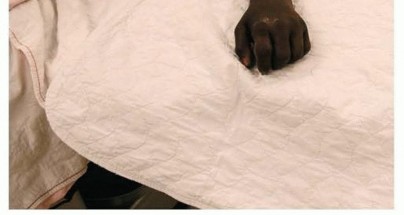
FIG 4 • Patient is positioned supine with arm on a hand table and tourniquet applied on proximal arm.
TECHNIQUES
Dorsal Plate Fixation of Distal Radius Fractures
Dorsal Plate Fixation of Distal Radius Fractures
INCISION AND DISSECTION


TECH FIG 1 • A. Skin incision is drawn in relation to the tubercle of Lister. B. Skin incision is carried down to extensor retinaculum. Tubercle of Lister and retinacular incision are drawn. C. The retinaculum is incised and the EPL tendon is exposed. Hematoma has already been evacuated.(continued)


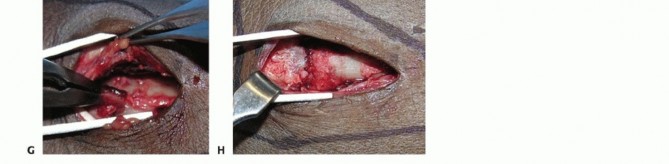
TECH FIG 1 •(continued)D. Exposing EPL by incising the septa of the third dorsal compartment. E. Subperiosteal elevation of the second and fourth dorsal compartments. F. Diagram demonstrating the transposition of EPL and dissection deep to the extensor compartments. G. Removal of tubercle of Lister. H. Exposing the radial shaft with a periosteal elevator. The tubercle of Lister is almost always involved in the fracture and should be completely removed using a rongeur ( TECH FIG 1G).The radius shaft is exposed with a periosteal elevator ( TECH FIG 1H).
REDUCTION AND PLATE FIXATION
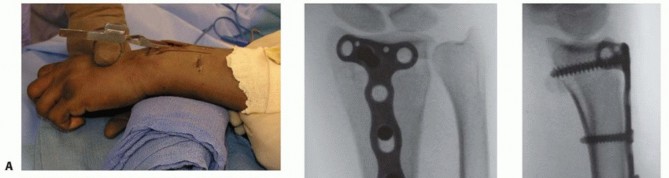
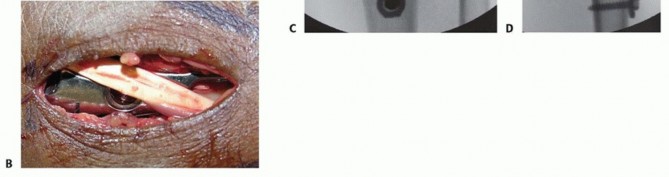
TECH FIG 2 • A. Reduction maneuver. The distal radius is reduced over a bump of towels using traction and palmar displacement of the carpus. B. Plate placement. The plate is placed deep to the EPL and aligned distally over the distal radius. C,D. Reduction imaging. C. PA fluoroscopic view demonstrating final reduction with well-aligned plate. D. Lateral fluoroscopic view demonstrating final reduction with appropriate-length screws and good distal buttressing of the fracture. Volar tilt has been restored. Bone graft is inserted to support reduced articular fragments and then the dorsal plate is applied directly on the radius ( TECH FIG 2B).The plate is first secured with a bicortical screw inserted through the oval sliding hole. Fracture reduction and placement of the plate are confirmed using fluoroscopy.The plate is secured to the distal fragment with one or two cancellous screws. Depending on the implant used, the surgeon should avoid placing the distal ulnar screw through the plate as the prominence of the screw head may irritate the overlying digital extensor tendons in the fourth dorsal compartment.P.298Additional cortical screws are added in the radius shaft. Reduction and stability are confirmed ( TECH FIG 2C,D).
WOUND CLOSURE
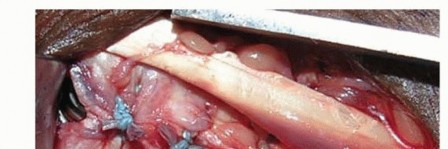
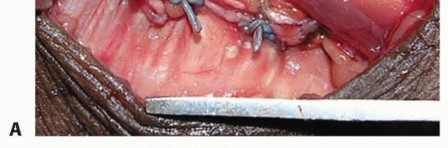
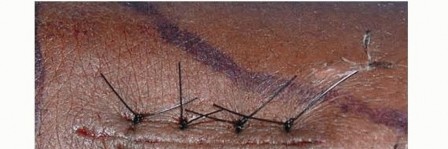
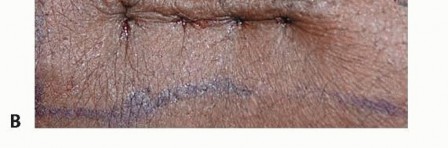
TECH FIG 3 • A. Retinacular closure. The extensor retinaculum is closed deep to the EPL with a nonabsorbable suture. B. Skin closure. The skin is closed with a horizontal mattress stitch to evert the skin edges.
Fixation of Distal Radius Fractures using a Dorsal Intramedullary Device (Tornier)
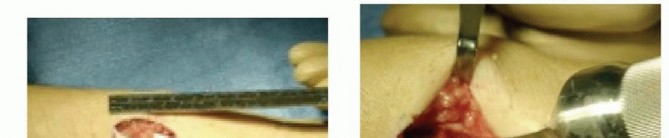
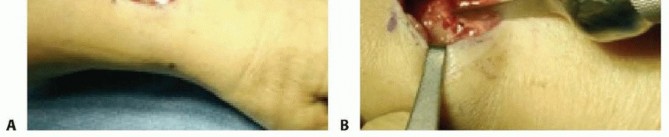
TECH FIG 4 • A. A 2.5-cm dorsal incision is used for exposure. B. The awl is inserted through the fracture site after removal of the tubercle of Lister.(continued)
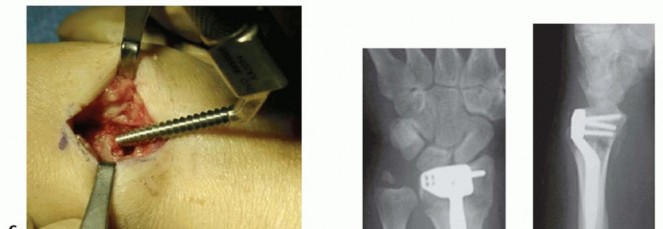
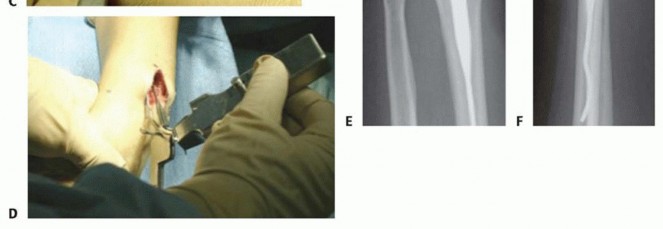
TECH FIG 4 •(continued)C. A rasp is used to create a path for the implant. D. The implant is placed using the insertion device so as to control rotation during seating. E,F. An unstable metaphyseal distal radius fracture has been reduced and stabilized using a dorsal intramedullary device (Tornier Corp). (E,F: Copyright Thomas R. Hunt III, MD.)
Fixation of Distal Radius Fractures using a Radial Intramedullary Device (Wright Medical) A 2- to 3-cm incision is made over the radial styloid between the first and second extensor compartments. Care is taken to protect branches of the radial sensory nerve.
A cannulated drill is used to penetrate the cortex 2 to 3 mm proximal to the radiocarpal joint line to create the entry point.
After insertion of a starter awl, the canal is broached sequentially under fluoroscopic guidance to fit the medullary canal.
The implant is then inserted with the insertion jig, making sure the implant is countersunk into the radial styloid.
The proximal interlocking screws are then placed using the insertion jig, using small incisions of the dorsal aspect of the forearm.
The distal interlocking screws are placed last using the insertion jig. Small adjustments to radial height and tilt can be made at this time.
Reduction and stabilization are confirmed radiographically. Wound closure and splinting are as described earlier.
PEARLS AND PITFALLS
P.300
Fixation of Distal Radius Fractures using a Radial Intramedullary Device (Wright Medical) A 2- to 3-cm incision is made over the radial styloid between the first and second extensor compartments. Care is taken to protect branches of the radial sensory nerve.
|Indications ▪ Determine the direction of fracture stability.1.Determine the area and extent of comminution.2.Ensure that an acute carpal tunnel syndrome does not exist.Surgical ▪ Incise the extensor retinaculum sharply to allow easier repair. approach ▪ Expose only the third dorsal compartment.3.Remove the tubercle of Lister to allow better plate contouring.Hardware ▪ Choose a low-profile implant system that offers the flexibility needed to stabilize choice and the fracture.placement ▪ Place the plate distally to ensure buttress effect.4.Place the oval plate hole screw initially.5.Do not place the plate distal to the dorsal lip of the distal radius.6.Avoid placing the distal ulnar screw.7.Although titanium implants and their particulate debris have been implicated in the development of tenosynovitis and other tendon pathology, there is no clear scientific evidence to substantiate these claims.Postoperative ▪ Avoid casting for long periods.8.Encourage early active range of motion of the wrist and fingers.||management ▪ Avoid using a sling to prevent unnecessary shoulder and elbow stiffness.1.Do not begin strengthening until range of motion is restored.|------
POSTOPERATIVE CARE
Postoperatively, the patient is placed in a bulky dressing that allows motion of the digits, elbow, and shoulder. A volar resting splint may be used to support the wrist if there is any concern about fixation strength.The patient is encouraged to begin finger range-of-motion exercises immediately after surgery.Seven to 10 days after surgery, the sutures are removed, Steri-Strips are applied, and the incision is allowed to get wet.The patient is evaluated by an occupational therapist, who provides a thermoplastic splint, and can start active and active-assisted range-of-motion exercises depending on fracture stability.When the fracture heals at about 6 weeks, gentle passive range of motion and strengthening may be started.There is evidence that vitamin C 500 mg/day for 50 days after distal radius fracture may have a preventative effect on complex regional pain syndrome. 27
OUTCOMES
Dorsal plating has recently been shown biomechanically to be stronger and stiffer than volar plating for dorsally unstable fractures. 23Dorsal plating has been associated with a higher complication rate than other means of stabilization. 2,14,18 Extensor tenosynovitis and tendon rupture have been prevalent in the past, mainly due to bulky implants. There has been renewed interest in dorsal plating of the distal radius as it has been shown to have a low rate of tendon-related complications with the use of low-profile, anatomic implants.6,18,20Recent studies show no statistically significant difference between dorsal or volar fixation in the overall risk of complications. 16,25,26Volar locking plates are associated with a higher rate of neuropathic complications than dorsal low-profile plates. 26It has been reported that after a 1-year follow up, there was a 21% complication rate with volar plates and a 14% complication rate with dorsal plates. 26Clinical reports have suggested that low-profile systems are more important in satisfactory outcomes for dorsal plating, with a much lower rate of complications. 18,26Fixation with low-profile dorsal plates can result in at least 80% of contralateral wrist range of motion, about 80% to 90% of grip strength, and over 90% pinch strength, with minimal risk of tendon rupture. 6,20Present studies show that intramedullary implants offer stable fixation 15,17,22:The mean grip strength and wrist motion were about 76% after 3 months and 91% after 1 year. 15This stability indicates early usage of the injured wrist which helps avoid muscle stiffness and atrophy. 22 It has been demonstrated that intramedullary implants have less complications than plate fixation15,17,21:There are fewer soft tissue complications because the implant does not have contact with surrounding tissues because the device is entirely within the medullary canal. 15,17,21Intramedullary fixation does not devascularize the fracture fragments and therefore does not need a section of periosteum to surround the fracture. 22
COMPLICATIONS
Infection (pin tract or deep)Injury to tendons, vessels, and nerves StiffnessPosttraumatic arthritis Weakness in grip or pinchTenosynovitis and tendon ruptures Malunion or nonunion Compartment syndromeCarpal tunnel syndromeLate tendon rupture, potentially related to implant design and material Hardware failureComplex regional pain syndrome type I TFCC injuriesRadial shortening DRUJ instability Loss of reduction Loss of motion
DISCLOSURE
Dr. Beredjiklian owns shares of stock on Tornier, Inc.
REFERENCES
- Glowacki KA, Weiss AP, Akelman E. Distal radius fractures: concepts and complications. Orthopedics 1996;19:601-608.
- Grewal R, Perey B, Wilmink M, et al. A randomized prospective study on the treatment of intra-articular distal radius fractures: open reduction and internal fixation with dorsal plating versus mini open reduction, percutaneous fixation, and external fixation. J Hand Surg Am 2005;30(4):764-772.P.301
- Ilyas AM. Intramedullary fixation of distal radius fractures. J Hand Surg Am 2009;34(2):341-346.
- Ipaktchi K, Livermore M, Lyons C, et al. Current concepts in the treatment of distal radial fractures.Orthopedics 2013;36:778-784.
- Jupiter JB, Fernandez DL. Comparative classification for fractures of the distal end of the radius. J Hand Surg Am 1997;22(4):563-571.
- Kamath AF, Zurakowski D, Day CS. Low-profile dorsal plating for dorsally angulated distal radius fractures: an outcomes study. J Hand Surg Am 2006;31(7):1061-1067.
- Katz MA, Beredjiklian PK, Bozentka DJ, et al. Computed tomography scanning of intra-articular distal radius fractures: does it influence treatment? J Hand Surg Am 2001;26(3):415-421.
- Knirk JL, Jupiter JB. Intra-articular fractures of the distal end of the radius in young adults. J Bone Joint Surg Am 1986;68(5):647-659.
- Lafontaine M, Hardy D, Delince P. Stability assessment of distal radial fractures. Injury 1989;20:208-210.
- Lichtman DM, Bindra RR, Boyer MI, et al. Treatment of distal radius fractures. J Am Acad Orthop Surg 2010;18:180-189.
- Mackenney PJ, McQueen MM, Elton R. Prediction of instability in distal radial fractures. J Bone Joint Surg Am 2006;88(9):1944-1951.
- Meyer C, Chang J, Stern P, et al. Complications of distal radial and scaphoid fracture treatment. J Bone Joint Surg Am 2013;95(16):1517-1526.
- Murray J, Gross L. Treatment of distal radius fractures. J Am Acad Orthop Surg 2013;21:502-505.
- Nana AD, Joshi A, Lichtman DM. Plating of the distal radius. J Am Acad Orthop Surg 2005;13:159-171.
- Nishiwaki M, Tazaki K, Shimizu H, et al. Prospective study of distal radial fractures treated with an intramedullary nail. J Bone Joint Surg Am 2011;93(15):1436-1441.
- Rausch S, Schlonski O, Klos K, et al. Volar versus dorsal latest-generation variable-angle locking plates for the fixation of AO type 23C 2.1 distal radius fractures: a biomechanical study in cadavers. Injury 2013;44:523-526.
- Rhee PC, Shin AY. Minimally invasive flexible insertion and rigid intramedullary nail fixation for distal radius fractures. Tech Hand Up Extrem Surg 2012;16:159-165.
- Rozental TD, Beredjiklian PK, Bozentka DJ. Functional outcome and complications following two types of dorsal plating for fractures of the distal part of the radius. J Bone Joint Surg Am 2003;85-A(10): 1956-1960.
- Schneppendahl J, Windolf J, Kaufmann RA. Distal radius fractures: current concepts. J Hand Surg Am 2012;37:1718-1725.
- Simic PM, Robison J, Gardner MJ, et al. Treatment of distal radius fractures with a low-profile dorsal plating system: an outcomes assessment. J Hand Surg Am 2006;31(3):382-386.
- Tan V, Bratchenko W, Nourbakhsh A, et al. Comparative analysis of intramedullary nail fixation versus casting for treatment of distal radius fractures. J Hand Surg Am 2012;37(3):460-468.
- Tan V, Capo J, Warburton M. Distal radius fracture fixation with an intramedullary nail. Tech Hand Up Extrem Surg 2005;9:195-201.
- Trease C, McIff T, Toby EB. Locking versus nonlocking T-plates for dorsal and volar fixation of dorsally comminuted distal radius fractures: a biomechanical study. J Hand Surg Am 2005;30(4): 756-763.
- Trumble TE, Culp RW, Hanel DP, et al. Intra-articular fractures of the distal aspect of the radius. Instr Course Lect 1999;48:465-480.
- Wei J, Yang TB, Luo W, et al. Complications following dorsal versus volar plate fixation of distal radius fracture: a meta-analysis. J of Int Med Res 2013;41:265-275.
- Yu YR, Makhni MC, Tabrizi S, et al. Complications of low-profile dorsal versus volar locking plates in the distal radius: a comparative study. J Hand Surg Am 2011;36(7):1135-1141.
- Zollinger PE, Tuinebreijer WE, Breederveld RS, et al. Can vitamin C prevent complex regional pain syndrome in patients with wrist fractures? A randomized, controlled, multicenter dose-response study. J Bone Joint Surg Am 2007;89(7):1424-1431.
