CASE 9 A 34-year-old female got into an altercation in a pub. During the course of the altercation, she struck a mirror sustaining a laceration to the dorsal aspect of her hand as shown in Figure 4–8. She presents to you now a few days out from the injury with difficulty in hand function. She is otherwise healthy, has no other medical problems, and has been in a splint to the fingertips.
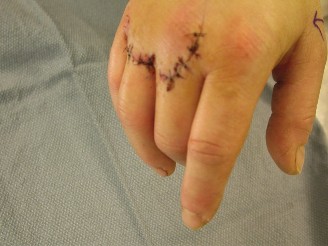
Figure 4–8
The most likely cause of her dysfunction is:
- Splint-related stiffness affecting all the joints in the hand
- Pain inhibition leading to loss of function in the hand
- Extensor tendon lacerations of the middle and ring fingers
- Reflex sympathetic dystrophy
- None of the above
Discussion
The correct answer is (C). This patient has sustained a laceration across the dorsal aspect of the MP joint of the hand. When the hand is formed into a fist, the extensor tendons are immediately subcutaneous. It is therefore extremely common for any laceration in this area, which runs across the long axis of the extensor mechanism, to sever the extensor mechanism of the fingers partially if not completely. The appearance is fairly typical. In most circumstances, patients are unable to extend their fingers fully at the metacarpophalangeal joint. Should there be any doubt about the ability to extend the metacarpophalangeal joints, infiltration of local anesthetic in this area and an examination in the office can reveal the weakness of extension. The ability to maintain extension against resistance is also a good test, and patients who have partial injury will often times be unable to maintain extension against resistance, the so-called piano key sign.
