Hallux Rigidus Oral Questions: Your Expert Answer Guide
Updated: Feb 2026
55 Views
Key Medical Takeaway
This topic focuses on Hallux Rigidus Oral Questions: Your Expert Answer Guide, Hallux rigidus is osteoarthritis of the big toe’s metatarsophalangeal joint, causing pain and stiffness. X-rays reveal loss of joint space, osteophytes, and sclerosis. Clinical examination assesses range of motion and pain. Management for questions hallux rigidus involves non-operative treatments like stiff-soled footwear or NSAIDs, with surgical options considered based on the disease grade and patient’s symptoms.
📖Clinical Article
Foot and ankle structured oral questions7: Hallux rigidus
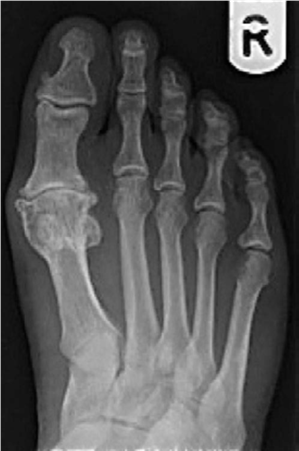
EXAMINER : This 45-year-old male patient has presented with pain and stiffness of his right big toe. Describe the X-ray findings. (Figure 4.9.)
🔍 Click to enlarge
Clinical Radiograph / Orthopedic Image
CANDIDATE : This is a radiograph of a right foot showing osteoarthritis of the first metatarsophalangeal joint ( MTPJ ) with loss of joint space, osteophytes and sclerosis. There is also a mild hallux valgus deformity. There is no other obvious deformity.
### EXAMINER : So what is this commonly called in orthopaedics?
CANDIDATE : Hallux rigidus.
EXAMINER : Tell me the range of movement of a healthy first MTPJ.
CANDIDATE : The joint should be able to dorsiflex between 70 and 90 and plantarflex between 24 and 40.
### EXAMINER : How would you go about managing this patient?
CANDIDATE : First of all I would need to perform a full history and clinical examination on the patient. I would also obtain a weightbearing lateral and an oblique X-ray of the foot in addition to the AP view we have here.
### EXAMINER : Very good. If we concentrate on the clinical examination what specific findings are you looking for to help with your management decision?
CANDIDATE : I would need to assess the integrity of the skin and the neurovascular status of the foot. I would palpate for large osteophytes and assess the range of movement of the first MTPJ and look to see whether the patient had pain limited to Figure 4.9 X-ray showing hallux rigidus.
the extremes of movement or throughout the arc of motion. A grind test of the joint would be informative. I also need to evaluate the motion and look for any sign of degenerative change at the interphalangeal joint ( IPJ ).
### EXAMINER : What is the importance of the IPJ?
CANDIDATE : A fusion of the first MTPJ may accelerate degeneration in the surrounding joints so if the IPJ is already symptomatic a motion-preserving procedure at the MTPJ may be more appropriate.
EXAMINER : Right so talk me through the management options for a patient with hallux rigidus.
CANDIDATE : In the first instance, unless there is a pressing indication for surgery such as impending skin compromise, I would maximize non-operative treatment. Options here include activity modification, footwear with a stiff sole and a rocker sole to reduce MTPJ motion. NSAIDs may be useful and in some cases an intra-articular injection may provide relief.
### EXAMINER : And the operative options?
CANDIDATE : That choice would depend on the grade of the disease.
### EXAMINER : Can you expand on that? Are you aware of any grading systems for this condition?
CANDIDATE : The most widely used is a radiographic grading by
Hattrup and Johnson in which Grade 1 has a well-preserved
 🔍 Click to enlarge