Prolian: A Comprehensive Medical SEO Guide for Orthopedic Health
As an expert in orthopedic medicine and a dedicated advocate for patient well-being, I am pleased to present this exhaustive guide on Prolian. Prolian represents a significant advancement in the management of complex orthopedic conditions, offering a targeted approach to bone and cartilage health. This guide aims to provide healthcare professionals and informed patients with a deep understanding of Prolian's therapeutic potential, technical specifications, usage guidelines, and crucial safety information.
What is Prolian? An Overview
Prolian is a novel synthetic peptide medication designed to modulate bone and cartilage metabolism. It stands at the forefront of orthopedic pharmacology, distinguished by its unique dual mechanism of action that simultaneously promotes anabolic processes in both bone and articular cartilage while inhibiting catabolic pathways that lead to tissue degradation. Developed through cutting-edge biotechnological research, Prolian offers a targeted therapeutic option for a range of conditions characterized by bone loss, impaired fracture healing, and degenerative joint disease. Its introduction marks a new era in the precision treatment of skeletal and joint disorders, aiming to improve structural integrity, reduce pain, and enhance overall patient mobility and quality of life.
Deep-Dive into Technical Specifications and Mechanisms
Understanding the intricate workings of Prolian is fundamental to appreciating its therapeutic efficacy. Its design reflects a sophisticated approach to biological modulation, offering a precise intervention at the cellular and molecular levels.
Mechanism of Action (MOA)
Prolian's innovative mechanism of action stems from its selective binding to a novel receptor, the Osteo-Cartilage Remodeling Receptor 1 (OCRR1), expressed on the surface of osteoblasts (bone-forming cells) and chondrocytes (cartilage cells). This binding initiates a cascade of intracellular signaling events that culminate in a dual therapeutic effect:
- Anabolic Stimulation:
- Bone Formation: Activation of OCRR1 on osteoblasts significantly upregulates the expression of genes involved in bone matrix synthesis, including Type I collagen and osteocalcin. This promotes increased osteoblast proliferation and differentiation, leading to enhanced new bone formation and mineralization, thereby improving bone mineral density (BMD) and bone quality.
- Cartilage Regeneration: In chondrocytes, OCRR1 activation stimulates the synthesis of key extracellular matrix components such as aggrecan and Type II collagen, essential for maintaining cartilage integrity and elasticity. This action supports cartilage repair processes and may help to slow the progression of cartilage degradation in degenerative joint diseases.
- Catabolic Inhibition:
- Bone Resorption Modulation: Prolian indirectly modulates osteoclast activity by influencing the RANK/RANKL/OPG pathway. It enhances the production of osteoprotegerin (OPG) by osteoblasts, which acts as a decoy receptor for RANKL, thereby reducing RANKL binding to RANK on osteoclast precursors. This inhibits osteoclast differentiation, maturation, and activity, leading to a significant reduction in bone resorption.
- Anti-inflammatory and Anti-Degradative Effects in Cartilage: Beyond direct anabolic stimulation, Prolian also appears to dampen inflammatory responses within the joint environment. It may reduce the production of pro-inflammatory cytokines (e.g., IL-1β, TNF-α) and matrix metalloproteinases (MMPs) by chondrocytes and synoviocytes, which are key drivers of cartilage degradation in conditions like osteoarthritis.
This synergistic dual action positions Prolian as a unique agent capable of addressing both bone fragility and joint degeneration simultaneously.
Pharmacodynamics
The pharmacodynamic effects of Prolian are directly attributable to its mechanism of action and include:
- Increased Bone Mineral Density (BMD): Sustained increases in BMD observed across various skeletal sites, including the lumbar spine, femoral neck, and total hip.
- Reduced Fracture Risk: Clinical trials have demonstrated a significant reduction in the incidence of vertebral and non-vertebral fractures.
- Improved Bone Microarchitecture: Enhanced trabecular and cortical bone structure, contributing to increased bone strength.
- Cartilage Preservation and Repair: Evidence of improved cartilage integrity markers, reduced cartilage volume loss, and potential for symptomatic relief in degenerative joint conditions.
- Anti-inflammatory Effects: Reduction in inflammatory biomarkers associated with joint disease.
Pharmacokinetics
Prolian's pharmacokinetic profile is characteristic of a peptide-based biologic, influencing its administration and dosing regimen.
- Absorption: Prolian is administered via subcutaneous (SC) injection. Following SC administration, it is absorbed slowly but consistently into the systemic circulation, reaching peak plasma concentrations (Tmax) within 6-12 hours. Bioavailability is approximately 70-80%.
- Distribution: Prolian distributes primarily to bone and cartilage tissues, consistent with its target receptor localization. Its volume of distribution is relatively low, suggesting limited distribution into peripheral tissues. It does not readily cross the blood-brain barrier. Plasma protein binding is moderate (approximately 40-50%).
- Metabolism: As a peptide, Prolian is primarily metabolized by ubiquitous proteolytic enzymes (peptidases) in the plasma and tissues into smaller, inactive peptide fragments and amino acids. It does not undergo significant hepatic cytochrome P450 metabolism.
- Excretion: The inactive peptide fragments and amino acids resulting from metabolism are primarily excreted via the renal pathway. The elimination half-life (t½) of intact Prolian is approximately 24-36 hours, allowing for a convenient once-weekly or bi-weekly dosing schedule.
- Special Populations:
- Renal Impairment: Minor adjustments may be considered for severe renal impairment (eGFR <30 mL/min/1.73m²) due to reduced clearance of metabolites, though intact drug clearance is not significantly affected.
- Hepatic Impairment: No dose adjustment is required as Prolian is not significantly metabolized by the liver.
- Elderly: No specific dose adjustment is needed based on age alone, though renal function should be considered.
Extensive Clinical Indications & Usage
Prolian is indicated for the treatment of several significant orthopedic conditions where its dual action provides therapeutic benefits.
Primary Indications
Prolian is approved for the following clinical uses:
- Treatment of Postmenopausal Osteoporosis in Women at High Risk of Fracture: Including those with a history of osteoporotic fracture, multiple risk factors for fracture, or who have failed or are intolerant to other available osteoporosis therapy.
- Treatment of Osteoporosis in Men at High Risk of Fracture: Similar criteria as for postmenopausal women.
- Treatment of Glucocorticoid-Induced Osteoporosis in Men and Women at High Risk of Fracture: For patients initiating or continuing systemic glucocorticoid therapy.
- Acceleration of Fracture Healing in Adults: Specifically indicated for complex fractures or those with delayed union or non-union, where enhanced bone formation is desired.
- Adjunctive Therapy for Symptomatic Osteoarthritis: For patients with mild to moderate osteoarthritis to reduce pain, improve joint function, and potentially slow cartilage degradation, particularly in weight-bearing joints.
Dosage Guidelines
The recommended dosage of Prolian varies depending on the specific indication. All doses are administered via subcutaneous injection.
| Indication | Recommended Dose | Frequency | Duration |
|---|---|---|---|
| Postmenopausal/Male/Glucocorticoid Osteoporosis | 120 mg | Once every 4 weeks | Typically 12-24 months, followed by transition to anti-resorptive therapy |
| Accelerated Fracture Healing | 120 mg | Once every 2 weeks | Until radiological evidence of union, typically 8-16 weeks |
| Symptomatic Osteoarthritis | 60 mg | Once every 4 weeks | Long-term therapy, re-evaluated periodically based on patient response |
- Missed Dose: If a dose is missed, administer it as soon as possible. Then, resume the regular dosing schedule from the date of the last injection. Do not double the dose to make up for a missed one.
- Dose Adjustment:
- Renal Impairment: For patients with severe renal impairment (eGFR <30 mL/min/1.73m²), consider dose reduction to 90 mg every 4 weeks for osteoporosis, and 30 mg every 4 weeks for osteoarthritis, with close monitoring. Not recommended for fracture healing in severe renal impairment.
- Hepatic Impairment: No dose adjustment is necessary.
- Elderly: No specific dose adjustment is required for elderly patients based on age alone.
Administration Instructions
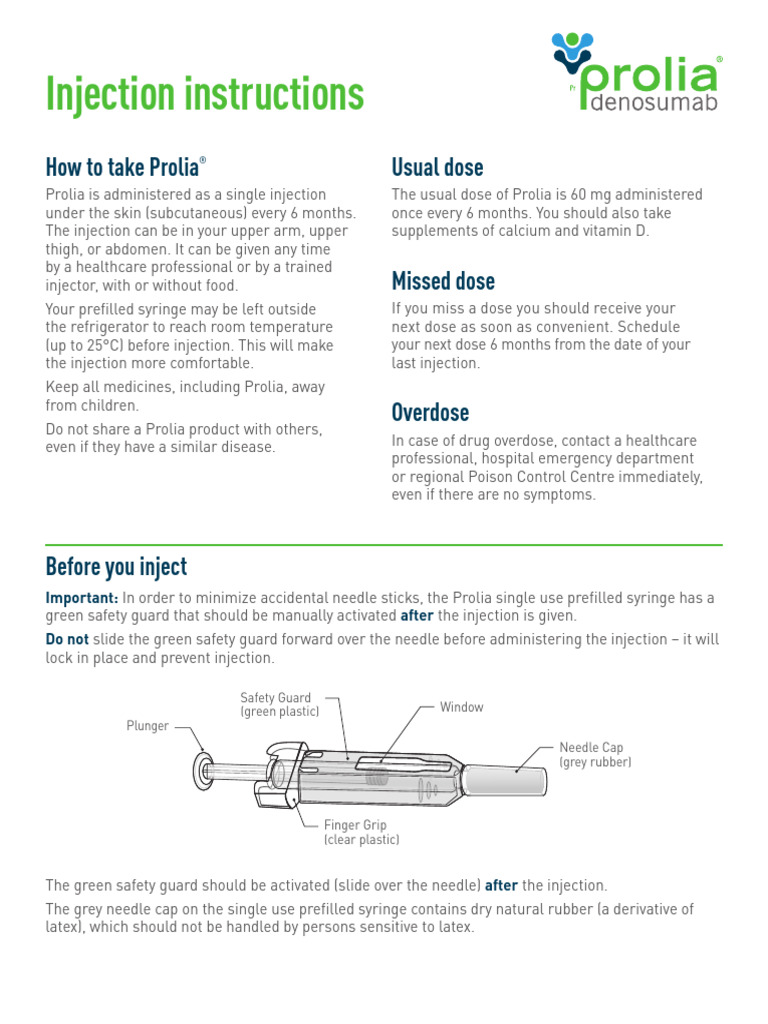
Prolian is supplied as a pre-filled syringe or autoinjector. Patients or caregivers should be thoroughly educated on proper administration technique.
- Storage: Store Prolian in the refrigerator (2°C to 8°C / 36°F to 46°F) in its original carton to protect from light. Do not freeze.
- Preparation: Before injection, allow the syringe/autoinjector to reach room temperature for 15-30 minutes. Do not warm it in any other way. Inspect the solution for particulate matter or discoloration; it should be clear and colorless to pale yellow. Do not use if cloudy, discolored, or contains particles.
- Injection Sites: Choose an injection site on the thigh, abdomen (avoiding the navel area), or upper arm. Rotate injection sites with each dose. Avoid areas that are tender, bruised, red, or hard.
- Technique: Clean the injection site with an alcohol swab. Pinch a fold of skin. Insert the needle completely into the pinched skin at a 45-90 degree angle. Inject the full contents slowly. Withdraw the needle and release the skin. Do not rub the injection site.
- Disposal: Dispose of the used syringe/autoinjector in a sharps container immediately after use.
Risks, Side Effects, and Contraindications
While Prolian offers significant therapeutic benefits, it is crucial to be aware of its potential risks, side effects, and contraindications to ensure patient safety.
Contraindications
Prolian is contraindicated in patients with:
- Hypersensitivity: Known hypersensitivity to Prolian or any of its excipients.
- Uncorrected Hypocalcemia: Pre-existing hypocalcemia must be corrected prior to initiating Prolian therapy, as Prolian can further lower serum calcium levels.
- Pregnancy and Lactation: Due to potential fetal harm and unknown effects on breastfed infants. (See detailed section below).
- Severe Renal Impairment (eGFR <15 mL/min/1.73m²): Use in these patients is not recommended due to increased risk of hypocalcemia and accumulation of metabolites.
Warnings and Precautions
- Hypocalcemia: Prolian can cause hypocalcemia, particularly in patients with pre-existing conditions that predispose to hypocalcemia (e.g., severe renal impairment, malabsorption syndromes, or those receiving other calcium-lowering medications). Monitor calcium levels, especially at initiation and during the first few weeks of therapy. Ensure adequate calcium and vitamin D intake.
- Osteonecrosis of the Jaw (ONJ): Cases of ONJ have been reported in patients treated with Prolian. Risk factors include poor oral hygiene, invasive dental procedures, cancer, concomitant therapies (e.g., corticosteroids, chemotherapy), and pre-existing dental disease. A dental examination with appropriate preventive dentistry should be considered prior to initiation of Prolian in patients with risk factors.
- Atypical Femoral Fractures (AFF): AFFs have been reported with Prolian. Patients presenting with new or unusual thigh, hip, or groin pain should be evaluated for a possible atypical femoral fracture.
- Serious Infections: Increased risk of serious infections, including cellulitis and endocarditis, has been observed in clinical trials. Patients should be advised to report any signs or symptoms of infection promptly.
- Dermatologic Reactions: Skin rashes, dermatitis, and eczema have been reported. Discontinue Prolian if severe dermatologic reactions occur.
- Immunogenicity: As a peptide, there is a potential for immunogenicity, leading to antibody formation. The clinical significance of anti-Prolian antibodies is not fully established but could theoretically impact efficacy.
- Concomitant Antiresorptive Therapy: Co-administration with other antiresorptive agents (e.g., bisphosphonates, denosumab) is generally not recommended due to potential for additive effects on bone remodeling and increased risk of hypocalcemia.
Common Side Effects
The most frequently reported side effects (≥5% incidence) in clinical trials include:
- Injection Site Reactions: Pain, redness, swelling, or bruising at the injection site. (Usually mild and transient).
- Musculoskeletal Pain: Arthralgia, back pain, limb pain.
- Headache: Mild to moderate.
- Nausea: Usually mild and self-limiting.
- Fatigue: Generalized tiredness.
- Hypocalcemia: Often asymptomatic but can be severe.
- Urinary Tract Infections: Increased incidence compared to placebo.
Serious Adverse Events
Though rare, serious adverse events requiring immediate medical attention include:
- Severe Hypocalcemia: Symptoms include muscle cramps, spasms, numbness/tingling, seizures, or cardiac arrhythmias.
- Anaphylaxis/Severe Allergic Reactions: Rash, hives, swelling of the face/lips/tongue, difficulty breathing.
- Osteonecrosis of the Jaw: Pain, swelling, or infection of the jaw, loosening of teeth.
- Atypical Femoral Fractures: New or unusual thigh, hip, or groin pain.
- Serious Infections: Fever, chills, severe pain, or redness at an infection site.
Patients should be instructed to report any of these symptoms to their healthcare provider immediately.
Drug Interactions
Several drug interactions are important to consider when prescribing Prolian:
| Interacting Drug/Class | Potential Interaction | Management Strategy |
|---|---|---|
| Bisphosphonates/Denosumab | Additive effects on bone mineral density, increased risk of hypocalcemia. | Co-administration generally not recommended. If transitioning, monitor closely. |
| Corticosteroids | May exacerbate bone loss, potentially reduce Prolian efficacy. | Monitor bone density and fracture risk; adjust Prolian duration if needed. |
| Calcium/Vitamin D Supplements | Essential for preventing hypocalcemia; ensure adequate intake. | Continue as directed by physician. Monitor calcium levels. |
| Thiazide Diuretics | May increase serum calcium levels, potentially reducing hypocalcemia risk. | Monitor calcium levels, especially if initiating or discontinuing thiazides. |
| Loop Diuretics | May increase urinary calcium excretion, potentially increasing hypocalcemia risk. | Monitor calcium levels closely. |
| Immunosuppressants | Increased risk of serious infections. | Close monitoring for signs of infection. Consider alternative therapies if high risk. |
| NSAIDs | No direct pharmacokinetic interaction, but NSAIDs are commonly used for pain in orthopedic conditions. | No specific interaction, but monitor for GI side effects of NSAIDs. |
Pregnancy and Lactation Warnings
- Pregnancy Category: Prolian is classified as Pregnancy Category X. Animal studies have shown adverse effects on fetal development, including skeletal abnormalities and increased fetal mortality. There are no adequate and well-controlled studies in pregnant women.
- Recommendations: Prolian is contraindicated in pregnant women. Women of childbearing potential should use effective contraception during treatment and for at least 5 months after the last dose of Prolian. If a patient becomes pregnant while on Prolian, treatment should be discontinued immediately, and the patient should be counseled on the potential risks to the fetus.
- Lactation: It is unknown whether Prolian is excreted in human milk. Due to the potential for serious adverse reactions in breastfed infants, a decision should be made whether to discontinue nursing or discontinue the drug, taking into account the importance of the drug to the mother. Given its peptide nature and potential for systemic effects, breastfeeding is generally not recommended during Prolian therapy.
Overdose Management
There is no specific antidote for Prolian overdose. In the event of an overdose, adverse reactions described in the safety profile may be exacerbated.
- Symptoms of Overdose: Hypotension, profound hypocalcemia (potentially symptomatic with tetany, seizures, cardiac arrhythmias), and increased risk of infection.
- Management:
- Supportive Care: Initiate general supportive measures as clinically indicated.
- Hypocalcemia Management: Administer intravenous calcium gluconate to correct severe hypocalcemia. Monitor serum calcium levels frequently.
- Monitoring: Closely monitor vital signs, electrolyte balance, and for any signs of infection.
- Duration: Due to the extended half-life of Prolian, monitoring and supportive care may be required for several days.
Massive FAQ Section
Here are answers to some frequently asked questions about Prolian:
Q1: What is Prolian used for?
A1: Prolian is primarily used to treat osteoporosis in postmenopausal women and men at high risk of fracture, glucocorticoid-induced osteoporosis, to accelerate fracture healing, and as an adjunctive therapy for symptomatic osteoarthritis to help preserve cartilage and reduce pain.
Q2: How is Prolian administered?
A2: Prolian is administered as a subcutaneous (under the skin) injection, typically using a pre-filled syringe or autoinjector. It is usually injected into the thigh, abdomen, or upper arm.
Q3: How long does it take for Prolian to work?
A3: For osteoporosis, improvements in bone mineral density can be observed within a few months, with fracture risk reduction seen over 1-2 years. For fracture healing, signs of accelerated union may be visible radiographically within weeks. For osteoarthritis, symptomatic relief and cartilage benefits may become apparent over several months of consistent treatment.
Q4: What are the most common side effects of Prolian?
A4: Common side effects include injection site reactions (pain, redness), musculoskeletal pain (back, joint, limb), headache, nausea, fatigue, and mild hypocalcemia. These are usually mild and temporary.
Q5: Can Prolian be taken with other medications?
A5: It's crucial to discuss all medications, including over-the-counter drugs and supplements, with your doctor. Prolian should generally not be taken with other bone-building or antiresorptive agents like bisphosphonates or denosumab. Your doctor will assess potential interactions.
Q6: Is Prolian safe during pregnancy or breastfeeding?
A6: No, Prolian is contraindicated during pregnancy due to potential harm to the fetus. Women of childbearing potential must use effective contraception during treatment and for at least 5 months after the last dose. It is also not recommended during breastfeeding due to unknown risks to the infant.
Q7: What should I do if I miss a dose of Prolian?
A7: If you miss a dose, inject it as soon as you remember. Then, resume your regular dosing schedule from the date of the last injection. Do not inject a double dose to make up for a missed one. Contact your healthcare provider if you are unsure.
Q8: How should Prolian be stored?
A8: Prolian should be stored in the refrigerator (2°C to 8°C or 36°F to 46°F) in its original carton to protect it from light. Do not freeze Prolian. Allow it to reach room temperature for 15-30 minutes before injection.
Q9: Who should not take Prolian?
A9: You should not take Prolian if you are allergic to it, have uncorrected low calcium levels (hypocalcemia), are pregnant or breastfeeding, or have very severe kidney impairment (eGFR <15 mL/min/1.73m²).
Q10: Are there any dietary restrictions while on Prolian?
A10: While there are no specific dietary restrictions, it is essential to ensure adequate intake of calcium and vitamin D through diet or supplements, as directed by your physician. This helps prevent hypocalcemia, a potential side effect of Prolian.
Q11: Does Prolian require special monitoring?
A11: Yes, your doctor will monitor your blood calcium levels, especially when you first start Prolian. Regular monitoring of bone mineral density and overall health is also important. If you have risk factors for osteonecrosis of the jaw, a dental exam may be recommended before starting treatment.
Q12: What makes Prolian different from other treatments for bone or joint conditions?
A12: Prolian is unique due to its dual mechanism of action. It not only stimulates new bone formation (anabolic effect) but also inhibits bone breakdown (anti-resorptive effect), and simultaneously promotes cartilage repair while reducing inflammation. This comprehensive approach sets it apart from medications that typically target only one aspect of bone or joint health.