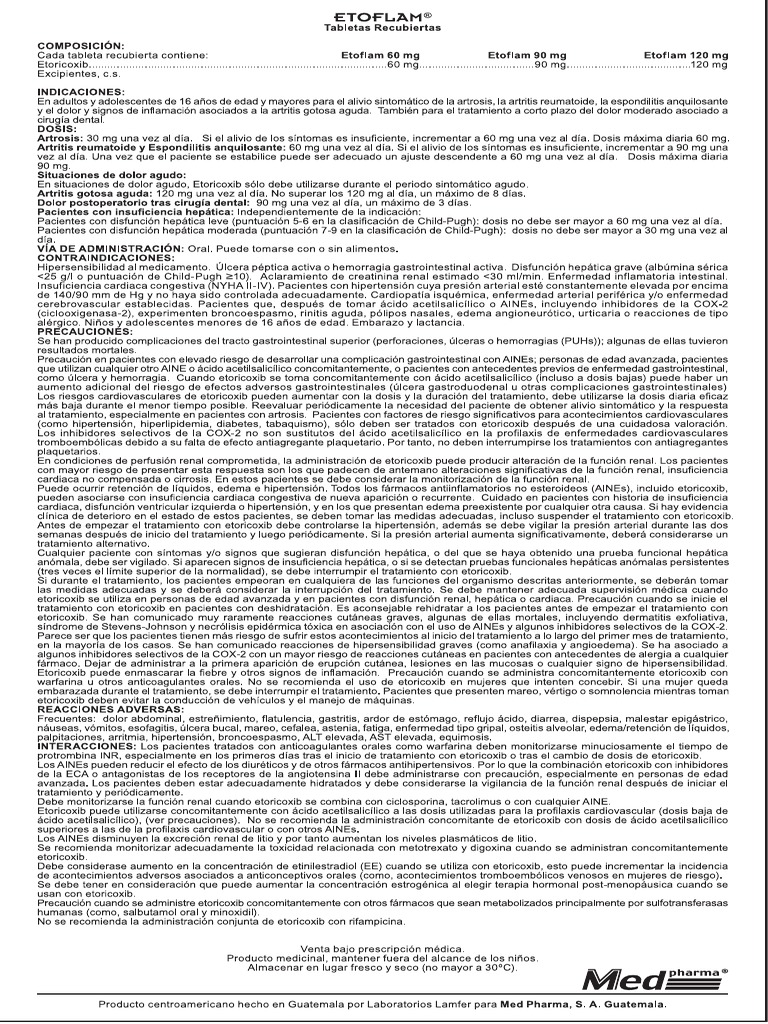
Etoricoxib (Etoflam): An Expert Orthopedic Guide to Selective COX-2 Inhibition
As an orthopedic specialist, understanding effective pain and inflammation management is paramount to improving patient quality of life and facilitating recovery. Etoricoxib, widely recognized by its brand name Etoflam in many regions, represents a significant advancement in the class of non-steroidal anti-inflammatory drugs (NSAIDs). This comprehensive guide delves into Etoricoxib's intricate mechanisms, clinical applications, safety profile, and critical considerations, offering an authoritative resource for both healthcare professionals and patients seeking detailed information.
Etoricoxib is a highly selective cyclooxygenase-2 (COX-2) inhibitor, a characteristic that sets it apart from traditional, non-selective NSAIDs. Its targeted action aims to provide potent anti-inflammatory and analgesic effects while minimizing some of the gastrointestinal side effects commonly associated with older NSAIDs. This selectivity makes it a valuable tool in managing various acute and chronic painful conditions, particularly those affecting the musculoskeletal system.
Deep Dive into Technical Specifications and Mechanisms
Understanding how Etoricoxib works is key to appreciating its therapeutic benefits and potential risks. Its action is fundamentally linked to the cyclooxygenase enzyme system.
Mechanism of Action: Selective COX-2 Inhibition
The cyclooxygenase (COX) enzymes are crucial in converting arachidonic acid into prostaglandins, prostacyclins, and thromboxanes, which are lipid mediators involved in various physiological and pathological processes. There are two main isoforms:
- COX-1 (Constitutive): This isoform is continuously expressed in most tissues and plays a vital role in maintaining normal physiological functions, including protecting the gastric mucosa, regulating renal blood flow, and facilitating platelet aggregation.
- COX-2 (Inducible): This isoform is typically expressed at low levels but is rapidly upregulated in response to inflammatory stimuli, cytokines, and growth factors. It is primarily responsible for the synthesis of prostaglandins that mediate pain, inflammation, and fever.
Etoricoxib is a potent and highly selective inhibitor of COX-2. By selectively blocking COX-2, Etoricoxib reduces the production of pro-inflammatory prostaglandins at the site of inflammation, thereby alleviating pain and swelling, without significantly inhibiting COX-1. This selectivity is theorized to result in a lower incidence of gastrointestinal adverse effects (such as ulcers and bleeding) compared to non-selective NSAIDs, which inhibit both COX-1 and COX-2.
Pharmacokinetics: Absorption, Distribution, Metabolism, and Excretion
The journey of Etoricoxib through the body is characterized by efficient absorption and metabolism, ensuring its therapeutic effect.
- Absorption: Etoricoxib is well absorbed orally. Peak plasma concentrations are typically achieved within approximately 1 hour after administration. The absolute oral bioavailability is high, estimated to be around 100%. Food does not significantly affect the extent of absorption but may slightly delay the time to peak concentration.
- Distribution: Etoricoxib is highly bound to plasma proteins (approximately 92%), indicating that a large portion of the drug in the bloodstream is not immediately available for action but is released over time. The volume of distribution at steady state is about 120 liters.
- Metabolism: The drug is extensively metabolized in the liver, primarily by cytochrome P450 (CYP) enzymes, particularly CYP3A4, with minor contributions from CYP2C9 and CYP2D6. The major metabolic pathway involves hydroxylation, leading to the formation of inactive metabolites.
- Excretion: Etoricoxib and its metabolites are primarily excreted via the kidneys (approximately 70% of the dose) and feces (approximately 20% of the dose). Less than 1% of the dose is excreted as unchanged drug in the urine. The elimination half-life is approximately 22 hours, allowing for once-daily dosing.
Extensive Clinical Indications & Usage
Etoricoxib (Etoflam) is indicated for the symptomatic relief of various inflammatory and painful conditions, many of which are commonly encountered in orthopedic practice.
Detailed Indications
| Indication | Description It can be done by using a custom function that uses the os.walk function to recursively traverse directories and count the files.
python
import os
def count_files_in_directory(directory_path):
"""
Counts the total number of files in a given directory and its subdirectories.
Args:
    directory_path (str): The path to the directory to start counting from.

Returns:
    int: The total number of files found, or -1 if the directory does not exist.
"""
if not os.path.isdir(directory_path):
    print(f"Error: Directory not found at '{directory_path}'")
    return -1

file_count = 0
for root, _, files in os.walk(directory_path):
    file_count += len(files)
return file_count
Example Usage:
if name == "main":
# Create a dummy directory structure for testing
test_dir = "test_root_dir"
os.makedirs(os.path.join(test_dir, "subdir1"), exist_ok=True)
os.makedirs(os.path.join(test_dir, "subdir2", "nested_subdir"), exist_ok=True)
# Create some dummy files
with open(os.path.join(test_dir, "file1.txt"), "w") as f: f.write("content")
with open(os.path.join(test_dir, "subdir1", "file2.txt"), "w") as f: f.write("content")
with open(os.path.join(test_dir, "subdir1", "file3.py"), "w") as f: f.write("content")
with open(os.path.join(test_dir, "subdir2", "file4.doc"), "w") as f: f.write("content")
with open(os.path.join(test_dir, "subdir2", "nested_subdir", "file5.jpg"), "w") as f: f.write("content")

print(f"Counting files in: {test_dir}")
total_files = count_files_in_directory(test_dir)

if total_files != -1:
    print(f"Total number of files: {total_files}") # Expected: 5

# Test with a non-existent directory
print("\nTesting with a non-existent directory:")
non_existent_dir = "non_existent_path"
total_files_non_existent = count_files_in_directory(non_existent_dir)

# Clean up dummy directory
import shutil
if os.path.exists(test_dir):
    shutil.rmtree(test_dir)
Explanation:
import os: This line imports theosmodule, which provides a way of using operating system dependent functionality like reading or writing to the file system.count_files_in_directory(directory_path)function:- Input Validation:
if not os.path.isdir(directory_path):checks if the provideddirectory_pathactually exists and is a directory. If not, it prints an error and returns -1. file_count = 0: Initializes a counter for the files.for root, dirs, files in os.walk(directory_path):: This is the core of the solution.os.walk()generates the file names in a directory tree by walking the tree either top-down or bottom-up. For each directory in the tree rooted atdirectory_path(includingdirectory_pathitself), it yields a 3-tuple:root: The path of the current directory.dirs: A list of the names of the subdirectories inroot.files: A list of the names of the non-directory files inroot.
- We are interested in the
fileslist for eachroot.
file_count += len(files): For each directoryos.walkvisits, it gives us a list of files directly within that directory (files). We simply add the number of files in this list (len(files)) to ourfile_count.return file_count: Afteros.walkhas traversed the entire directory tree,file_countwill hold the total number of files.
- Input Validation:
This approach is efficient and robust for counting files recursively in a directory structure.